
NFT Birdies
27 Apr 2026
Web3 Identity Explained: Wallets, NFTs, and the End of Platform Lock-In
From Accounts to Ownership: The Identity Shift of the Internet
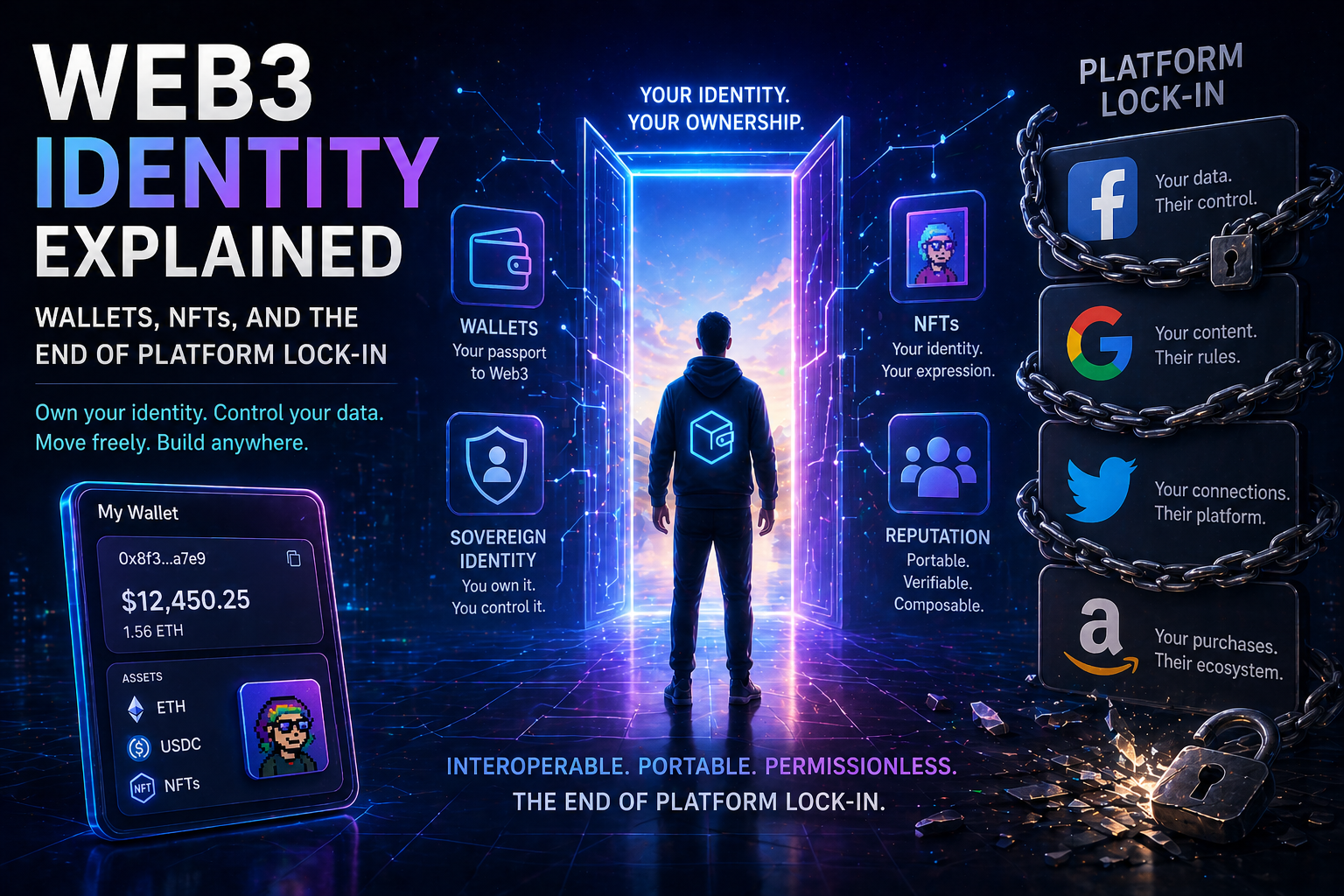
For most of the internet’s history, identity has been synonymous with accounts - email logins, social media profiles, and platform-bound credentials controlled not by users, but by corporations. This model, often referred to as Web2 identity, is inherently centralized: users authenticate themselves through services that store, manage, and ultimately monetize their data. The consequence is a fragmented digital existence, where identity is siloed across platforms, subject to revocation, censorship, or algorithmic invisibility at any moment.
Web3 proposes a fundamentally different architecture - one in which identity is no longer granted by platforms but owned by users. At the center of this transformation lies a simple but radical concept: instead of logging into platforms, users connect through cryptographic accounts that they control. In this model, identity is not a username and password stored on a server, but a cryptographic proof of ownership tied to a blockchain address.
This shift redefines the relationship between users and the internet itself. Rather than being products within centralized ecosystems, users become sovereign participants in a decentralized network, capable of carrying their identity, assets, and reputation across applications without permission.
Wallets as Identity: The New Login Layer
If Web2 identity is built on accounts, Web3 identity is built on wallets. A Web3 wallet is not merely a storage tool for cryptocurrencies - it is the primary interface through which users interact with decentralized systems. It allows individuals to sign transactions, authenticate themselves, and prove ownership without relying on intermediaries.
In practical terms, this means that the wallet address becomes the identity. Authentication is achieved not through passwords, but through cryptographic signatures generated by a private key that never leaves the user’s control. The implications of this are profound: there is no centralized database to hack, no password to reset, and no authority capable of revoking access.
More importantly, wallets introduce a new paradigm of identity portability. A single wallet can be used to access thousands of decentralized applications (dApps), eliminating the need to create separate accounts for each service. This stands in stark contrast to Web2, where identity is fragmented and locked within individual platforms.
In effect, the wallet becomes both passport and key - an always-on, user-controlled identity layer that travels seamlessly across the decentralized web.
NFTs as Identity Primitives: Ownership Becomes Expression
While wallets establish the foundation of identity, non-fungible tokens (NFTs) add a new dimension: representation. NFTs are unique digital assets that encode ownership, authenticity, and metadata on a blockchain. Traditionally associated with digital art and collectibles, NFTs are increasingly evolving into identity primitives - elements that define who a user is within Web3 environments.
In practice, NFTs can function as social signals, credentials, or access keys. Users display NFT avatars as profile pictures, signaling membership in communities or alignment with specific cultural movements. Projects issue tokens to early participants, embedding reputation directly into blockchain-based identity systems.
More advanced implementations extend this concept further. NFTs can represent memberships, event participation (via POAPs), or even professional credentials. They can act as portable identity layers, allowing users to carry their digital persona - including achievements, affiliations, and assets - across platforms without friction.
This creates a new form of composable identity: one that is not defined by static profiles, but by dynamic, verifiable ownership.
The End of Platform Lock-In
Perhaps the most transformative implication of Web3 identity lies in its potential to dismantle platform lock-in - a defining feature of the Web2 era. Today, users are deeply embedded within ecosystems such as social networks, gaming platforms, and marketplaces, where their data, connections, and assets are confined to proprietary systems. Leaving a platform often means abandoning one’s digital history entirely.
Web3 challenges this model by decoupling identity from platforms. Because identity is anchored in a wallet rather than a service, users can move freely between applications while retaining their assets, reputation, and relationships. NFTs, in particular, enable this portability by existing independently of any single platform, allowing them to be transferred, displayed, or utilized across multiple environments.
This interoperability has far-reaching implications. It enables cross-platform economies, persistent digital identities, and new forms of user ownership that extend beyond individual applications. In theory, a user could carry their identity from a decentralized social network to a metaverse environment, maintaining continuity across entirely different digital contexts.
The result is a more fluid and competitive digital landscape—one in which platforms must compete for users rather than trapping them.
Identity Without Identity: Privacy and Pseudonymity
A defining paradox of Web3 identity is that it is simultaneously more transparent and more private. On one hand, blockchain transactions are publicly visible, creating a permanent and auditable record of activity. On the other hand, identities are not inherently tied to real-world information, allowing users to operate pseudonymously.
This model shifts identity from being about “who you are” to “what you can prove.” A wallet does not reveal personal details; it proves control over a set of assets and actions. This enables selective disclosure, where users can verify specific attributes - such as ownership of a token or participation in an event—without exposing unnecessary personal data.
However, this system is not without challenges. Research has shown that wallet activity can be analyzed to infer user behavior, and interactions with decentralized applications may expose data to third parties. The tension between transparency and privacy remains one of the central design challenges of Web3 identity systems.
From Addresses to Digital Souls
As Web3 identity evolves, it is moving beyond simple wallet addresses toward richer, more expressive systems. Early implementations treated users as anonymous endpoints - strings of characters representing accounts. Today, new frameworks are emerging that layer social, reputational, and credential-based data onto these addresses, creating what some describe as “digital souls.”
These identities are persistent, composable, and programmable. They can include verifiable credentials, reputation scores, and social graphs, all anchored to a user-controlled wallet. This evolution reflects a broader ambition: to create identities that are both private and meaningful, capable of supporting complex interactions across decentralized ecosystems.
In this vision, identity is no longer a static profile but a living system - one that evolves with the user and is fully owned by them.
The Risks Beneath the Promise
Despite its transformative potential, Web3 identity introduces new risks and responsibilities. The absence of centralized control means there is no safety net: lost private keys cannot be recovered, and compromised wallets can result in irreversible loss of assets and identity.
Security challenges are compounded by the complexity of interacting with decentralized systems. Phishing attacks, malicious smart contracts, and wallet exploits remain persistent threats, requiring users to adopt a level of operational security that far exceeds typical Web2 practices.
Moreover, the ecosystem remains fragmented. There is no universal standard for identity, and interoperability - while a core promise - remains incomplete. As a result, users often navigate a patchwork of protocols, wallets, and identity systems, each with its own assumptions and limitations.
Conclusion: Identity as Infrastructure
Web3 identity represents more than a technical innovation - it is a philosophical shift in how digital existence is defined. By replacing platform-controlled accounts with user-owned cryptographic identities, it reconfigures the power dynamics of the internet, placing control back in the hands of individuals.
Wallets serve as the foundation, enabling authentication and ownership without intermediaries. NFTs extend identity into the realm of expression and reputation, creating portable digital personas. Together, they form a new identity layer - one that is decentralized, interoperable, and resistant to platform lock-in.
Yet this transformation is still in its early stages. The infrastructure is evolving, the standards are emerging, and the user experience remains far from seamless. What is clear, however, is that the direction of travel is unmistakable: toward an internet where identity is not something you are given, but something you own.
In that future, the question is no longer which platform you belong to - but how your identity moves across them.
NFT Birdies

NFT Birdies
29 May 2026

NFT Birdies
26 May 2026

NFT Birdies
18 May 2026
Nora Daisy
22 Jul 2026

Build authority in Web3 - share your insights on our blog!
Become our guest authorGot a cool idea for NFTBirdies?
Drop your thoughts and help us build the best NFT platform together.
Drop Your IdeaTopics
Recent comments

Share your review
Article: Web3 Identity Explained: Wallets, NFTs, and the End of Platform Lock-In