

NFT Birdies
18 May 2026
Composable Finance Explained: Why DeFi Is More Than Yield Farming
Introduction
 For much of the mainstream financial world, decentralized finance has long been reduced to a single narrative: yield farming. The image became familiar during the explosive DeFi boom of 2020 and 2021- users chasing unsustainably high APYs, liquidity pools inflating and collapsing overnight, and protocols competing for attention through token incentives that often resembled short-term speculation more than financial innovation. To many outsiders, DeFi appeared to be little more than a casino wrapped in blockchain terminology.
But that interpretation, while understandable, misses the deeper structural transformation taking place underneath. Yield farming was never the destination. It was the early stress test.
The real innovation of DeFi is composability: the ability for financial applications, assets, and protocols to interact with one another permissionlessly, transparently, and programmatically. This is the architectural layer that differentiates decentralized finance from both traditional banking infrastructure and conventional fintech systems. In DeFi, applications are not isolated products competing inside closed ecosystems; they are interoperable building blocks capable of being combined into entirely new financial structures. Lending protocols plug into decentralized exchanges, derivatives markets integrate with stablecoin systems, NFTs interact with collateral mechanisms, and governance layers coordinate capital allocation across networks without centralized intermediaries.
This composability is why DeFi matters. It is also why its long-term implications extend far beyond speculative trading or passive yield generation.
By 2026, the conversation around decentralized finance has matured significantly. The industry is no longer focused solely on annual percentage yields or token emissions. Instead, attention has shifted toward infrastructure, interoperability, risk management, real-world asset integration, modular liquidity systems, and onchain coordination mechanisms. The speculative phase, while not gone, has become only one layer of a much larger ecosystem.
Understanding composable finance means understanding that DeFi is less a collection of isolated apps and more a programmable financial operating system.
The Core Idea Behind Composability
The term “composability” originates from software engineering, where systems are designed so individual components can be combined and recombined into larger structures without losing functionality. In decentralized finance, this concept manifests through smart contracts operating on public blockchains.
Unlike traditional financial systems, where banks, brokers, and payment processors maintain closed infrastructure and proprietary databases, DeFi protocols are generally open by design. Their smart contracts are public, permissionless, and interoperable. Developers can build new applications directly on top of existing protocols without negotiating partnerships or requesting access from centralized gatekeepers.
This creates what many in the industry describe as “money legos” - financial primitives that can be assembled into increasingly sophisticated systems.
A lending protocol can become collateral infrastructure for a derivatives platform. A decentralized exchange can serve as liquidity routing infrastructure for a prediction market. Stablecoins can move seamlessly between payment rails, staking systems, and yield-bearing vaults. Governance tokens can coordinate incentives across entirely separate applications.
The important point is that these integrations are not exceptional events requiring enterprise agreements or proprietary APIs. They are native to the architecture itself.
This is the foundational difference between traditional fintech and decentralized finance. Fintech digitized financial services. DeFi modularized them.
Why Yield Farming Became the Public Narrative
Yield farming dominated early DeFi discourse because it was the first large-scale mechanism that visibly demonstrated composability in action.
Protocols distributed governance tokens to incentivize liquidity provision. Users deposited assets into pools, earned rewards, and then redeployed those rewards into other protocols to maximize returns. Entire ecosystems emerged where capital continuously flowed across interconnected applications in search of optimization opportunities.
At the time, this looked revolutionary—and in many ways it was. But it also created distortions.
The emphasis on APY overshadowed the underlying infrastructure being built. Many users interacted with DeFi purely as speculative participants rather than understanding the financial architecture enabling these behaviors. Protocols competed aggressively through emissions strategies, often prioritizing growth metrics over sustainability. Liquidity became mercenary. Capital moved rapidly between ecosystems without loyalty or long-term alignment.
Yet even during the excesses of the yield farming era, the core technological breakthrough remained composability itself.
What mattered was not merely that users could earn yield. What mattered was that decentralized systems could coordinate liquidity, lending, trading, and governance entirely through interoperable smart contracts without centralized oversight.
Yield farming was simply the first visible application of that capability.
Financial Primitives: The Building Blocks of DeFi
To understand composable finance properly, it helps to think in terms of primitives rather than applications.
Traditional finance bundles multiple services together under single institutions. A bank handles deposits, lending, payments, custody, compliance, and liquidity management simultaneously. DeFi separates these functions into modular layers.
Stablecoins act as programmable dollars. Lending protocols provide collateralized credit markets. Decentralized exchanges offer liquidity infrastructure. Oracle networks supply external data feeds. Bridges connect ecosystems. Governance systems coordinate incentives and upgrades.
Each primitive performs a narrow function exceptionally well, but the power emerges when these primitives interact.
A user can deposit stablecoins into a lending protocol, borrow against them, deploy borrowed assets into liquidity pools, use LP tokens as collateral elsewhere, and hedge exposure through decentralized derivatives—all without leaving the onchain environment.
In traditional finance, executing similar strategies would require multiple institutions, regulatory approvals, settlement intermediaries, custodians, and operational friction. In DeFi, composability compresses these interactions into programmable workflows executed through smart contracts.
This is not merely efficiency improvement. It is a different model of financial architecture.
Ethereum and the Rise of Shared Financial Infrastructure
Much of DeFi’s composability emerged because of Ethereum’s shared execution environment.
On Ethereum, applications operate within the same programmable ecosystem. Smart contracts can interact directly with one another, read shared state, and execute complex sequences atomically. This means multiple financial operations can occur inside a single transaction.
Atomic composability is one of DeFi’s most important innovations. Either the entire sequence succeeds, or the entire transaction fails.
This dramatically reduces settlement risk while enabling sophisticated financial coordination impossible in fragmented systems.
The concept has since expanded across Layer 2 networks, modular blockchains, and cross-chain ecosystems, but Ethereum established the foundational model. Protocols like decentralized exchanges, lending markets, and synthetic asset systems became infrastructure rather than isolated products.
Over time, certain DeFi applications evolved into what can effectively be described as financial middleware: base-layer services upon which entire ecosystems depend.
This mirrors the evolution of the internet itself. HTTP, cloud infrastructure, and open-source libraries became foundational layers that enabled rapid innovation on top. DeFi protocols increasingly function the same way.
DeFi as Infrastructure, Not Product
One of the most important conceptual shifts in understanding composable finance is recognizing that many DeFi protocols are infrastructure providers rather than consumer-facing applications.
This distinction matters because it changes how value is created.
In traditional fintech, companies often compete through user acquisition and interface design. In DeFi, some of the most important protocols operate almost invisibly beneath the surface, serving as backend liquidity, collateral, or routing systems for other applications.
The end user may never directly interact with the infrastructure layer, yet entire ecosystems depend on it.
This infrastructure-centric model also accelerates innovation. Developers do not need to rebuild lending systems, exchange logic, or payment rails from scratch. They can integrate existing primitives and focus on creating new user experiences or coordination mechanisms.
As a result, DeFi evolves exponentially rather than linearly.
Each new protocol increases the number of possible integrations across the ecosystem.
Risk: The Hidden Side of Composability
Composability also introduces systemic complexity.
In traditional finance, institutions are compartmentalized. In DeFi, protocols are deeply interconnected. This creates efficiency, but also contagion risk.
A vulnerability in one protocol can cascade across dependent systems. A stablecoin depegging event can trigger liquidations in lending markets, destabilize liquidity pools, and create stress throughout interconnected ecosystems.
This became increasingly clear during multiple market collapses across previous crypto cycles.
Composable systems amplify both innovation and fragility.
As a result, risk management has become one of the most important areas of modern DeFi development. Auditing, formal verification, insurance protocols, modular architecture, isolated lending markets, and real-time monitoring systems have become critical infrastructure layers themselves.
The industry’s maturation since the early yield farming era can largely be understood as a transition from pure growth experimentation toward sustainable financial engineering.
Real-World Assets and the Expansion of DeFi
By 2026, one of the most significant developments in composable finance is the integration of real-world assets into onchain ecosystems.
Treasury bills, private credit, invoices, commodities, and tokenized equities increasingly interact with decentralized liquidity systems. Stable yield derived from real-world instruments is gradually replacing the hyperinflationary emissions models that defined earlier DeFi eras.
This transition matters because it fundamentally changes DeFi’s economic foundation.
Instead of relying primarily on speculative token appreciation, protocols increasingly generate value through actual cash-flow-producing assets.
Composable infrastructure makes this possible at scale. Real-world assets can serve as collateral, feed into lending markets, support structured products, and integrate with automated treasury systems.
The distinction between “crypto finance” and broader digital capital markets is beginning to blur.
Governance and Coordination as Financial Layers
Another underappreciated dimension of composable finance is governance.
In traditional finance, governance is typically concentrated within corporate boards, regulators, and executive leadership. In DeFi, governance itself becomes programmable infrastructure.
Token holders vote on protocol upgrades, treasury allocations, emissions schedules, and risk parameters. While governance systems remain imperfect and often highly political, they represent a fundamentally different coordination model.
More importantly, governance protocols themselves are becoming composable.
Voting systems integrate with delegation markets, identity frameworks, treasury management systems, and reputation mechanisms. Entire ecosystems now coordinate economic behavior through governance primitives layered across multiple protocols.
This creates a new form of internet-native institutional structure - fluid, transparent, and programmable.
The Future of Composable Finance
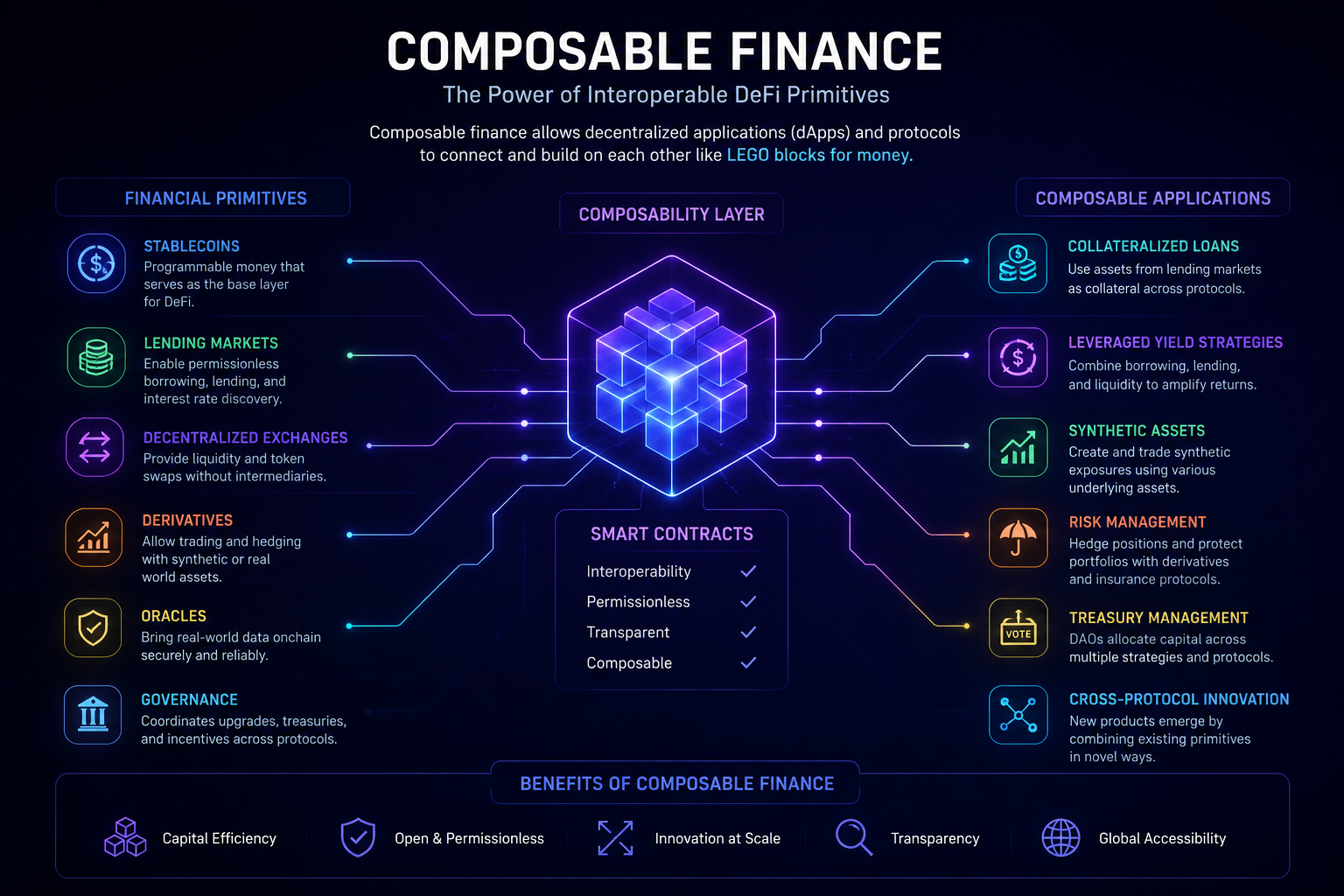
The next phase of DeFi will likely look less like speculative farming and more like modular financial infrastructure embedded across digital economies.
Consumers may interact with composable finance without even realizing it. Wallets will abstract complexity. Applications will integrate DeFi rails invisibly. Stablecoins will function as default internet settlement layers. AI agents may eventually execute financial strategies autonomously across interoperable protocols.
In this environment, composability becomes not merely a feature, but the defining characteristic of digital finance itself.
The long-term significance of DeFi is therefore not that it introduced new ways to speculate. It is that it introduced a financial system where infrastructure is open, programmable, and interoperable by default.
That changes the speed of innovation. It changes who can build. It changes who controls access.
And perhaps most importantly, it changes what finance can become.
Conclusion
To reduce decentralized finance to yield farming is to misunderstand the entire trajectory of the industry.
Yield farming was simply the earliest visible manifestation of a much larger structural innovation: composability. The true breakthrough of DeFi lies in its ability to transform financial services into programmable primitives that can interact, evolve, and coordinate without centralized intermediaries.
This composable architecture is already reshaping how liquidity moves, how capital is deployed, how governance operates, and how digital economies form around shared infrastructure. As the ecosystem matures beyond speculative cycles, the emphasis increasingly shifts toward sustainability, interoperability, and real-world integration.
The most important DeFi applications of the next decade may not resemble the protocols that dominated headlines during the early boom years. They may instead function quietly in the background - as invisible infrastructure powering payments, lending, digital ownership, governance, and machine-to-machine economies across the internet.
Composable finance is ultimately not about chasing yield.
It is about rebuilding financial systems as open networks.
NFT Birdies

NFT Birdies
29 May 2026

NFT Birdies
26 May 2026

NFT Birdies
28 Apr 2026
Nora Daisy
22 Jul 2026

Build authority in Web3 - share your insights on our blog!
Become our guest authorGot a cool idea for NFTBirdies?
Drop your thoughts and help us build the best NFT platform together.
Drop Your IdeaTopics
Recent comments

Share your review
Article: Composable Finance Explained: Why DeFi Is More Than Yield Farming