
NFT Birdies
20 Apr 2026
OpenSea on Pause: Market Hesitation, Token Delays, and the Uncertain Future of $SEA
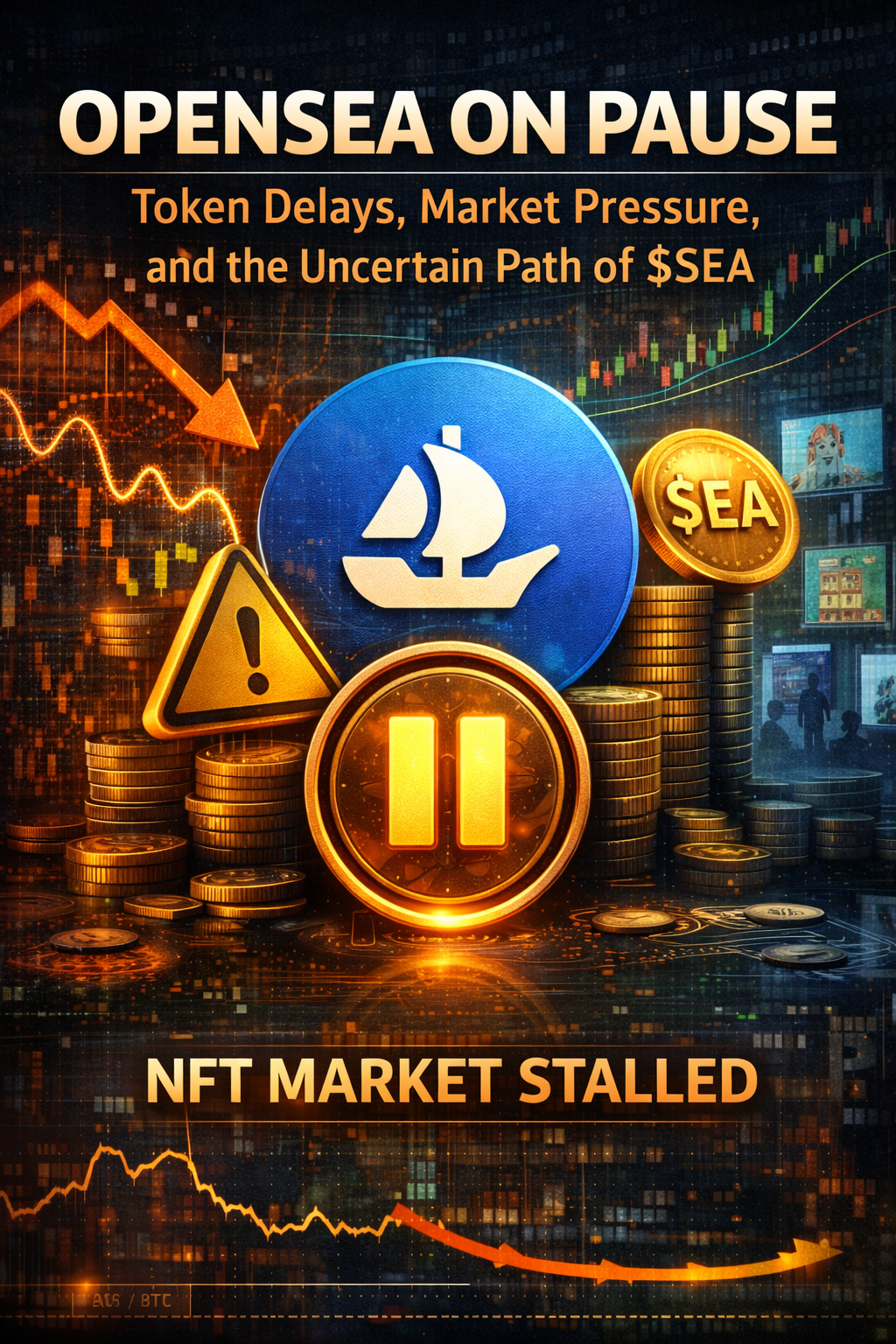
Over the past two months, a notably complex and increasingly polarizing situation has taken shape around OpenSea - once the undisputed leader of the NFT marketplace sector, now navigating a delicate intersection of market timing, community trust, and strategic recalibration. What initially appeared to be a routine pre-token launch phase has gradually evolved into a broader reflection of the platform’s standing within a significantly transformed digital asset landscape. Across X (formerly Twitter), sentiment has ranged from skepticism to outright criticism, with many participants revisiting long-standing frustrations tied to missed expectations, delayed initiatives, and a perceived erosion of leadership during the NFT market’s contraction phase. Yet beneath the noise, the current moment offers a far more nuanced story - one that reflects not only OpenSea’s internal decisions, but also the structural realities of a market still searching for renewed momentum.
At the center of this evolving narrative lies the most consequential recent development: the postponement of the $SEA token launch. On March 16, OpenSea CEO Devin Finzer publicly confirmed that the platform would delay its anticipated Token Generation Event (TGE), which had initially been expected to see early-stage activation around March 30. The reasoning, while unsurprising to seasoned market observers, underscores the fragile state of the NFT ecosystem in early 2026. Finzer pointed to several converging factors: persistently weak NFT trading volumes, an ambiguous and often fragile market sentiment, and the tangible risk that a premature launch could result in a structurally weak token debut. In his framing, the logic was straightforward but critical - $SEA will only launch once, and therefore must do so under conditions that maximize both market reception and long-term viability.
This decision, however, was not made in isolation. It coincided with a broader strategic pivot inside OpenSea’s ecosystem - one that effectively marked the conclusion of its incentive-driven engagement phase. The platform formally shut down its farming program, bringing an end to a multi-wave rewards system designed to stimulate trading activity and user participation. Wave 6 was confirmed as the final iteration, signaling a definitive break from the cyclical reward mechanics that had defined recent months. In parallel, the company introduced a series of adjustments intended to both reset expectations and stabilize its user base. Fees paid during Waves 3 through 6 would be refunded - albeit with a controversial caveat that associated “Treasures” earned during those phases would be revoked. At the same time, all previously accumulated Treasures from earlier participation would still be recognized during the eventual TGE, preserving at least part of the incentive structure’s value proposition.
Perhaps more strategically significant was the introduction of a temporary zero-fee environment for token trading, implemented for a 60-day window beginning March 31. This move, while ostensibly promotional, reflects a deeper shift in OpenSea’s approach: away from direct incentivization through rewards and toward a more organic model of user acquisition and retention. The company has also deliberately avoided providing a new timeline for the $SEA token, notably abandoning the industry’s overused “soon” rhetoric in favor of a more cautious, undefined horizon. In doing so, OpenSea appears to be attempting a reset - not just operationally, but psychologically - signaling a desire to rebuild credibility through measured execution rather than aggressive promises.
Interestingly, the conclusion of the farming phase produced an unexpected secondary effect within the NFT market itself. Community observers noted a measurable increase in floor prices across several blue-chip collections, suggesting that the removal of artificial trading incentives may have reduced sell pressure and speculative churn. One of the most cited examples has been Bored Ape Yacht Club (BAYC), whose floor price rose from approximately 5.15 ETH to above 6 ETH within a matter of weeks. While causality remains debated, a growing segment of market participants attributes this rebound—at least in part - to the end of OpenSea’s reward-driven trading dynamics, which may have previously distorted natural price discovery mechanisms.
Beyond token-related developments, OpenSea continues to build out its product infrastructure, signaling that despite delays, the platform remains actively engaged in long-term development. Among the most notable initiatives is an enhanced discovery system on the homepage, aimed at improving content surfacing and user navigation in an increasingly saturated NFT ecosystem. Additionally, the platform is pushing toward seamless multi-chain support, enabling listings across Ethereum, Solana, and Base without the friction traditionally associated with cross-chain interactions. Complementing this is ongoing work on simplified cross-chain swaps, designed to eliminate the complexity of manual bridging - a persistent barrier for less sophisticated users.
At the same time, OpenSea is reportedly testing a mobile application, reflecting a broader industry shift toward mobile-first engagement models. Perhaps most intriguingly, there are indications that the platform is exploring perpetual trading (perps), a move that, if realized, would represent a significant expansion beyond its traditional NFT marketplace identity and into the broader derivatives ecosystem. Such a transition would not only diversify revenue streams but also position OpenSea more directly within the competitive landscape of full-stack crypto trading platforms.
Despite these developments, community sentiment remains deeply divided. Critics argue that the prolonged and often opaque timeline surrounding $SEA has further eroded trust, particularly when combined with the selective nature of fee refunds - limited only to later farming waves—and the lingering reputational impact of past controversies. These include workforce reductions, contentious royalty policy disputes, and a measurable loss of market share to emerging competitors during the NFT downturn. For many, these issues are not isolated incidents but part of a broader narrative of strategic inconsistency.
Yet it would be reductive to frame the situation purely in negative terms. A notable subset of the community has taken a more constructive stance, with some users even publicly declining refunds in symbolic gestures of long-term support. These actions, frequently shared on X, suggest that despite widespread skepticism, there remains a residual base of users willing to extend trust - provided the platform demonstrates meaningful progress and accountability moving forward.
Market-based indicators reinforce this ambivalence. On Polymarket, where participants have been actively speculating on the fully diluted valuation (FDV) of the eventual $SEA token, sentiment has shown modest signs of stabilization following the postponement announcement. However, confidence remains subdued, with many traders still expressing doubts about the strength of the eventual launch. The prevailing expectation appears to be one of cautious skepticism rather than outright optimism—a reflection of both macro market conditions and OpenSea’s own execution track record.
In a broader sense, the situation surrounding OpenSea serves as a microcosm of the NFT sector’s current state: a space caught between past excesses and future potential, struggling to reconcile ambitious narratives with the realities of a more mature and discerning market. The delay of $SEA is not merely a tactical adjustment but a signal - one that highlights the increasing importance of timing, credibility, and structural alignment in an environment where attention is scarce and competition is intensifying.
Whether OpenSea can ultimately restore confidence and reestablish itself as a central pillar of the NFT ecosystem remains an open question. Much will depend not only on the eventual execution of the $SEA token launch but also on the platform’s ability to deliver consistent product innovation while addressing the trust deficits that have accumulated over time. For now, the project remains in a state of strategic pause - neither failing nor fully recovering, but recalibrating in a market that no longer rewards hesitation lightly.
The key question, then, is not simply when $SEA will launch, but under what conditions - and whether those conditions will be strong enough to revive expectations of a meaningful, high-impact token debut.
NFT Birdies

NFT Birdies
29 May 2026

NFT Birdies
26 May 2026

NFT Birdies
18 May 2026
Nora Daisy
22 Jul 2026

Build authority in Web3 - share your insights on our blog!
Become our guest authorGot a cool idea for NFTBirdies?
Drop your thoughts and help us build the best NFT platform together.
Drop Your IdeaTopics
Recent comments

Share your review
Article: OpenSea on Pause: Market Hesitation, Token Delays, and the Uncertain Future of $SEA