
NFT Birdies
14 Apr 2026
Altcoins as Oscillators: Why Most Crypto Assets Still Revolve Around Bitcoin
By an independent digital markets analytical bureau
In every cryptocurrency cycle, investors inevitably return to the same familiar question: whether altcoins represent genuine long-term value creation or merely temporary speculative instruments orbiting around Bitcoin’s gravitational pull. While narratives surrounding technological innovation, ecosystem growth, token utility, and mass adoption continue to dominate retail discourse, a growing body of market analysis suggests that the overwhelming majority of alternative cryptocurrencies behave less like independent appreciating assets and more like oscillators relative to Bitcoin itself. In practical terms, this means that most altcoins are not sustainably compounding stores of value but rather cyclical trading vehicles whose primary purpose is to periodically outperform - or underperform - Bitcoin during moments of heightened speculation before ultimately reverting downward over time.
Historical market structure appears to support this increasingly widespread thesis. During the previous major crypto expansion, passive exposure to the broader altcoin market—even through a diversified basket of top-100 assets - produced inferior long-term performance when compared to a straightforward Bitcoin buy-and-hold strategy. This has forced many institutional and sophisticated retail investors to abandon the once-popular “buy everything” approach in favor of a far more selective framework: identifying only those altcoins capable of preserving or expanding their value relative to Bitcoin over multiple market cycles. Under this framework, the central objective is no longer to simply find “good projects,” but to isolate what analysts increasingly describe as the market’s “best oscillators” - assets capable either of outperforming Bitcoin outright or at minimum maintaining structural resilience against BTC-denominated drawdowns.
To evaluate this theory in practical terms, analysts recently applied a strict two-filter methodology across 95 veteran altcoins - defined broadly as digital assets that have survived through multiple market environments and possess sufficient historical data for cross-cycle comparison. The first filter focused on comparative peak performance between cycles, measuring whether each asset had managed to recover meaningfully in the 2024–2025 cycle relative to its 2021 high when priced against Bitcoin. To qualify, a coin needed to reclaim at least 35% of its prior cycle BTC-pair peak, a threshold intended to eliminate assets whose rallies remain structurally weak despite nominal USD gains. The second filter examined downside integrity, requiring that the asset’s present BTC valuation remain above its prior bear market floor from the past five years. In other words, if a coin had broken below previous cycle lows relative to Bitcoin, it was considered to be in what traders describe as “negative price discovery” - a structurally dangerous state implying persistent capital flight and deteriorating long-term relevance.
The results of this screening painted a stark picture of the crypto landscape and highlighted just how narrow the field of true altcoin leaders has become.
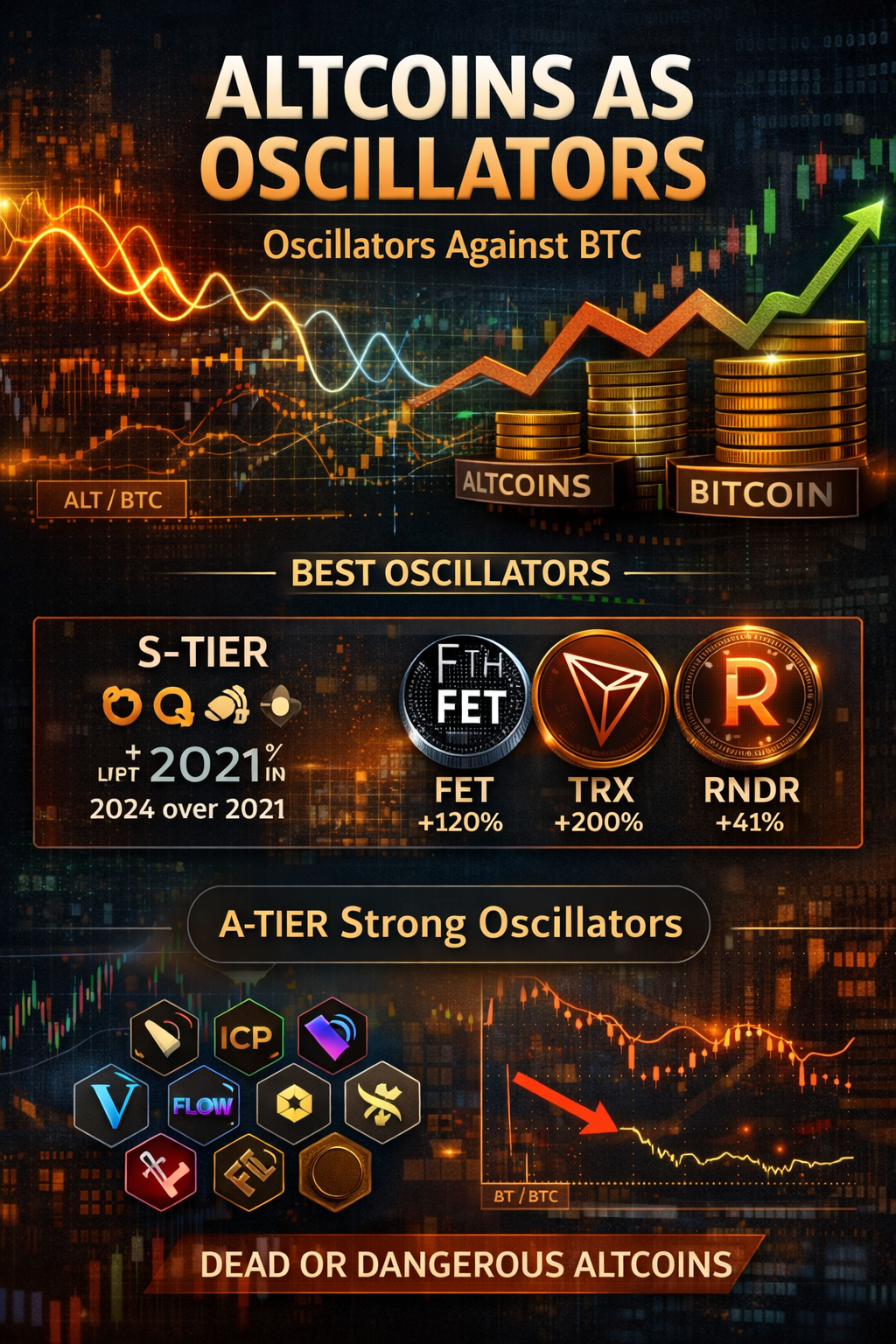
At the very top of the rankings sits the so-called S-Tier, representing the rare class of digital assets that have not merely survived but actively exceeded their prior cycle highs relative to Bitcoin. These are the market’s clearest leaders—the only projects to have demonstrably outperformed BTC itself over a multi-cycle horizon. Among them, Fetch.ai (FET/ASI) emerged as perhaps the strongest performer overall, recording a peak more than 120% above its 2021 BTC-denominated high. The token’s performance underscores the extraordinary momentum behind artificial intelligence-linked blockchain narratives, which continue to dominate speculative capital allocation across digital markets. Closely alongside it stands Tron (TRX), one of the cycle’s most surprising outperformers. Once frequently dismissed as a legacy chain with limited upside, Tron has quietly rewritten expectations by not only breaking to fresh highs against Bitcoin but maintaining a support floor approximately 200% above its lows from five years prior—a sign of remarkable structural strength rarely seen among large-cap altcoins. Render (RNDR) likewise secured elite positioning, outperforming Bitcoin by 41% relative to its previous cycle high and reinforcing its position as one of the market’s most technically robust AI infrastructure plays. Meanwhile, Zcash (ZEC) earned a controversial but statistically justified inclusion in the top tier, largely driven by a sharp resurgence in privacy-focused narratives during 2025, though analysts caution that its volatility profile makes it considerably riskier than other members of the category.
Below this elite group lies the A-Tier, populated by what analysts define as “strong oscillators”—assets that may not have achieved new all-time highs relative to Bitcoin but continue to exhibit healthy cyclical performance and robust downside protection. Unsurprisingly, this category includes crypto’s largest blue-chip alternatives such as Ethereum (ETH) and Solana (SOL). Yet notably, Ethereum—despite its institutional prominence and dominant DeFi ecosystem—was characterized as one of the weaker members of this otherwise strong class, hovering near the lower threshold for qualification. Solana, by contrast, appears to maintain somewhat stronger cyclical momentum and remains one of the healthier large-cap beta plays within the market. XRP and BNB also ranked favorably, with XRP in particular displaying one of the clearest cyclical structures among established majors, repeatedly avoiding breakdowns into new BTC lows despite prolonged market skepticism. In a surprising development, Floki (FLOKI) was identified as arguably the strongest-performing meme coin by this framework, having nearly reclaimed its 2021 BTC-pair highs—an indication that meme-driven speculative capital remains a persistent force within the ecosystem. Monero (XMR) also retained solid positioning, though analysts note its outlook remains heavily dependent on the persistence of privacy-related narratives and regulatory developments.
Further down the rankings sits the B-Tier, composed of weaker oscillators—projects that remain technically intact but have demonstrated only limited recovery strength and less than 35% retracement toward prior BTC highs. This category includes Maker (MKR), Stellar (XLM), Quant (QNT), and Hedera (HBAR), each of which has maintained support levels but failed to generate meaningful relative momentum. Particularly noteworthy is Bitcoin Cash (BCH), which analysts identify as the only major legacy Proof-of-Work altcoin to have transitioned away from perpetual decline versus Bitcoin into a more stable sideways trading structure, suggesting that while not strong, its structural deterioration may at least be slowing.
Perhaps most revealing, however, is the composition of the F-Tier - a graveyard category containing 54 assets deemed structurally broken, obsolete, or highly dangerous from an investment standpoint. These include numerous once-prominent names such as VeChain (VET), Internet Computer (ICP), Flow (FLOW), Filecoin (FIL), SushiSwap (SUSHI), and Axie Infinity (AXS). Each either failed to mount any significant recovery during 2024 or has already broken beneath critical multi-year lows against Bitcoin, effectively entering long-term negative price discovery. Such performance suggests that despite occasional narrative-driven rallies, many former market leaders have permanently lost relative relevance. Analysts additionally flagged Avalanche (AVAX), Injective (INJ), and Near Protocol (NEAR) as assets entering a “danger zone,” warning that their BTC-denominated charts are deteriorating rapidly and nearing breakdown levels that could place them into the same structurally compromised category.
Beyond veteran assets, attention increasingly turns toward the market’s emerging post-2022 entrants - the so-called single-cycle coins, which lack sufficient historical data for full cross-cycle evaluation and therefore require more qualitative analysis. Among these, SUI has attracted considerable praise as perhaps the most promising next-generation Layer-1 blockchain, frequently compared to Solana in both architecture and upside potential. BitTensor (TAO) has become widely regarded as one of the strongest fundamentally driven AI-focused blockchain projects, even amid short-term negative sentiment and controversial headlines. Pepe remains a standout in the meme sector due to its extraordinary virality and persistent community engagement, while World Liberty has drawn speculative interest due to its association with political narratives connected to the Trump family - a reminder that cultural and political relevance increasingly play outsized roles in token speculation. Meanwhile, Layer Zero continues to attract positive analyst commentary for maintaining aggressive development momentum even through bearish market conditions, suggesting long-term conviction from its builder ecosystem.
From a broader strategic perspective, analysts remain cautious on immediate timing despite constructive long-term views on selected names. As of April 2026, the market is widely viewed as being in a corrective or consolidation phase rather than an optimal accumulation window. Many strategists argue that current conditions do not yet offer ideal risk-reward dynamics for aggressive entry, suggesting that more attractive opportunities may emerge either if Bitcoin retraces toward the $50,000 region or if the market confirms a renewed macro bullish breakout with clear momentum continuation. In either scenario, patience rather than urgency remains the dominant recommendation.
Perhaps the most important macro conclusion drawn from this framework is the increasingly overwhelming dominance of artificial intelligence as crypto’s defining speculative driver heading into the next major cycle. Unlike prior narratives - many of which proved fleeting, fragmented, or unsustainable - AI is increasingly viewed as the only thematic catalyst with both mainstream legitimacy and speculative certainty likely to persist into future market expansions. Consequently, projects such as TAO, FET, and RNDR are repeatedly highlighted as the sector’s highest-conviction narrative leaders and probable beneficiaries of future speculative inflows.
Ultimately, the data reinforces a conclusion that may be uncomfortable for many market participants but increasingly difficult to ignore: the overwhelming majority of altcoins are not long-term stores of value but temporary instruments of rotational speculation. In an environment where most tokens consistently lose value against Bitcoin over time, successful participation in altcoin markets demands ruthless selectivity rather than broad optimism. The era of indiscriminately buying dozens of coins and expecting universal upside appears decisively over. Instead, the modern investor’s challenge is far narrower and more difficult - identifying the very small number of assets capable of proving, cycle after cycle, that they deserve to exist not merely beside Bitcoin, but in competition with it.
NFT Birdies

NFT Birdies
29 May 2026

NFT Birdies
26 May 2026

NFT Birdies
18 May 2026
Nora Daisy
22 Jul 2026

Build authority in Web3 - share your insights on our blog!
Become our guest authorGot a cool idea for NFTBirdies?
Drop your thoughts and help us build the best NFT platform together.
Drop Your IdeaTopics
Recent comments

Share your review
Article: Altcoins as Oscillators: Why Most Crypto Assets Still Revolve Around Bitcoin