

NFT Birdies
16 Feb 2026
What Happens When Blockchains Disappear? UX-First Web3 and the Rise of Invisible Chains
For more than a decade, blockchains have been the protagonists of the Web3 narrative. Ethereum versus Solana. Layer 1 against Layer 2. Rollups, sidechains, appchains, modular stacks. Entire market cycles have been defined by infrastructure debates, throughput benchmarks, gas fees, and consensus models. Yet as the industry matures, a quiet but profound shift is underway: the most important innovation in Web3 may be the gradual disappearance of the blockchain from the user experience altogether.
This does not mean that blockchains are becoming irrelevant. On the contrary, they are becoming foundational. But like TCP/IP in the early internet or cloud servers in modern SaaS, their visibility to end users is fading. What emerges in their place is a UX-first paradigm in which users interact with applications, identities, communities, and assets without consciously thinking about chains, bridges, gas tokens, or RPC endpoints. The infrastructure recedes into the background. The experience moves to the foreground. And in that transition, Web3 may finally approach mainstream viability.
The Infrastructure Era: When Chains Were the Product
To understand the significance of invisible chains, we must first acknowledge the infrastructure-centric phase that preceded them. In early Web3, blockchains were not just rails; they were brands. Users identified themselves as belonging to Ethereum, Solana, or other ecosystems. Token holders debated architectural superiority. Developers optimized for chain-specific standards. Even NFT culture was segmented by network allegiance.
This focus was historically necessary. Early systems were fragile and experimental. Performance differences were tangible. Fees could spike unpredictably. Security assumptions varied dramatically. Choosing a chain was not a trivial decision—it defined cost structure, composability, and community.
However, this architecture-first model came at a cost: complexity. Users needed to understand gas mechanics, manage multiple wallets, bridge assets across chains, and manually switch networks. A simple action—minting an NFT or swapping a token—often required navigating multiple interfaces and approving a series of cryptic transactions. For early adopters, this friction was tolerable. For mainstream users, it was prohibitive.
The paradox became clear: Web3’s promise of user sovereignty was undermined by unusable interfaces. True decentralization would not scale if participation required technical literacy comparable to a developer’s.
The UX Reckoning
Every technological wave eventually confronts a usability threshold. The internet in the 1990s required manual configuration and arcane knowledge. Smartphones before iOS and Android were fragmented and unintuitive. In both cases, adoption accelerated only when abstraction layers simplified interaction.
Web3 is now at that inflection point. The rise of account abstraction, gasless transactions, session keys, intent-based architectures, and cross-chain messaging protocols signals a collective effort to prioritize experience over architectural purity. Instead of forcing users to adapt to chains, chains are being redesigned to adapt to users.
Account abstraction, in particular, represents a conceptual leap. By separating transaction validation logic from externally owned accounts, it allows wallets to implement flexible authentication models—biometrics, social recovery, multisig configurations—without exposing users to private key fragility. Transactions can be sponsored, batched, or automated. Gas payments can be abstracted away or paid in stablecoins. The user interacts with an application; the infrastructure handles the rest.
Similarly, cross-chain interoperability frameworks reduce the cognitive burden of network fragmentation. Rather than bridging assets manually, users interact with a unified interface where liquidity routing and settlement occur invisibly in the background. The application determines optimal execution paths across chains without requiring the user to understand the mechanics.
The Concept of Invisible Chains
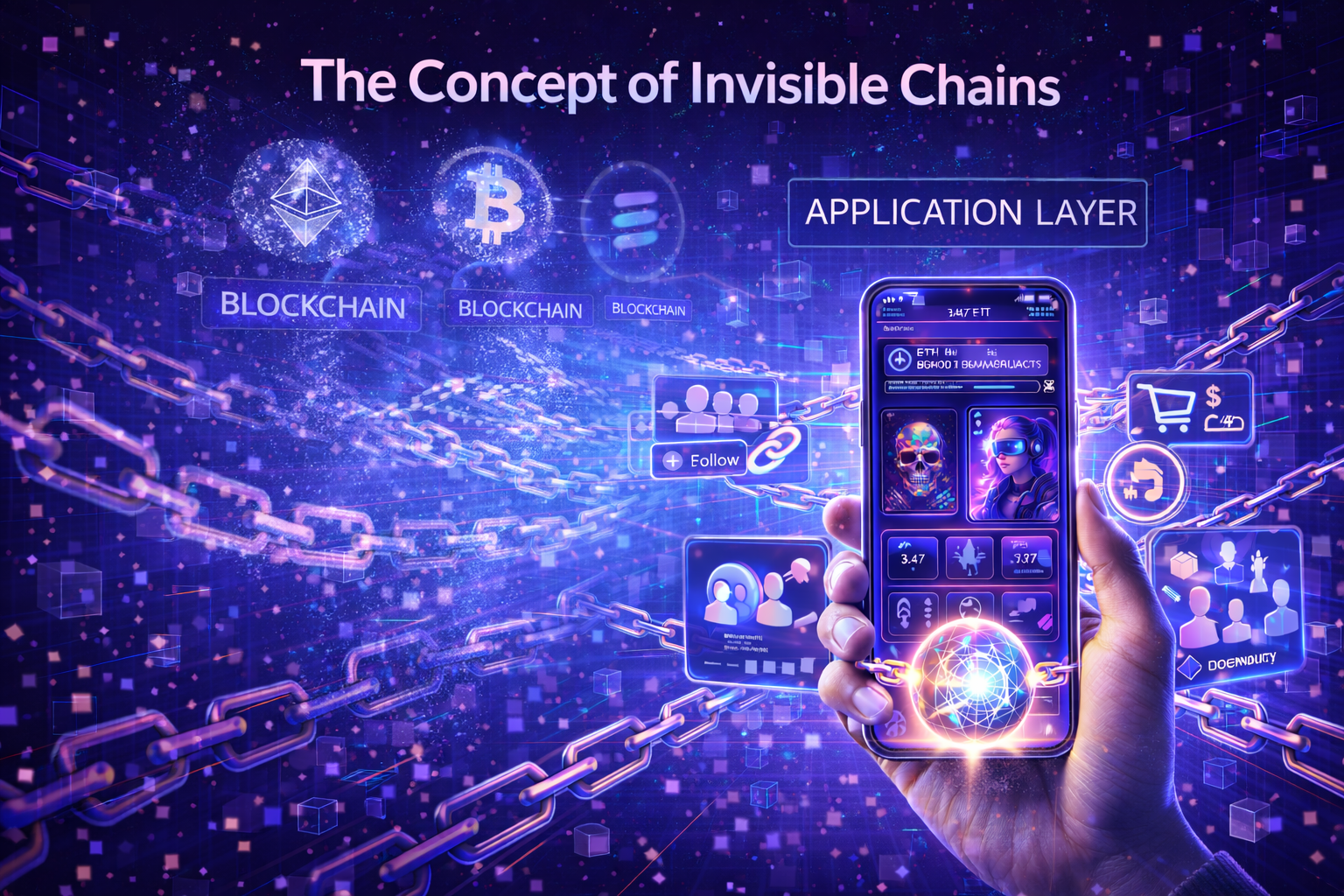
The notion of “invisible chains” does not imply a single dominant blockchain. Instead, it envisions a modular backend where multiple chains coexist, but their boundaries are abstracted. In this model, the application becomes the primary interface, and the blockchain becomes a settlement layer chosen dynamically based on cost, speed, and security requirements.
This architecture mirrors cloud computing. Most internet users do not know—or care—which data center processes their request. They trust the application layer to manage infrastructure decisions. Invisible chains extend this principle to decentralized systems. The end user signs into a Web3-native app, interacts with digital assets, and completes transactions without consciously selecting a network.
Such abstraction also reshapes economic incentives. If users no longer identify strongly with specific chains, competition shifts from branding to performance and developer tooling. Chains become interchangeable modules in a broader ecosystem. The loyalty shifts from infrastructure to experience.
Wallets as UX Gateways
The disappearance of visible chains elevates the role of the wallet. As wallets integrate account abstraction and cross-chain compatibility, they become orchestration layers that mediate between user intent and blockchain execution. Instead of prompting users to confirm raw contract calls, wallets can present human-readable summaries, risk assessments, and contextual explanations.
Intent-based systems push this even further. A user expresses an outcome—“swap this token for the best available rate” or “mint this asset at the lowest fee”—and the network determines how to fulfill it across chains. The user experience resembles interacting with a fintech app rather than a distributed ledger.
This shift aligns Web3 closer to mainstream expectations. Consumers are accustomed to seamless interfaces. They do not wish to understand clearinghouses when using credit cards. They will not wish to manage bridges and RPC settings when using decentralized applications.
The Cultural Implications of Abstraction
Yet the disappearance of visible chains raises philosophical questions. Web3 emerged as a reaction to opaque infrastructure controlled by centralized entities. If blockchains become invisible, does that invisibility risk recreating the opacity Web3 sought to eliminate?
The answer lies in distinguishing between abstraction and obfuscation. Abstraction improves usability without removing user control. Obfuscation hides mechanisms in ways that reduce transparency and agency. Invisible chains must remain inspectable, auditable, and user-owned, even if they are not foregrounded in daily interaction.
In fact, abstraction may strengthen decentralization. By lowering entry barriers, it broadens participation beyond technically sophisticated users. Sovereignty becomes accessible rather than exclusive. The power to self-custody, verify transactions, and audit protocols remains intact—but it is no longer gated by UX friction.
Moreover, invisible chains may reduce tribalism. When users engage primarily with applications rather than chains, ecosystem rivalries diminish. The conversation shifts from which blockchain is superior to which experience delivers real value.
Enterprise and Institutional Adoption
The abstraction of chains also carries implications for enterprise integration. Businesses evaluating Web3 often hesitate due to perceived complexity and regulatory uncertainty. Invisible chain architectures offer a pragmatic bridge. Enterprises can integrate tokenized assets, on-chain loyalty systems, or decentralized identity solutions without exposing customers to technical friction.
For institutions, modular infrastructure allows compliance layers to operate alongside decentralized settlement. Transactions can route through appropriate jurisdictions automatically. Audit trails remain transparent, yet user interfaces remain familiar.
As tokenization expands to real-world assets, supply chain tracking, and digital identity verification, invisible chains enable blockchain benefits without blockchain anxiety. The technology becomes a backend enhancement rather than a user-facing hurdle.
Risks and Trade-Offs
Despite its promise, the UX-first paradigm introduces trade-offs. Greater abstraction can centralize power within wallet providers or application developers who control routing logic and interface design. If users rely on a single wallet super-app to manage cross-chain interactions, that wallet becomes a critical intermediary.
Ensuring interoperability and open standards becomes essential. Invisible chains must remain modular and replaceable. Users should retain the ability to switch wallets, export credentials, and verify transaction paths independently.
Security also evolves. As complexity shifts from user to infrastructure, vulnerabilities may concentrate within middleware layers. Cross-chain messaging protocols, account abstraction modules, and intent solvers become high-value targets. Rigorous auditing and decentralized governance of these components are non-negotiable.
Toward a Post-Chain Narrative
The maturation of Web3 may depend less on inventing new chains and more on rendering them invisible. Just as early internet companies competed on protocol innovation before shifting toward user-centric design, blockchain ecosystems are transitioning from infrastructure maximalism to experiential refinement.
This does not diminish the importance of technical innovation. Scalability, security, and decentralization remain core challenges. But their success will increasingly be measured not by whitepaper metrics, but by whether users notice them at all.
When blockchains disappear from the interface, they do not vanish from existence. They become reliable utilities—persistent, composable, and silent. The value accrues to the applications that harness them elegantly, to the wallets that orchestrate them seamlessly, and to the users who benefit without confronting their complexity.
The ultimate irony is that Web3 may fulfill its promise precisely when it stops talking about blockchains. In a UX-first future defined by invisible chains, decentralization becomes infrastructure rather than ideology. The user simply participates—owning assets, joining communities, transacting globally—without ever needing to ask which chain made it possible.
NFT Birdies


NFT Birdies
17 Mar 2026
Julie Guay
16 Mar 2026

NFT Birdies
26 Mar 2026

Build authority in Web3 - share your insights on our blog!
Become our guest authorGot a cool idea for NFTBirdies?
Drop your thoughts and help us build the best NFT platform together.
Drop Your IdeaTopics
Recent comments

Share your review
Article: What Happens When Blockchains Disappear? UX-First Web3 and the Rise of Invisible Chains