

NFT Birdies
24 Dec 2025
Top-10 Tools for Tokenizing Content in Web3
In 2025, the idea of tokenizing content has moved from abstract theory to an essential strategy for creators, brands, and platforms in the Web3 ecosystem. Tokenization isn’t just for digital art anymore — it’s a framework that enables ownership, royalties, access control, and community monetization across music, writing, video, social interactions, and even content licensing itself. At a high level, tokenization uses blockchain technology to attach a unique cryptographic token to digital content, turning what was once just data into a tradeable and programmable asset with real economic logic behind it.

The tools to accomplish this have proliferated rapidly — from platforms that let you mint NFTs from articles and music, to development kits that help you launch your own tokenized content marketplace, to protocols that gate premium content behind token ownership. As this trend grows, creators and builders need clarity on which tools actually help you bring tokenized content to life.
This article explores the top-10 tools and platforms pushing content tokenization forward, explaining what each does, who it’s for, and why it matters — so you can decide which ones fit your project or creative workflow.
1. Paragraph — Tokenized Publishing Engine
Paragraph is among the earliest and most recognized tools for turning long-form content into NFTs. It allows writers and creators to publish articles on a decentralized framework where each piece of writing can be minted as an NFT, enabling on-chain ownership and secondary market trading. Paragraph’s approach lets creators tap into programmable monetization — including royalties on resales and token-gated access for holders — while preserving the provenance and immutable record of content ownership on blockchain. This makes it ideal for authors, journalists, and Web3 thought leaders wanting to monetize both content and community.
2. Tokeny Solutions — Enterprise Tokenization Toolkit
For larger projects that straddle content and broader tokenization use cases, Tokeny Solutions provides a full stack for token issuance and lifecycle management. While originally conceived for asset tokenization like securities and real-world assets, platforms like Tokeny are increasingly used by brands and creators to structure tokenized experiences, fractional ownership models, and gated content markets. It supports KYC, vesting schemes, and secondary trading features that make tokenized content compliant and scalable, especially for projects that need integrated legal and financial tooling.
3. Securitize — Compliant Tokenization Platform
Securitize is worth highlighting because it combines token creation with regulatory compliance, which opens up tokenized content strategies for enterprises and creators who care about institutional credibility. Securitize supports token issuance, investor onboarding, and secondary market access, which means content owners can tie premium experiences and rights (e.g., revenue sharing on content sales) into compliant digital tokens. For projects that bridge Web2 audiences and regulated markets, this adds an important dimension.
4. Bitbond Token Tool — No-Code Content Tokenizer
Built originally for asset tokenization, Bitbond has carved out practical usability with a no-code interface and intuitive workflows. Creators who don’t want to write smart contracts can use Bitbond’s Token Tool to generate tokens representing content rights or gating keys for premium materials. This “drag-and-drop” approach lowers the barrier to entry for tokenized content and lets smaller teams experiment with layered monetization strategies without deep blockchain expertise.
5. TokenFi Heptad — All-in-One Tokenization Suite
A newer entrant in the tokenization landscape is TokenFi Heptad, which markets itself as a comprehensive toolkit for everything from RWA tokenization to token launch automation. Although not exclusively focused on content, TokenFi offers modules like no-code token launchers, fractional issuance bots for social channels like Telegram and Discord, and launchpad infrastructure. For Web3 creators wanting to unify content tokenization, community token economics, and monetization, this all-in-one stack is increasingly appealing.
6. Decentralized Content Gating Tools (EtherMail Insights)
Tokenization isn’t only about creating tokens — it’s also about gating access to experiences based on token ownership. Platforms highlighted in token-gated content tool lists, such as EtherMail, provide specialized capabilities that allow creators to segment audiences, deliver premium newsletters, or unlock access based on token holdings. These tools integrate seamlessly into NFT and token-centric ecosystems to tailor engagement, subscriptions, and rewards — all while letting creators maintain control of token logic.
7. Creative NFT Platforms (OpenSea, Rarible, Audius, Lens)
While not pure tokenization toolkits, platforms like OpenSea, Rarible, Audius, and Lens Protocol form the execution layer for tokenized content distribution and monetization. OpenSea and Rarible let creators mint and sell NFTs tied to content like articles, music, or video; Audius enables musicians to distribute tokenized tracks and share revenue directly with fans; Lens Protocol offers social graph integration that lets creators monetize engagement and interactions as tokens or gated experiences tied to wallet addresses. These platforms provide the essential marketplace and engagement surface where tokenized content actually reaches an audience — a crucial piece in any tokenization strategy.
8. RWA and Specialized Tokenization Firms (Centrifuge, Harbor)
Even though firms like Centrifuge and Harbor are traditionally associated with real-world assets (RWA), they illustrate a broader tokenization trend that content creators can learn from: enabling fractional ownership, liquidity, and programmable revenue distribution. These firms support complex token models and secondary market operations that could be mirrored in tokenized content ecosystems — for example, revenue-sharing pools tied to content revenues or fractionalized rights for high-value creative works. They represent the edge of what tokenization can become beyond simple NFTs.
9. Custom Smart Contract Toolkits (Moralis & Dev SDKs)
Behind many of the specialized and custom tokenization workflows are developer-focused tools such as Moralis token management APIs and SDKs, which help teams build tailored token issuance systems. These suites provide libraries for minting, burning, managing token rights, and integrating token logic into Web3 apps — whether you’re building a proprietary marketplace, a content subscription protocol, or a community token economy. These frameworks are indispensable for builders who want full control over token functionality beyond the prebuilt stack.
10. Emerging Tokenization Tools & AI-Enhanced Platforms
The next generation of tokenization tools blurs lines between token issuance and content creation workflows. Tools are emerging that combine generative AI with token minting, community engagement automation, and content-centric token flows. These tools promise to greatly reduce friction for creators to launch tokenized content products — for instance, by auto-generating smart contracts, managing token economics automatically, and linking content metadata with token metadata intelligently. Though nascent, this trend signals what the tokenization landscape will feel like by 2026 — smoother, more creator-friendly, and less dependent on developer resources.
How to Choose the Right Tokenization Tool for Your Content
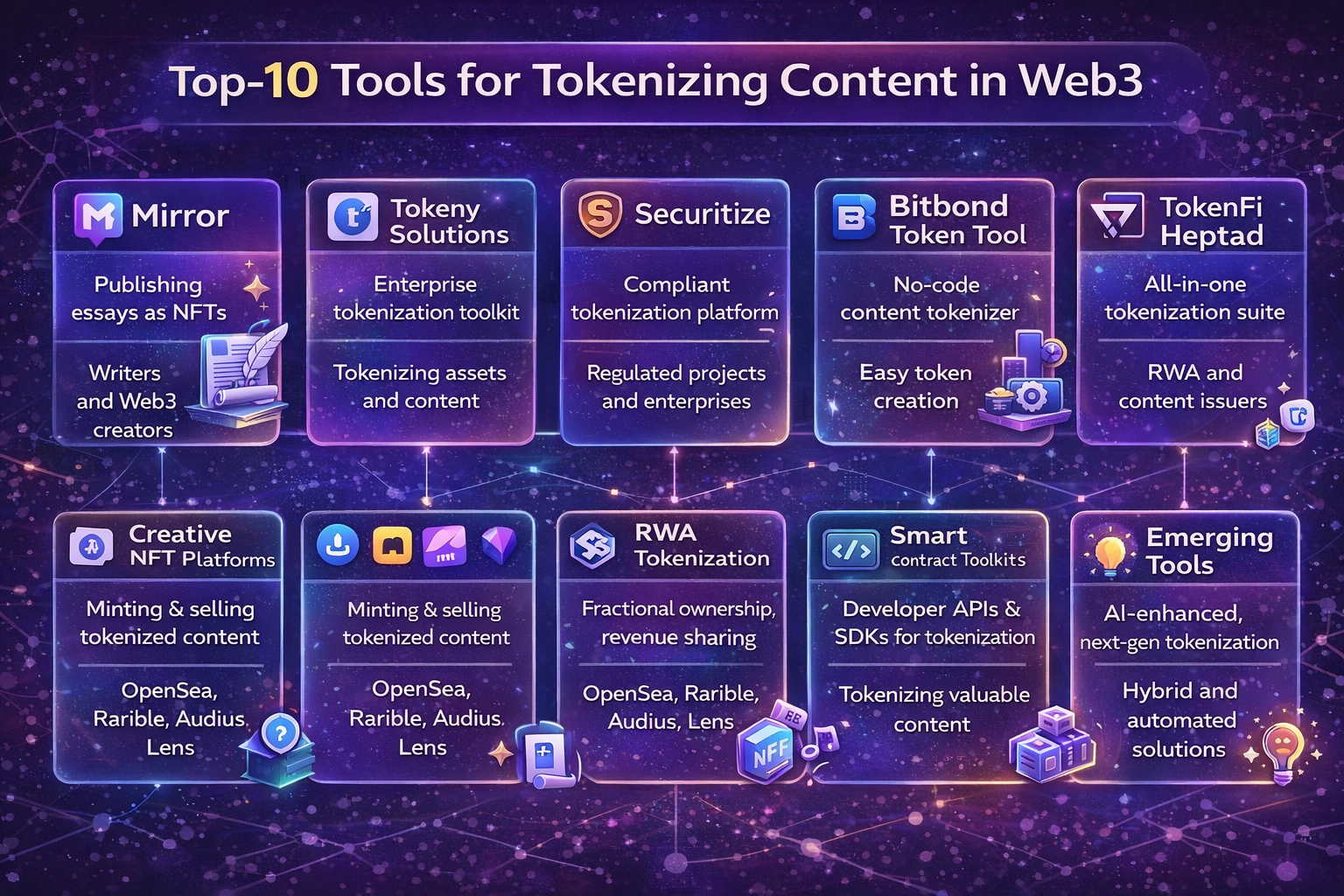
Every project has unique goals, and no one tool fits all. Here are some practical principles to guide your choice:
Ease Versus Control — No-code GUI platforms help you launch quickly, while developer SDKs maximize customization.
Audience and Engagement — Marketplace-driven platforms like OpenSea or Audius help reach crypto-native communities, while gated token tools deepen engagement with holders.
Compliance Needs — Institutional creators and brands might prioritize tools like Securitize or Tokeny that integrate regulatory frameworks.
Revenue Logic — If your monetization strategy includes royalties, revenue sharing, subscriptions, or fractional ownership, choose tools that support programmable token economics.
Scalability — Some platforms aim squarely at enterprise-level issuance, while others are built for independent creators or DAOs.
Tokenization is as much art as it is infrastructure. The best outcomes come from matching your creative vision, audience roadmap, and technical appetite with the right set of tools.
Final Thoughts — Tokenization Is Content 2.0
In the early Web3 era, NFTs were mainly about collectible art and profile pics. But tokenization is now maturing into a foundational layer for content ownership, monetization, and community economics across digital writing, video, music, and interactive media. Whether you’re an independent artist releasing tokenized stories, a DAO experimenting with fractional rights, or an enterprise launching tokenized subscriptions, the tools profiled here represent the cutting edge of what’s possible right now.
As this space evolves, expect new hybrid platforms, automated token-gating solutions, and token creation suites powered by AI to further democratize content tokenization, bringing creator control and audience ownership into a single economic plane.
NFT Birdies
NFT Birdies
31 Mar 2026
NFT Birdies
17 Mar 2026
Build authority in Web3 - share your insights on our blog!
Become our guest authorGot a cool idea for NFTBirdies?
Drop your thoughts and help us build the best NFT platform together.
Drop Your IdeaTopics
Recent comments

Share your review
Article: Top-10 Tools for Tokenizing Content in Web3