
NFT Birdies
24 Feb 2026
Three Ways to Earn in Crypto in 2026
We have selected several directions that are working right now, explained how they function in practice, named specific platforms, and assessed the risks without embellishment. The goal is not to promise easy money, but to map the terrain. Crypto remains cyclical, volatile, and structurally risky. Allocate only capital you can afford to lose.
The State of the Market: Why Strategy Matters More in a Downturn
The market is not in peak condition. Major cryptocurrencies have pulled back from recent highs, sentiment is fragile, and many participants are waiting on the sidelines. None of this is unusual. Crypto has always moved in cycles, and corrections of this magnitude recur every few years.
In euphoric phases, almost any exposure produces gains. When liquidity is abundant and narratives are strong, even passive positioning can look like skill. The real differentiation begins when the market stalls or declines. In such conditions, returns accrue to those who act deliberately: farming future token distributions, deploying capital into fixed-yield instruments, or entering projects early at depressed valuations.
Below are three approaches — from the most straightforward to more advanced — that illustrate how capital can be put to work even in a flat or declining market.
1. Dual Investment: Short-Term Yield with Defined Scenarios
For anyone familiar with bank deposits, the logic behind Dual Investment will feel intuitive, albeit adapted to a far more dynamic asset class. The core idea is simple: you commit your crypto (or stablecoins) for a short period — typically one to seven days — in exchange for an elevated yield, while agreeing to transact at a predefined price if market conditions are met.
This product is available on major exchanges such as Binance, Bybit, and OKX, usually under the “Earn” section, with entry thresholds starting around $50.
Mechanically, there are two primary scenarios.
In the first — effectively “buy lower” — you deposit USDT and select a target price below the current market level. Suppose Bitcoin is trading at $97,000, and you set a target of $93,000 for a three-day term. If the price drops below $93,000 at settlement, you purchase Bitcoin at that level and receive the agreed yield. If it does not, you simply receive your USDT back plus interest. This structure is particularly useful for investors who already intend to accumulate on dips.
In the second scenario — “sell higher” — you deposit Bitcoin and set a target above the current price, say $102,000. If the market rallies past that level, your Bitcoin is sold at the predefined price, and you receive the yield on top. If it does not, your Bitcoin is returned with interest accrued.
Consider a simplified example. You allocate 1,000 USDT into a “buy lower” strategy with a strike 5% below market, a five-day term, and an annualized yield of 15%. Over five days, this translates into roughly $2 in interest. On a standalone basis the figure appears modest, but repeated weekly, and especially during periods of elevated volatility when yields spike, the cumulative effect becomes material.
The principal risk lies in price movement. If the market moves sharply against your expectations, you may be assigned at a level that, in hindsight, is less favorable than prevailing prices. The discipline, therefore, is to select only those target prices at which you would genuinely be comfortable buying or selling. When structured correctly, the outcome is acceptable under either scenario: you either transact at a price you pre-approved or collect enhanced short-term yield.
2. Lending Stablecoins: Structured Yield Without Price Exposure
For participants who prefer to avoid directional exposure altogether, lending stablecoins such as USDT or USDC offers a more predictable path. Because these assets are designed to maintain a peg to the U.S. dollar (1 USDT ≈ $1), the lender’s primary variable is yield, not price fluctuation.
The model is straightforward. You deposit stablecoins into a lending protocol or exchange product. Borrowers pay interest, which is passed through to you. On most platforms, withdrawals are available on demand.
Risk and return vary significantly depending on where you deploy capital.
At the conservative end (approximately 2–6% annually), decentralized lending protocols such as Aave dominate. Operating since 2020, Aave has undergone multiple security audits and manages billions in total value locked. By connecting a wallet and depositing USDC or USDT, users begin earning yield immediately, with funds typically withdrawable at any time.
Moderate strategies (roughly 4–8% annually) include newer mechanisms such as Morpho or synthetic dollar systems like Ethena and its yield-bearing asset sUSDe. In Ethena’s model, a synthetic dollar (USDe) is paired with derivatives-based hedging strategies to generate native yield; holders of sUSDe see the token appreciate over time. The mechanics are more complex, but returns can exceed those of traditional overcollateralized lending.
At the aggressive end (10–20%+ annually), smaller or more experimental protocols offer elevated yields, compensating for smart contract risk, liquidity constraints, or peg fragility. These opportunities demand technical understanding and continuous monitoring.
Entry thresholds on decentralized platforms typically begin around $100, though exchange-based products such as Binance Earn or Bybit Earn may offer lower minimums and eliminate network transaction fees for smaller allocations.
The risks are structural rather than market-driven. There is no deposit insurance. Smart contracts can contain vulnerabilities. Even stablecoins can depeg under stress, as demonstrated by the collapse of TerraUSD in 2022. While such events are rare among leading assets, they are not theoretical.
3. Airdrops: Token Distributions for Early Participation
A more asymmetric, but less predictable, avenue lies in airdrops — token distributions to early users of emerging protocols. Projects seeking traction often allocate a portion of future tokens to active participants who trade, test features, provide liquidity, or otherwise engage before the token officially launches.
For projects, this is a customer acquisition strategy. For users, it can be a source of non-dilutive upside: tokens received at zero cost that can later be sold on the open market.
Recent history provides instructive examples. In late 2025, the exchange Lighter distributed approximately $675 million worth of its LIT tokens to users who had traded on the platform during the preceding year. The company had previously raised $68 million from prominent venture firms, including Andreessen Horowitz and Founders Fund. Earlier, Hyperliquid executed one of the largest token distributions in the industry’s history.
At present, several projects are widely monitored by airdrop-focused participants. Nado (app.nado.xyz), built on the Ink network from the team behind Kraken, is running an open beta with a points program; market participants expect future token allocations to be directed primarily at active users. Extended, developed by a former Revolut team, has reportedly reserved 30% of its token supply for program participants. Paradex has launched a second season of its incentive campaign, while Aztec, a privacy-focused protocol on Ethereum, operates a testnet with potential for retroactive rewards.
The practical approach is methodical rather than speculative. Create a dedicated wallet (for example, MetaMask or Rabby). Fund it with a modest amount — typically $50–200 for mainnet activity, or zero capital for testnets. Select two or three projects and interact consistently, ideally multiple times per week. Vary the actions: swaps, bridging between networks, liquidity provision, governance votes. Most 2026 distributions employ anti-sybil filters designed to detect artificial farming; a single, organically active wallet with transaction history is often more effective than multiple dormant accounts.
The risks are behavioral and structural. A majority of newly issued tokens decline in value within the first three months of trading; many participants choose to sell 50–70% of allocations immediately. Phishing campaigns frequently imitate official claim sites, so verification through primary communication channels is essential. And, of course, some projects ultimately decide against issuing a token at all.
Final Considerations
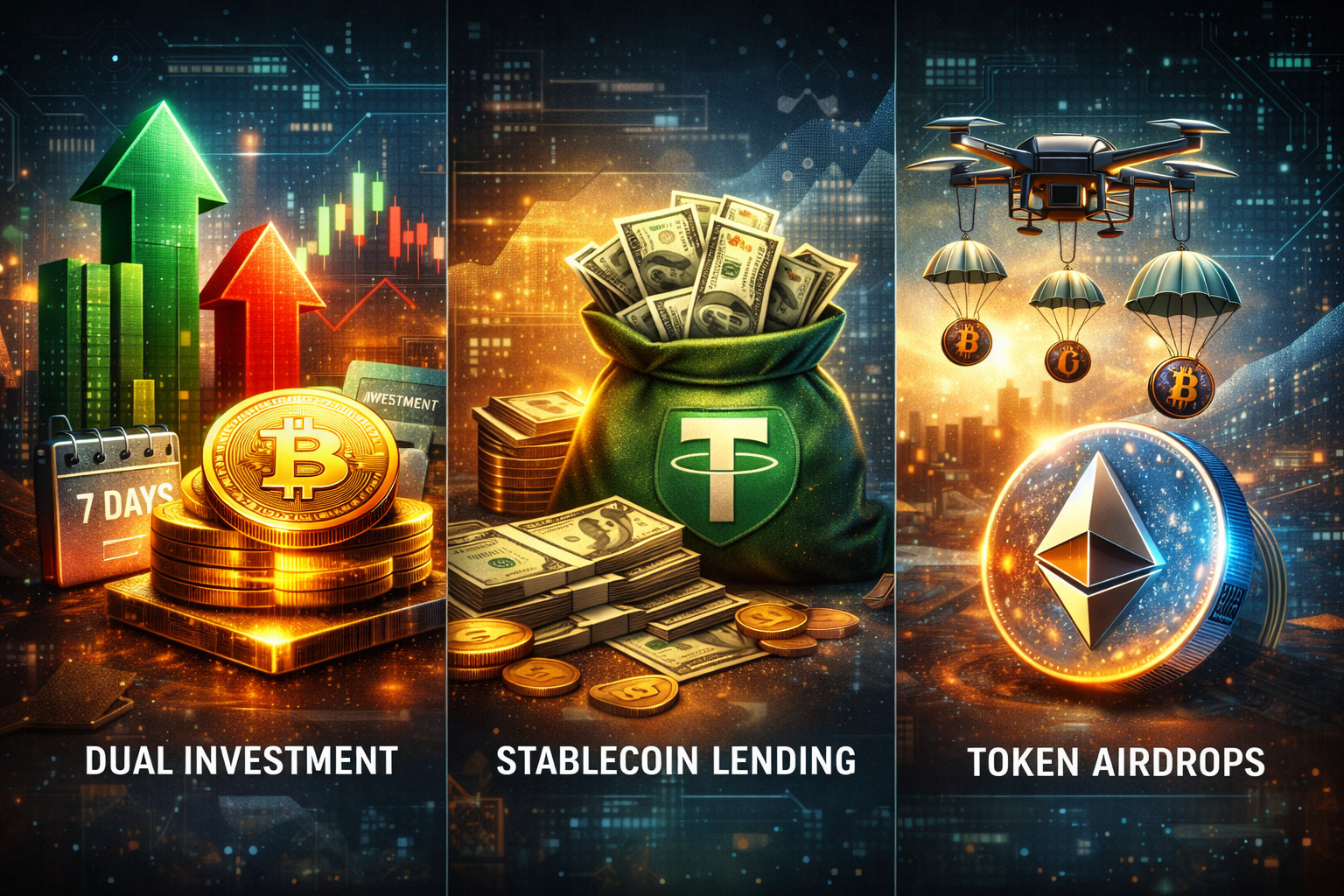
There is no universal strategy for earning in crypto. Dual Investment products monetize volatility and defined price preferences. Stablecoin lending converts counterparty and smart contract risk into structured yield. Airdrop participation exchanges time and activity for probabilistic upside.
In expansionary markets, passive exposure often suffices. In corrective phases, intentional positioning becomes decisive. The common denominator across all three approaches is selectivity: clear entry criteria, realistic return expectations, and rigorous risk control. In a cyclical industry defined by rapid shifts in liquidity and narrative, process matters more than prediction.
NFT Birdies
NFT Birdies
30 Mar 2026

NFT Birdies
17 Mar 2026
Build authority in Web3 - share your insights on our blog!
Become our guest authorGot a cool idea for NFTBirdies?
Drop your thoughts and help us build the best NFT platform together.
Drop Your IdeaTopics
Recent comments

Share your review
Article: Three Ways to Earn in Crypto in 2026