

NFT Birdies
26 Feb 2026
Three More Ways to Earn in Crypto in 2026
In our previous article, we examined three practical ways to generate income in crypto markets under current conditions. Today, we continue that discussion by exploring three additional strategies that expand the toolkit for both analytical participants and long-term allocators. As before, the focus is not on speculation for its own sake, but on understanding structure, incentives, and risk. Crypto rewards those who approach it as a system - not a lottery.
Prediction Markets: Earning on Information, Not Fortune
Prediction markets represent one of the clearest intersections between finance, probability theory, and real-world knowledge. These platforms allow participants to stake capital on the outcome of measurable events: political elections, macroeconomic decisions, sporting results, technological milestones, or crypto price thresholds. The premise is simple: the market price reflects collective probability. Profit accrues not to the lucky, but to those whose assessment of probability is more accurate than the crowd’s.
The mechanism is elegant. A market poses a binary question — for example, “Will Bitcoin reach $120,000 by March?” Participants purchase shares in “Yes” or “No” at a floating market price. That price corresponds to implied probability. If a “Yes” share trades at $0.30, the market is assigning a 30% chance to the event. Should the event occur, the share settles at $1; if it does not, it settles at $0.
Consider a practical illustration. If you believe the real probability is closer to 50% while the market prices it at 30%, you might purchase 100 “Yes” shares for $30. If the event materializes, those shares are worth $100, generating a $70 profit. If not, the $30 is lost. The core edge lies in identifying mispriced probability — a task requiring domain expertise, data analysis, and disciplined thinking rather than intuition.
The largest venue in this sector is Polymarket, whose monthly trading volumes have reached into the billions of dollars. During the 2024 U.S. election cycle, its markets demonstrated accuracy levels approaching 99% in the final stages before resolution. The platform’s valuation has reportedly been estimated between $9 and $15 billion, with backing linked to ownership associated with the New York Stock Exchange. Beyond direct trading profits, there is a structural incentive layer: management has confirmed plans for a future $POLY token, with distribution expected to reward early and active participants. In practical terms, users may benefit twice — first from correct forecasts, and second from eventual token allocation tied to trading activity.
Within the TON ecosystem, participants may also examine emerging prediction tools such as TONCO and related Telegram-native platforms, though these operate at earlier stages of liquidity and development.
The barrier to entry is relatively modest — often $20–50. The risks, however, are straightforward: incorrect forecasts result in total loss of the stake, and token distributions remain speculative until formally announced. The most rational approach is to engage only in markets where one possesses genuine informational advantage.
Decentralized Exchanges: Multiple Revenue Streams Within One Infrastructure
Centralized exchanges custody user assets and impose identity verification requirements. Decentralized exchanges (DEXs), by contrast, allow participants to trade directly from self-custodied wallets, interacting with smart contracts rather than intermediaries. The growth of this model has been substantial: annual trading volume expanded from approximately $647 billion in 2023 to over $1.2 trillion by 2025, reflecting increasing comfort with on-chain execution and self-custody.
Importantly, “trading on a DEX” is not a single strategy but an umbrella encompassing several distinct approaches.
The most familiar is directional trading. Participants buy and sell tokens, capturing price differentials. On perpetual DEXs offering leverage, traders can amplify exposure — deploying $100 in capital to control $1,000 in notional value. Leverage magnifies both gains and losses, demanding rigorous risk management and continuous monitoring. This path suits those willing to dedicate time to market structure, technical analysis, and liquidity dynamics.
A second approach involves liquidity provision. Automated market makers require token reserves to facilitate swaps. By depositing a token pair — for example, ETH and USDC on Uniswap — users supply liquidity and receive a proportional share of transaction fees generated by that pool. On highly active pairs, annualized returns may range between 5% and 20%, while more exotic pairs can offer higher yields accompanied by elevated volatility and smart contract risk. The primary structural hazard here is impermanent loss: if one asset in the pair moves sharply relative to the other, the value of withdrawn assets may underperform a simple hold strategy.
A third vector combines trading activity with incentive farming. Many DEXs launch points programs prior to issuing their native token. Users accumulate points through trading volume, liquidity provision, or consistent engagement. When a token is eventually released, those points convert into allocation. In such cases, participants may aim merely to break even on trading fees while positioning for a potentially meaningful airdrop. This dynamic underpinned the success of earlier distributions by platforms such as Lighter and Hyperliquid.
A more advanced strategy involves funding rate arbitrage on perpetual exchanges. Leveraged markets employ periodic funding payments between long and short positions to anchor price to spot markets. When long positions dominate, shorts receive funding; when shorts dominate, longs are compensated. By opening offsetting positions across two venues and hedging directional exposure, sophisticated traders can harvest funding payments as relatively neutral yield. At the same time, they accumulate trading volume that may qualify them for future token distributions — effectively stacking incentives.
Entry thresholds vary: basic swaps may require as little as $20, while leveraged strategies generally demand at least $100–200 to manage risk appropriately. The dangers are material. Leverage remains one of the fastest ways to both compound capital and eliminate it entirely. Liquidity provision introduces non-linear outcomes under volatile price swings. Any participant entering this domain should begin with limited capital and scale only after understanding the mechanics in practice.
AI-Crypto Tokens: A Long-Term Technological Bet
Artificial intelligence has emerged as the defining technological narrative of recent years. The intersection of AI and blockchain centers on a structural thesis: instead of confining AI models to centralized corporate servers, decentralized networks can coordinate computing power, data provisioning, and model deployment across distributed participants. In theory, contributors are compensated through native tokens, aligning incentives between infrastructure providers and protocol users. The market capitalization of AI-linked crypto tokens has surpassed $39 billion, reflecting strong narrative momentum.
There are two principal ways to engage this theme. The simplest is accumulation and holding. An investor might allocate capital across two or three projects representing different niches — decentralized compute, data marketplaces, AI agent frameworks — and hold for six to twenty-four months. The thesis rests on expanding AI adoption within Web3 ecosystems. Upside multiples of 2x–10x are plausible in favorable cycles, but so is significant drawdown or total capital loss if narratives fade or execution falters.
The second path mirrors earlier airdrop strategies: participation in early-stage AI protocols through testnets and points programs. By contributing feedback, running nodes, or engaging with beta products, users position themselves for potential retroactive token distributions. Current payouts in this segment remain modest — anecdotal results suggest a few hundred dollars over several weeks — yet the sector’s growth trajectory suggests increasing opportunity as projects mature.
Entry capital typically begins around $100–200 for meaningful exposure. The primary risk is valuation inflation driven by hype cycles. Many AI tokens trade at premiums disconnected from fundamental revenue or usage metrics. A prudent allocation rarely exceeds 5–10% of a diversified crypto portfolio.
Strategic Positioning Going Forward
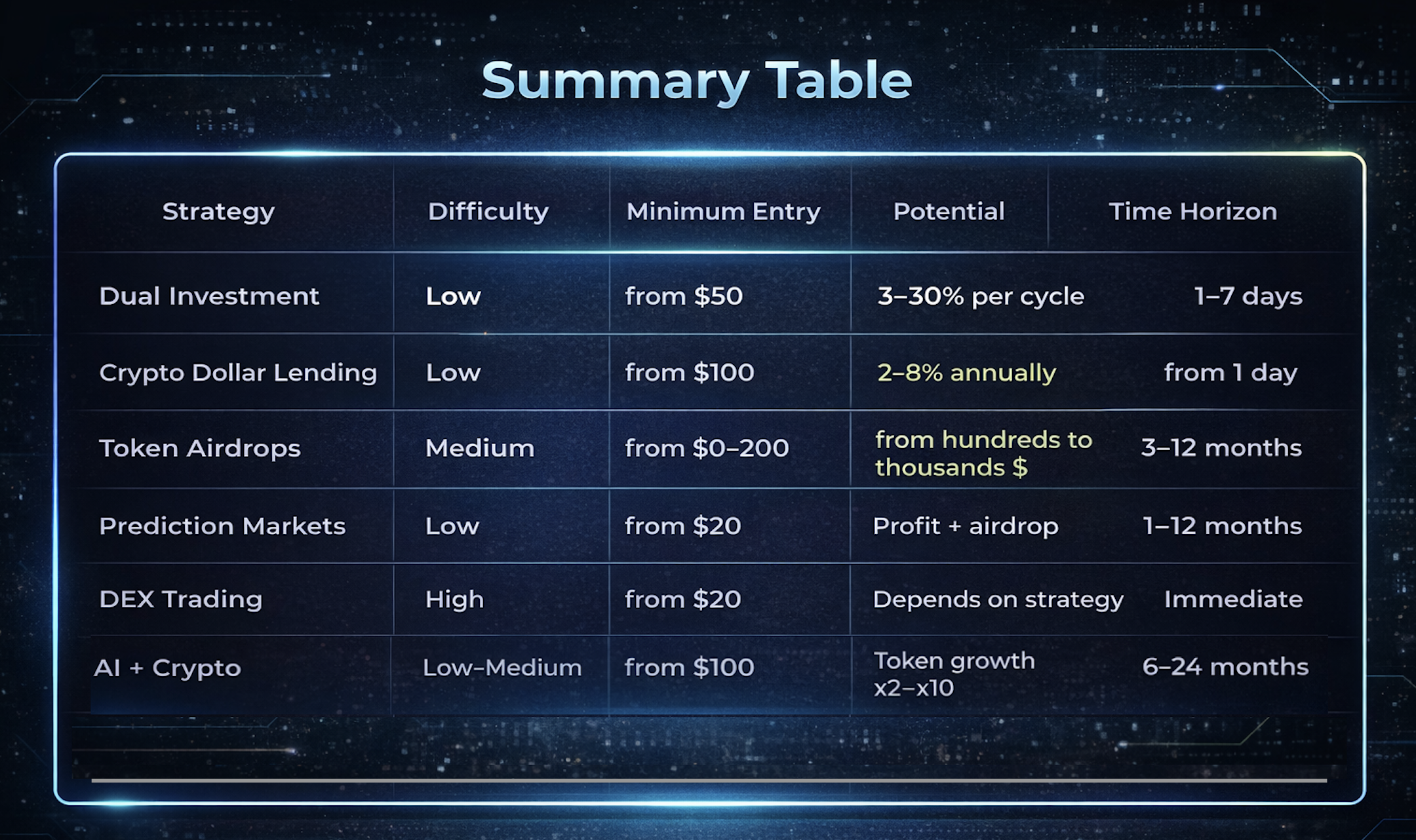
For newcomers, lower-volatility instruments such as Dual Investment products or stablecoin lending offer structured entry points with defined parameters and relatively contained risk profiles by crypto standards. Once operational confidence increases, participation in token distributions and prediction markets can introduce asymmetry without demanding large capital commitments.
More aggressive participants may explore DEX trading strategies or thematic exposure to AI-linked tokens, recognizing that higher potential return correlates with higher volatility and complexity. Across all tiers, concentration risk remains the central error to avoid. A portfolio combining two or three complementary approaches is structurally more resilient than reliance on a single narrative.
A declining market is not necessarily a dormant one. Historically, periods of compression and skepticism have laid the groundwork for subsequent expansion. The participants who build systems, accumulate positioning, and refine process during quieter phases are often those best prepared for the next structural upswing.
We analyze these mechanisms daily — in plain language, with concrete examples and explicit warnings about fraud and structural risk. For ongoing breakdowns and practical commentary, follow “Crypto Made Accessible” and “Web3 Made Accessible.”
NFT Birdies

NFT Birdies
30 Mar 2026


NFT Birdies
17 Mar 2026


Build authority in Web3 - share your insights on our blog!
Become our guest authorGot a cool idea for NFTBirdies?
Drop your thoughts and help us build the best NFT platform together.
Drop Your IdeaTopics
Recent comments

Share your review
Article: Three More Ways to Earn in Crypto in 2026