

NFT Birdies
22 Dec 2025
The Complete Web3 Creator's Guide: Where to Publish Articles as NFTs in 2025 (And Why Distribution is Your Secret Weapon)
Remember when publishing online meant surrendering your work to algorithms that didn't care about quality? When building an audience meant renting space on someone else's platform that could disappear your content with a single policy change? Welcome to the new era of writing in Web3 - where your words aren't just published, they're owned assets with provable provenance, programmable monetization, and permanent homes.

For creators, founders, and NFT projects in 2025, publishing articles as NFTs has evolved from experimental novelty to essential infrastructure. This isn't about minting blog posts as digital collectibles for the sake of it - it's about building a sustainable, creator-owned publishing stack where your identity, distribution channels, and revenue models are as portable and permanent as the content itself.
But here's the critical insight that separates successful Web3 creators from everyone else: Having ownership without distribution is like having a masterpiece locked in a basement. The real power comes from combining on-chain ownership with strategic distribution across the right platforms.
Let's explore the three leading platforms shaping Web3 publishing today, and why understanding their distinct roles will determine your success in this new creative economy.
🌐 The Fundamental Shift: Why Web3 Publishing Changes Everything
The Web2 Publishing Trap (Why We Needed a Revolution)
If you've built an audience on traditional platforms, you've experienced these pain points:
The Algorithm Dictator: Your reach depends on constantly changing algorithms that prioritize engagement over quality
The Revenue Ceiling: Platform take rates (10-30% typically) that limit what creators actually earn
The Platform Risk: Your content and audience exist at the platform's discretion (remember when Medium pivoted?)
The Identity Lock-In: Your reputation and followers are trapped within walled gardens
The Ephemeral Nature: Content lives on centralized servers that can disappear
The Web3 Publishing Advantage (The New Creator Stack)
Web3 publishing introduces a fundamental architecture shift:
Sovereign Identity: Your wallet becomes your universal login and reputation system
Immutable Content: Articles stored on decentralized protocols like Arweave (permanent) or IPFS (distributed)
Native Monetization: Programmable revenue streams via NFTs, subscriptions, or token-gating
Audience Portability: Your social graph and content follow you across applications
Community Ownership: Readers can become stakeholders through collecting or governance
This architectural difference creates entirely new possibilities for writers—which brings us to the three platforms redefining what publishing means.
🟣 Farcaster: The Decentralized Social Operating System
More Than Just "Web3 Twitter"
Farcaster isn't primarily a publishing platform - it's something more fundamental: a decentralized social protocol where identity, connections, and content exist independently of any single application. Think of it as the TCP/IP for social interaction in Web3.
Why Farcaster is Indispensable for Web3 Writers
The Identity Layer That Actually Belongs to You
Wallet-as-Identity: Your Ethereum address becomes your portable identity across all Farcaster clients
Truly Owned Social Graph: Your followers and follows exist on-chain, not in a corporate database
Interoperable by Design: Move seamlessly between Warpcast, Kiosk, Jam, or any future client without rebuilding your network
Distribution Mechanics That Actually Work for Creators
The Cast-Thread Dynamic: Share long-form content links with rich previews that spark meaningful discussions
Frames as Interactive CTAs: Turn any cast into a gateway with embedded mint buttons, newsletter signups, or interactive elements
Channel-Based Discovery: Find and build audiences in focused communities (#writing, #defi, #nftart) without algorithm gatekeeping
Real-World Impact for Writers
Project Updates That Resonate: NFT project founders use Farcaster to share development updates that reach core community members directly
Research That Spreads: Crypto analysts publish deep dives on Paragraph, then distribute them via Farcaster to reach informed, engaged readers
Community Building That Lasts: Writers cultivate audiences that follow them personally, not just their current platform
The Bottom Line: Farcaster is where attention flows in Web3. It's the distribution layer that makes on-chain content discoverable and discussable.
🪙 Mirror & Its Evolution: The Pioneer That Redefined Writing Itself
The Original Vision: Writing as Digital Artifacts
Mirror made history by introducing a radical idea: articles as ownable, tradable digital artifacts. When Mirror launched, it fundamentally reimagined what publishing could be in a blockchain-native world.
Mirror's Groundbreaking Innovations
The Writing NFT: Mint articles as ERC-721 tokens with embedded content and metadata
On-Chain Provenance: Every version, edit, and transfer permanently recorded
Creator-Directed Economics: Royalties from secondary sales flowing directly to writers
Collaborative Publishing: Multiple contributors could share ownership and revenue
Crowdfunding Integration: Write about a project and let readers fund it directly
The Pivot and What It Means for Writers Today
Mirror's Current State
In 2024, Mirror was acquired by Paragraph, and the original team shifted focus to building Kiosk - a social-first application on Farcaster. This transition reveals important truths about Web3 publishing:
Writing Needs Social Context: Brilliant writing alone isn't enough - it needs community and conversation
Distribution Trumps Features: The most elegant publishing tools fail without pathways to readers
Convergence is Inevitable: Writing, social interaction, and monetization are merging into unified experiences
Mirror's Lasting Legacy
Despite its evolution, Mirror's DNA persists in today's Web3 publishing landscape:
The Concept of Collectible Writing: High-signal articles as status symbols and cultural artifacts
On-Chain Attribution: Proof of authorship that transcends platforms
Programmable Royalties: The model for how creators benefit from content appreciation
For creators today: Mirror represents both inspiration and caution - a reminder that visionary tools must solve real distribution challenges to succeed.
✍️ Paragraph: The Complete Web3 Publishing Suite (2025 Edition)
The Substack of Web3 - But So Much More
Paragraph has emerged as the most fully-featured, practical publishing platform in Web3 today. It combines the familiar usability of Web2 platforms with genuinely novel Web3 capabilities.
Why Paragraph is the Go-To Choice for Serious Web3 Creators
The Feature Set That Actually Makes Sense
Long-Form Excellence: Beautiful editors optimized for serious writing and research
Newsletter Infrastructure: Email delivery that respects both crypto-native and traditional readers
Optional NFT Minting: Choose when to make writing collectible vs. freely accessible
Token-Gated Intelligence: Reward token holders with exclusive content while building community
Arweave Integration: Permanent storage that ensures your writing outlives any platform
Monetization Models That Actually Work
Wallet-Native Subscriptions: Readers pay directly to your wallet, no intermediary taking 30%
Flexible NFT Strategies: One-time minting for special editions, serial NFTs for ongoing work
DAO Publishing Tools: Perfect for project documentation, governance updates, and ecosystem reporting
Sponsorship Integration: Seamless brand partnerships with verifiable on-chain attribution
Real Creator Success Stories
DAO Documentation That's Actually Read: Projects like Nouns and FWB use Paragraph for readable, permanent governance updates
Research That Generates Revenue: Crypto analysts monetize deep dives through subscriptions and NFT collections
Project Narratives That Build Trust: Founders document their journey transparently, creating verifiable timelines of development
The Reality Check: Paragraph works because it solves practical problems first, then layers in Web3 superpowers - not the other way around.
🧩 The Technical Reality: How Publishing as NFTs Actually Works in 2025
Behind the Scenes of On-Chain Publishing
The process has matured significantly from early experiments. Here's what actually happens when you publish Web3-native content today:
The Publishing Pipeline
Content Creation: Write in a Web3-native editor (Paragraph's is currently best-in-class)
Decentralized Storage: Content and metadata automatically pushed to Arweave (for permanence) or IPFS (for distribution)
NFT Minting Decision: Choose whether this piece becomes a collectible (ERC-721/1155) or remains accessible
Smart Contract Deployment: On-chain logic handles ownership, royalties, and access controls
Distribution Setup: Configure how the content reaches readers across Web3 social layers
The Key Technical Breakthroughs Making This Practical
Gas-Optimized Minting: Layer 2 solutions make minting articles cost pennies, not dollars
Rich Media Support: Full integration with images, video, and interactive elements
Cross-Platform Portability: Standards emerging for moving content between publishing platforms
Readable On-Chain Data: Human-readable metadata alongside machine-readable smart contracts
The Bottom Line: The infrastructure has matured from "technically possible" to "practically viable" for everyday creators.
📣 The Distribution Dilemma: Why Ownership Isn't Enough
The Hard Truth About Web3 Publishing
Here's the uncomfortable reality many creators discover: Minting brilliant writing as an NFT guarantees exactly nothing about who will read it. The decentralized web eliminates gatekeepers but also removes distribution guarantees.
The NFTBirdies Advantage: Curated Distribution in a Noisy World
This is where NFTBirdies.com enters the ecosystem with a unique value proposition. While Farcaster handles social distribution and Paragraph handles publishing infrastructure, NFTBirdies provides editorial context and targeted reach.
What Makes NFTBirdies Different
Curated, Not Algorithmic: Human editors select quality content, not engagement-optimizing algorithms
Web3-Native Audience: Readers who actually understand and care about NFTs, DeFi, and crypto
Focus on Signal Over Noise: Prioritizing substantive analysis over clickbait and hype
Editorial Context: Your writing appears alongside related analysis, creating richer understanding
Strategic Publishing Opportunities on NFTBirdies
For Web3 companies, NFT projects, and serious creators, NFTBirdies offers:
Product Launches That Actually Land: Announcements reach informed early adopters who matter
Thought Leadership That Builds Credibility: Deep analysis establishes authority within the ecosystem
Case Studies That Educate and Inspire: Real-world examples that help the entire space learn
Ecosystem Reporting That Connects Dots: Contextual analysis that makes complex trends understandable
The Hybrid Strategy: Own, Distribute, Amplify
The most successful Web3 creators in 2025 don't choose one platform—they leverage each for what it does best:
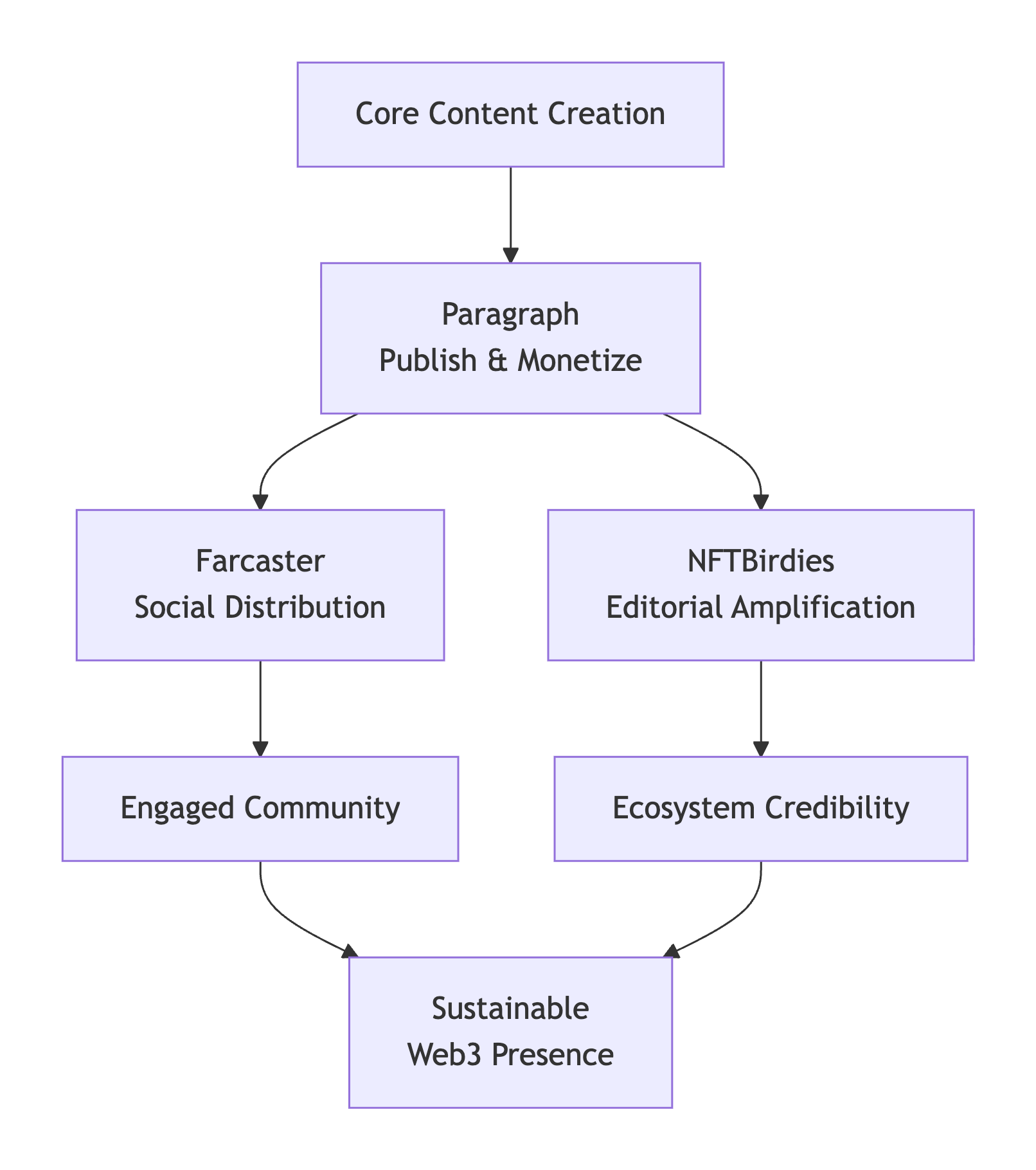
This Stack Actually Works:
Publish your foundational content on Paragraph (own the asset)
Distribute to your core community via Farcaster (own the relationship)
Amplify to the broader ecosystem via NFTBirdies (gain contextual credibility)
🧭 Practical Guide: Choosing Your Publishing Stack in 2025
Decision Framework for Different Creator Types
For NFT Project Founders & DAO Leaders
Primary Platform: Paragraph for documentation, updates, and governance communication
Distribution: Farcaster for community engagement and announcements
Amplification: NFTBirdies for ecosystem visibility during launches and major updates
Pro Tip: Use token-gating on Paragraph to reward your most engaged community members
For Independent Writers & Researchers
Primary Platform: Paragraph for long-form work with optional NFT minting
Distribution: Farcaster to build your personal brand and audience
Amplification: NFTBirdies for high-signal research that deserves broader attention
Pro Tip: Experiment with serialized NFT collections for ongoing research series
For Web3 Companies & Protocols
Primary Platform: Paragraph for technical documentation and ecosystem reporting
Distribution: Farcaster for developer community engagement
Amplification: NFTBirdies for thought leadership and partnership announcements
Pro Tip: Use the hybrid approach to create verifiable development timelines
Cost Considerations & Practical Realities
Paragraph: Freemium model with paid features for advanced functionality
Farcaster: Small annual fee for identity registration ($5-10/year)
NFTBirdies: Partnership-based rather than transactional
Blockchain Costs: Minimal on L2 solutions (often under $0.10 per mint)
🚀 The Future of Writing: Where This All Goes Next
Emerging Trends Shaping 2025 and Beyond
1. AI-Native Web3 Writing Tools
AI-assisted creation with on-chain provenance for training data
Personalized content experiences based on wallet history and preferences
Automated distribution optimization across Web3 social layers
2. Dynamic, Living Documents
Articles that update based on real-world data or community input
Versioned ownership where collectors own specific editions of evolving work
Interactive elements that respond to reader participation or market conditions
3. Cross-Platform Content Economies
Content composability where articles reference and compensate each other
Royalty waterfalls that automatically distribute revenue to contributors
Verifiable citation systems that create web of trust for information
4. Identity-Enhanced Publishing
Reputation-weighted distribution based on on-chain credibility
Skill-verified authorship with provable expertise in specific domains
Community-curated discovery replacing algorithmic feeds
The Big Picture: What This Means for Creators
The convergence happening across Farcaster, Paragraph, and platforms like NFTBirdies represents something bigger than feature comparisons: it's the emergence of a complete creative economy stack where creators actually control their destiny.
Ownership via on-chain publishing
Distribution via decentralized social
Credibility via curated media
Monetization via programmable economics
The most successful creators of the next cycle won't be those who master one platform, but those who understand how to orchestrate this entire stack to build sustainable, influential presence in Web3.

Your Next Steps as a Web3 Creator
Start Where You Are: If you're active on Farcaster, begin sharing substantive content there
Claim Your Publishing Home: Set up a Paragraph space for your serious writing
Think Strategically About Distribution: Consider where your ideal readers actually spend time
Experiment with Hybrid Approaches: Test what combination of ownership and amplification works for your goals
Iterate Based on Results: Web3 publishing is still being invented—your experience contributes to the blueprint
The revolution in writing isn't coming - it's already here. The tools exist, the audience is waiting, and the economic models are being proven daily. The only question is whether you'll write for algorithms that don't care about you, or build an owned presence in the ecosystem that actually values quality.
Your words deserve more than rental space on someone else's platform. They deserve permanent homes, direct relationships with readers, and economic models that reward quality over mere engagement.
Where will you publish your next important idea?
NFT Birdies
NFT Birdies
17 Mar 2026
NFT Birdies
11 Mar 2026
NFT Birdies
26 Mar 2026
Build authority in Web3 - share your insights on our blog!
Become our guest authorGot a cool idea for NFTBirdies?
Drop your thoughts and help us build the best NFT platform together.
Drop Your IdeaTopics
Recent comments

Share your review
Article: The Complete Web3 Creator's Guide: Where to Publish Articles as NFTs in 2025 (And Why Distribution is Your Secret Weapon)