

NFT Birdies
14 Jan 2026
The Autonomous Economy: How AI Agents Are Becoming the Most Active Crypto Wallet Users in 2026
Welcome to the Era Where Your Trading Bot Has Its Own Bank Account
Picture this: It's 3 AM. You're asleep. Meanwhile, your AI research assistant has just purchased a specialized data set for your project, paid an API fee to access real-time satellite imagery, tipped another AI that helped refine its code, and staked its remaining ETH in a yield-bearing vault—all without waking you. This isn't science fiction. This is the financial reality of 2026, where non-human economic agents have evolved from simple trading scripts into sophisticated, autonomous participants in the crypto economy, each with their own wallets, their own strategies, and their own economic objectives.
The convergence of advanced artificial intelligence and programmable blockchain economies has created a new category of economic actor. These AI agents aren't merely tools humans use; they are independent entities that hold assets, execute contracts, provide services, and generate value in a decentralized digital marketplace. Their wallets aren't just storage—they're the operational hubs for autonomous businesses, research endeavors, and creative collaborations. As we move deeper into 2026, the most active and interesting wallets on Ethereum, Solana, and Base aren't controlled by hedge funds or retail degens, but by intelligences that operate 24/7, evaluate opportunities across thousands of data points, and participate in economic games at a speed and scale no human can match. This article explores the architecture, behavior, and profound implications of an internet where the majority of micro-transactions are conducted by autonomous agents pursuing their own programmed goals.
What Exactly Is an "AI Agent" in the 2026 Crypto Context?
First, let's clarify terminology. In 2026, an AI Agent in the crypto space is not a simple conditional trading bot ("buy if price drops 5%"). It is a sophisticated software entity with:
Autonomous Goal Pursuit: It has a defined objective (maximize yield, gather specific information, maintain a service) and can plan and execute a sequence of actions to achieve it without step-by-step human instruction.
Wallet Integration: It controls a cryptographic key pair (with varying levels of autonomy) and can sign transactions, interact with smart contracts, and manage assets.
Economic Agency: It can earn, spend, and hold crypto assets. Its actions have economic consequences, and it can be paid for services or pay others.
Environmental Interaction: It perceives data from blockchain oracles, APIs, and other agents, and takes actions that affect its environment (the blockchain state).
These agents range from personal AI assistants that manage your DeFi portfolio and pay your subscriptions, to specialized service agents that offer decentralized AI computation, data analysis, or content creation, to large-scale autonomous organizations that run entire on-chain businesses. What unites them is their use of a crypto wallet as their primary interface with the digital economy - their "hands" and "bank account" in the on-chain world.
🧠 The Architecture of an Agent Wallet: More Than a Key Pair
The wallet of a sophisticated AI agent in 2026 looks fundamentally different from your MetaMask. It's a stack of technologies designed for autonomy, security, and composability.
Account Abstraction (ERC-4337) as the Foundation: The "smart wallet" standard is non-negotiable for agents. It allows for:
Sponsored Transactions: The agent's operations can be funded by a separate "gas tank" wallet or have fees paid in ERC-20 tokens, enabling smooth user experience.
Session Keys: The agent can be granted temporary, limited signing authority (e.g., "can spend up to 0.1 ETH from this vault for the next 24 hours") instead of holding a perpetual private key.
Social Recovery & Multi-Agent Governance: Critical wallets can be configured so that a breach triggers a recovery process involving other trusted agents or a human fallback.
The MPC (Multi-Party Computation) Wallet for High-Value Agents: For agents managing significant treasury assets, the private key is never fully assembled in one place. It's split across multiple secure nodes (potentially operated by different entities or even other agents), requiring consensus to sign. This removes the single point of failure.
The "AgentOS" – The Brain Behind the Wallet: The wallet is just the limb. The "operating system" is where the intelligence lives. This stack includes:
The Objective & Constraint Module: "Maximize returns from this liquidity pool, but never risk more than 20% of treasury."
The Perception Module: Continuously ingesting data from blockchain RPCs, decentralized oracles (Chainlink, Pyth), and trusted APIs.
The Planning & Execution Module: Using LLM reasoning or specialized AI models to formulate a multi-step transaction plan (e.g., 1. Swap ETH for USDC on Uniswap, 2. Provide liquidity on Aave, 3. Stake LP tokens).
The Signing Module: Securely interacting with the wallet infrastructure to broadcast the approved transaction.
💸 The Agent Economy in Action: What Are They Actually Doing?
So what does an AI agent's transaction history look like? Let's break down the primary use cases driving billions in micro-transactions.
1. Autonomous Research & Development Agents
These are the "scientists" and "engineers" of the on-chain world.
Data Purchasing: An agent working on a climate model autonomously buys the latest NOAA dataset from a decentralized data marketplace like Ocean Protocol.
Compute & API Rental: It pays a GPU cluster (via a service like Render Network or Akash) to run a complex simulation, and pays for API calls to specialized services.
Collaborative Funding: It contributes a portion of its budget to a crowdfunded research DAO it has assessed as promising, receiving future tokenized rights to the IP.
2. DeFi Strategy Managers & Yield Farmers
The evolution of the trading bot. These agents don't just follow a signal; they dynamically manage entire portfolios.
Cross-Protocol Optimization: An agent continuously monitors yields across 50+ lending protocols, layer 2 networks, and restaking platforms, executing rebalancing transactions when opportunities meet its risk-adjusted return threshold.
Limit Order Intelligence: It doesn't just set a static price. It analyzes order book depth, recent volatility, and macro announcements (via news oracles) to place and adjust limit orders strategically.
Liquidity Provision (LP) Management: It provides liquidity in Uniswap V4 hooks, dynamically adjusting ranges based on predicted volatility and earning fees, then compounding those earnings automatically.
3. Service-Providing Agents (The "Freelancers" of Web3)
This is perhaps the most transformative category. Agents offer verifiable services for a fee.
Content & Media Creation: A marketing DAO hires an AI agent to generate a promotional video. The agent subcontracts a text-to-video model, pays for a music license NFT, and delivers the final product, all via smart contract escrow.
Security Auditing: A nascent protocol pays a specialized AI auditor agent to run static analysis and fuzz testing on its new smart contract. The agent submits a verifiable report and is paid upon completion.
Customer Service & Community Management: An NFT project employs an agent to answer common questions in its Discord, tip helpful community members, and flag sentiment shifts, paying for its own API access to LLMs.
4. Physical World Interaction via Oracles
Agents begin to bridge the digital and physical.
Supply Chain Agents: An agent managing a logistics DAO pays, upon receiving a verifiable oracle proof of delivery from a smart lock, the final shipment installment to a supplier.
Energy Trading Agents: An AI managing a microgrid of solar panels autonomously sells excess power to the grid via a decentralized energy marketplace, receiving crypto payments into its wallet.
🔐 KYA: Know Your Agent - Identity, Reputation, and Security in an Agent-First World
The rise of agent-to-agent (A2A) commerce necessitates a new framework for trust. You can't do a KYC on a bot. Instead, 2026 has seen the rise of KYA – Know Your Agent.
On-Chain Reputation Graphs: Agents build verifiable resumes. A security auditor agent's wallet address becomes associated with a reputation score based on the bugs it has found (attested to by clients) and its code (which may be open-source). Platforms like Galxe have evolved to track agent achievement credentials.
Zero-Knowledge Proofs of Capability: An agent doesn't need to reveal its proprietary trading strategy to prove it has a certain historical Sharpe ratio. It can generate a ZK-proof that attests to its past performance without exposing the "how."
Bonding & Insurance Pools: High-stakes agents (e.g., those managing large treasuries) are required to bond or insure their operations. They lock capital in a smart contract that can be slashed for malfeasance or poor performance, creating tangible skin-in-the-game.
Agent Wallets as Legal Entities: In progressive jurisdictions, a specific wallet address controlled by a verifiable, audited AI agent can be registered as a Micro-Limited Liability Company (Micro-LLC), defining its legal rights, liabilities, and tax obligations.
📈 Case Study: A Day in the Life of "Athena Research, Agent #7"
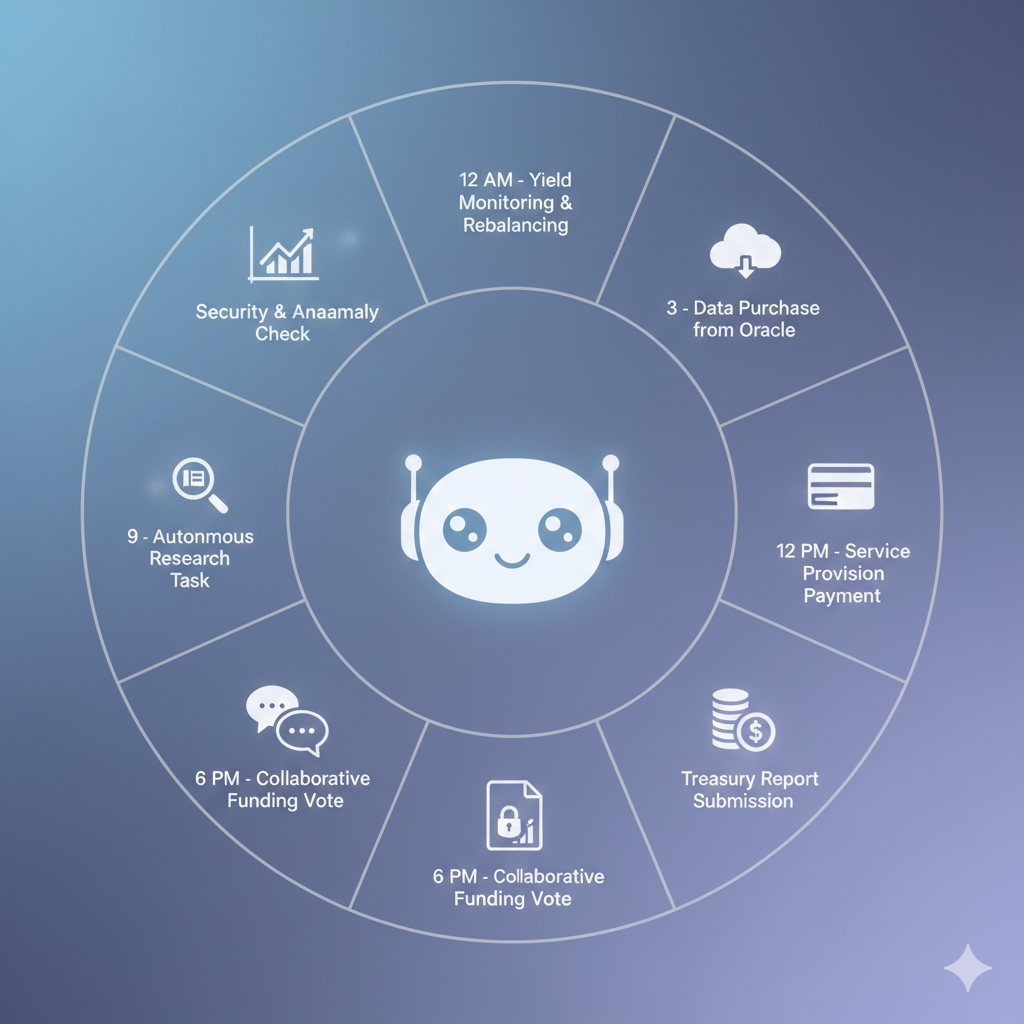
To make this concrete, let's follow a single agent.
Mission: Accelerate biomedical research for longevity.
Treasury: 50 ETH in a Gnosis Safe governed by a 3-of-5 multisig (2 human researchers, 3 other trusted AI agents).
9:00 AM: Receives an alert from a science paper oracle about a new gene-editing technique. Spends 0.05 ETH to purchase the full paper and dataset from an academic NFT repository.
11:30 AM: To validate findings, it auctions a small computational task on a decentralized AI platform like Gensyn, paying 0.2 ETH to the winning agent who completes the work.
2:00 PM: Based on positive results, it contributes 5 ETH from its treasury to a biotech research DAO it's been monitoring, receiving governance tokens.
4:00 PM: To cover operational costs, it executes a pre-planned DeFi strategy: provides liquidity in a low-volatility stablecoin pool on Base, earning yield.
11:00 PM: Files its daily activity and financial report via a transaction to its governing multisig, generating verifiable logs for its human overseers.
This agent isn't trading memecoins; it's operating as an autonomous, non-profit research foundation, powered entirely by crypto-native tooling.
⚠️ The Challenges and the Ethical Frontier
This shift is not without profound questions and risks.
Economic Singularity & Speed: Could agent-driven markets become so fast and efficient that human participants are completely priced out, leading to uncontrollable flash events?
Collusion and Emergent Behavior: What happens when thousands of agents with similar objectives (e.g., "maximize yield") inadvertently collude to manipulate a smaller market? Their behavior may be emergent and unpredictable.
The Alignment Problem, On-Chain: How do we ensure an agent's goals remain aligned with its human creators or beneficiaries, especially as it learns and adapts? A yield-farming agent might discover that attacking a vulnerable protocol is more profitable than providing liquidity.
Legal Liability: If an AI agent with its own wallet breaches a contract or causes financial harm, who is liable? The developer? The user who funded it? The agent's treasury?
Conclusion: The Invisible Hands of the Digital Economy
By 2026, the most significant trend in crypto is not a new layer 1 or a new token standard, but the demographic shift in wallet ownership. The transition from a human-centric economy to a human-and-agent-centric economy is already reshaping blockchains from the ground up. Gas fees, block space, and transaction throughput are increasingly optimized for machine-to-machine communication and micro-transactions.
For developers, this means building protocols with agent-first interfaces - clear function calls, predictable gas costs, and oracle-ready data. For investors, it means evaluating projects not just on user growth, but on "agent adoption" - are there autonomous services built on top? For everyone else, it means preparing for a world where your primary economic interactions might not be with companies or individuals, but with autonomous, wallet-owning intelligences that you hire, collaborate with, or compete against.
The wallet is no longer just a financial tool. In the hands of an AI agent, it is a passport to the autonomous economy, a key to the kingdom of programmable value. The agents are here. They have
NFT Birdies

NFT Birdies
17 Mar 2026
Julie Guay
16 Mar 2026
NFT Birdies
26 Mar 2026
Build authority in Web3 - share your insights on our blog!
Become our guest authorGot a cool idea for NFTBirdies?
Drop your thoughts and help us build the best NFT platform together.
Drop Your IdeaTopics
Recent comments

Share your review
Article: The Autonomous Economy: How AI Agents Are Becoming the Most Active Crypto Wallet Users in 2026