

NFT Birdies
21 May 2026
Tether Froze $1.4 Billion in Just Five Months: How USDT Can Become Untouchable
Introduction
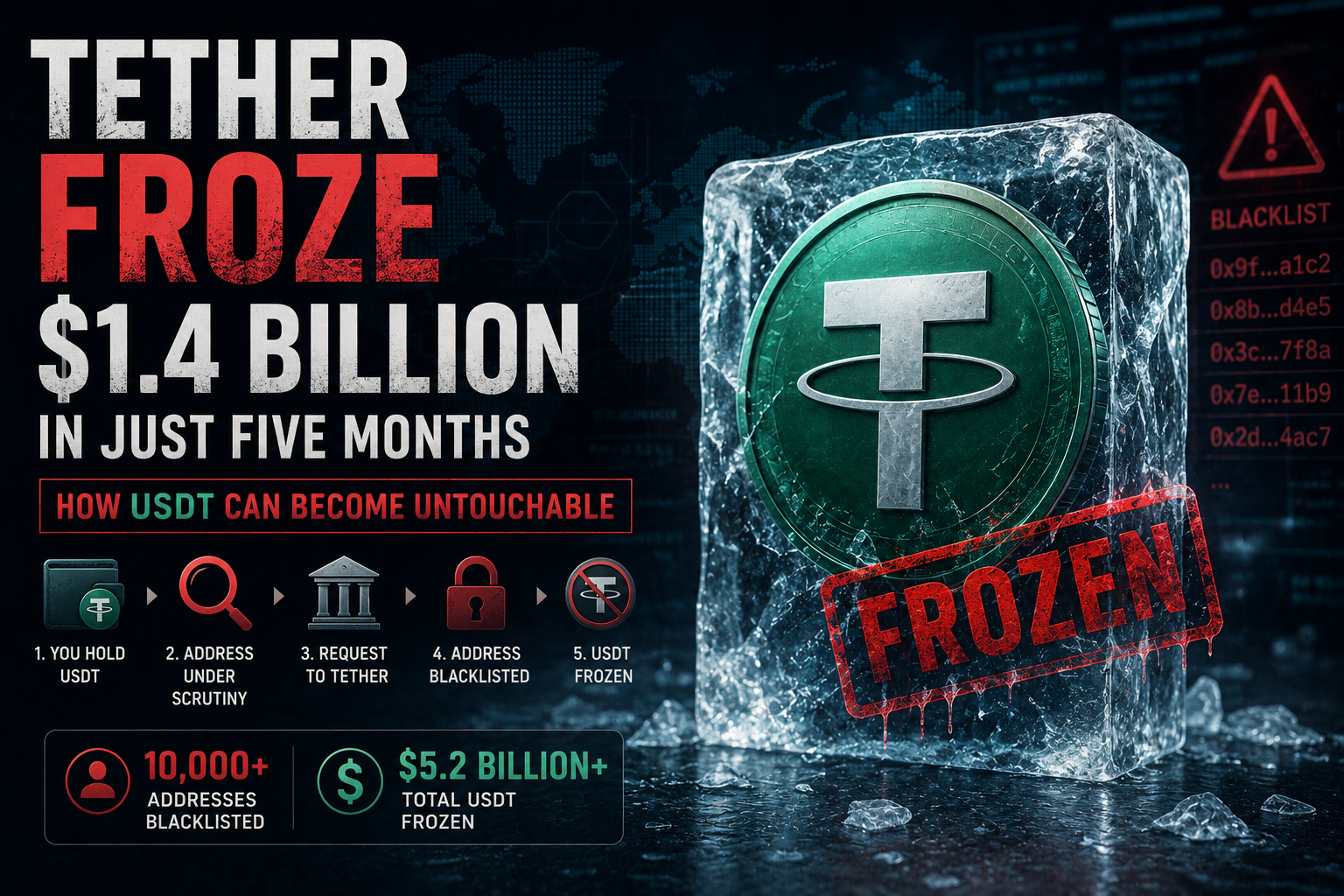
Stablecoins were originally designed to bring stability into the volatile world of cryptocurrencies. For millions of users, they became digital dollars — assets that can be transferred globally within seconds, used in trading, payments, and decentralized finance without the price swings associated with Bitcoin or other cryptocurrencies. Among all stablecoins, USDT by Tether remains the undisputed market leader.
However, the rapid growth of stablecoins has also highlighted a reality many crypto users overlook: not all blockchain assets operate under the same principles of ownership and control. While cryptocurrencies are often associated with decentralization and financial sovereignty, some digital assets maintain significant centralized oversight.
In 2026, Tether reportedly froze approximately $1.4 billion worth of USDT in just five months, setting a new record for asset freezes within the crypto sector. The numbers themselves are striking, but the larger question is what they reveal about how stablecoins actually function.
Understanding what happens during a USDT freeze provides a useful look into the balance between decentralization, regulation, and control within modern crypto markets.
How a USDT Freeze Happens
To many users, holding USDT feels identical to holding any other cryptocurrency. Tokens sit inside a wallet, appear on a blockchain explorer, and can be moved from one address to another. On the surface, the experience seems no different from holding Bitcoin or Ethereum.
The process changes when an address becomes subject to investigation or regulatory attention.
A typical sequence looks like this:
1. Funds sit inside a wallet
A user holds USDT on a blockchain address as usual.
2. The address comes under scrutiny
Several factors can trigger review:
Court orders
Sanctions compliance requirements
Exchange reports
Fraud investigations
Anti-money laundering monitoring
Law enforcement requests
Not every reviewed address belongs to a malicious actor. Investigations can involve broader networks of transactions or associated accounts.
3. A request reaches Tether
Unlike decentralized cryptocurrencies, USDT has a centralized issuer. Tether has authority over the token contract and can take action when it determines intervention is necessary.
4. The address enters a blacklist
Once an address is blacklisted, the smart contract blocks interaction with those USDT holdings.
5. The tokens remain visible — but become unusable
This is where many users misunderstand the process.
The tokens do not disappear.
Blockchain explorers still show the balance sitting at the address. The wallet itself continues functioning normally. Bitcoin, Ethereum, or other assets stored there remain unaffected.
Only the USDT becomes locked.
The funds effectively become immobile: they cannot be transferred, swapped, or used.
For the holder, the practical outcome can resemble having assets reduced to zero utility despite remaining visible on-chain.
The Scale of the Freeze Activity
The scale of recent freezes is substantial.
Current estimates suggest:
$1.4 billion frozen since the beginning of 2026
More than 10,000 blacklisted addresses
Over $5.2 billion in cumulative frozen USDT
These numbers illustrate how deeply stablecoins have become integrated into global financial and regulatory systems.
As crypto markets expand, regulators increasingly expect issuers to implement mechanisms for compliance and enforcement.
Tether argues that these actions help combat:
Money laundering
Terrorist financing
Sanctions evasion
Fraud
Stolen funds
Illicit activity
Supporters view freezing tools as essential for legitimacy and broader institutional adoption.
Critics see them as evidence that certain digital assets are far less decentralized than many users assume.
Why Tether Can Freeze Funds
The answer lies directly inside the token architecture.
USDT contains administrative functionality within its smart contracts that permits Tether to block or restrict specific addresses.
This capability is intentionally built into the system.
Only Tether controls access to these functions.
The mechanism exists because stablecoins occupy a unique position between traditional finance and decentralized networks. Unlike Bitcoin, which was designed specifically to avoid centralized control, stablecoins often require compliance features to satisfy regulators and financial partners.
The ability to freeze funds is therefore not a bug or exploit.
It is part of the intended design.
Why Bitcoin Works Differently
Comparisons between USDT and Bitcoin often create confusion because the two systems operate according to fundamentally different principles.
With Bitcoin:
There is no issuing company
No central authority exists
No administrator controls the network
No single entity can freeze addresses
Ownership is determined by private keys.
The common crypto saying, "Not your keys, not your coins," reflects this model. If users hold their own keys, they maintain direct control over their Bitcoin.
USDT functions differently.
There is an issuer responsible for maintaining the stablecoin ecosystem.
Because an issuing authority exists, ownership becomes partially dependent on that issuer's rules and infrastructure.
Users may control wallet access, but Tether still controls aspects of token behavior.
The Broader Debate: Security vs Decentralization
The discussion around freezing capabilities often splits the crypto community into two perspectives.
One side argues that some level of centralized control is necessary.
Without intervention mechanisms:
Stolen funds become harder to recover
Criminal activity becomes more difficult to combat
Regulatory approval becomes less likely
Institutional participation may decrease
The opposing argument focuses on financial autonomy.
If a third party can restrict access to assets, critics argue that users no longer possess full ownership in the traditional crypto sense.
Instead, they possess conditional access.
The debate ultimately reflects a larger question that has followed crypto since its beginning:
Should digital finance prioritize freedom above all else, or should it include safeguards similar to those found in traditional banking systems?
Stablecoins sit directly in the middle of that discussion.
What This Means for Crypto Users
The growth of stablecoins has transformed digital finance. USDT powers trading platforms, payment systems, decentralized applications, and global transfers at enormous scale.
Yet the mechanics behind these systems remain important to understand.
Holding USDT is not the same as holding Bitcoin.
One operates through decentralized consensus.
The other operates through a company-issued system designed with centralized administrative controls.
Neither model is automatically better or worse. Each introduces different trade-offs involving speed, stability, security, and autonomy.
As crypto continues moving toward broader adoption, understanding those differences becomes increasingly important.
Conclusion
The record $1.4 billion frozen by Tether within five months highlights a reality that many users discover only after entering the market: blockchain transparency does not always equal decentralization.
USDT remains one of the most important assets in crypto and has become critical infrastructure for global digital markets. But it also demonstrates that some blockchain assets function under rules very different from those of Bitcoin and other decentralized cryptocurrencies.
The lesson is not necessarily that stablecoins are dangerous or unreliable.
It is that digital ownership depends heavily on the architecture behind the asset itself.
Because in crypto, owning a token and controlling it are not always exactly the same thing.
NFT Birdies

NFT Birdies
27 May 2026


NFT Birdies
2 Mar 2026
Nora Daisy
22 Jul 2026

NFT Birdies
29 May 2026
Build authority in Web3 - share your insights on our blog!
Become our guest authorGot a cool idea for NFTBirdies?
Drop your thoughts and help us build the best NFT platform together.
Drop Your IdeaTopics
Recent comments

Share your review
Article: Tether Froze $1.4 Billion in Just Five Months: How USDT Can Become Untouchable