

NFT Birdies
17 Dec 2025
Social NFTs: The Rise of Tokenized Social Media Content

Web3 social networks are redefining how creators share and monetize content. Unlike Web2 platforms, blockchains let users own their data, profiles and posts via wallet identities. These “Social NFTs” or on-chain tokens allow posts, memes or profiles to become collectible assets, and they come with native crypto mechanics for tipping, airdrops and token-gated access. This creator-focused model is booming: one report projects Web3 social could grow from ~$7.2 billion in 2024 to nearly $471 billion by 2034, noting that Lens Protocol and Farcaster already “boast 10 million daily active users”. In short, decentralized social promises user-owned networks (not walled gardens) with built-in NFT and token features. Key differences from Web2 include:
True ownership & portability: Creators and fans hold profiles and content in their wallets, so their social graph can move across dApps. For example, Lens Protocol’s team talks about “empowering creators to own the links between themselves and their community”.
Built-in crypto mechanics: Posts can embed on-chain actions – NFT mints, polls, or purchases – without third-party tools. Tipping, subscriptions and royalties are native, so creators earn on every trade or reshare automatically.
Transparency & trust: On-chain content is censorship-resistant. Platforms can use wallet analytics instead of opaque algorithms to measure engagement. Creators and brands see exactly which addresses interacted (no fake likes).
Creator-driven communities: Independent makers (artists, influencers, writers, meme-creators) build tokenized fan economies. Social NFTs and tokens give them direct revenue channels beyond ads and sponsorships.
Web3 Social Platforms and Networks
Blockchain projects are launching decentralized social protocols to rival Twitter and Facebook. These platforms turn social features into blockchain-enabled services (often called SocialFi). Below are some leading examples:
Lens Protocol – Modular Creator Graph
Lens Protocol is a decentralized social graph built on Polygon, where user profiles and posts are NFTs you truly own. Lens lets users mint a unique “.lens” handle (as an NFT) and write posts on a blockchain backend, not a server. Profiles on Lens are portable: if you switch apps (e.g. from Lenster to Lenstube) your followers and content move with you. Lens v2 even separates handles and profile NFTs so your network stays with your identity. Key features include:
NFT Usernames: Every username on Lens is a tradable NFT. You can sell or transfer your handle while keeping your content and followers intact.
Composable Social Graph: Lens feeds and follows are public on-chain. Other apps can read your profile, so the social graph is open and interoperable.
On-chain Actions: Lens recently introduced “Open Actions” – buttons in posts that trigger on-chain events (like “Buy NFT Ticket” or “Join DAO”). This makes posts interactive, e.g. you could mint or trade an NFT directly from a Lens feed.
Creator Tools: Many Lens-based dApps exist (Lenster for microblogging, Lenstube for videos, etc.) to help creators tokenize content and run NFT drops without coding.
Farcaster – Ethereum-native SocialFi
Farcaster is a decentralized social network built on Ethereum (via Optimism) by ex-Coinbase engineers. Users connect with an Ethereum wallet instead of a central account, so they own their identity and data. Farcaster emphasizes tokenized interactions – it has its own tip token ($DEGEN) and community reward token ($WARPS) built in. Unique aspects of Farcaster include:
Frames (Mini-Apps): Posts on Farcaster (called “casts”) can include Frames – small web apps that let readers perform actions (vote polls, mint NFTs, make purchases) right in the feed. For example, a Farcaster post could embed a button to mint an NFT art piece on the spot.
Decentralized Data: Profiles and follows are anchored on-chain. Farcaster uses smart contracts for user identities and peer-to-peer “hubs” for scalability, keeping user data in the user’s control. You can switch between Farcaster clients (Warpcast, Supercast, etc.) without losing your audience.
Crypto Tipping & Rewards: Farcaster natively supports crypto micro-payments. Fans tip creators in $DEGEN, and active users earn $WARPS by contributing. This on-chain economy aligns incentives in ways Web2 can’t.
Privacy & Identity: Farcaster leverages ENS and wallet keys for identity. Users stay pseudonymous if they choose, but at least their on-chain history is transparent.
friend.tech – Share Trading for Social Capital
friend.tech is a novel SocialFi app on Base (Coinbase’s Ethereum L2) where you trade shares of people. Each user has a set of “social tokens” (like personal NFTs); other users buy or sell those tokens as a bet on that person’s influence. In practice: you put ETH into someone’s “address” to buy shares; the price rises with demand. Key points:
Trading Social Worth: friend.tech’s slogan is “Your network is your net worth.” It lets anyone buy shares in others. (E.g. “I believe influencer X will rise, so I invest in their token.”) Early data show thousands of ETH traded daily.
Creator Revenue: Whenever a user’s token is traded, a percentage fee goes to that user. In other words, an influencer earns whenever their own shares trade. As friend.tech says, “the attention that you command directly correlates to how much you make”. This novel royalty model turns popularity into real income.
Private Access: Buying a share also unlocks a private chat with that user. So tokens aren’t just speculating on fame – they give holders exclusive communication (though replies aren’t guaranteed).
Viral Growth: Launched in August 2022, friend.tech quickly drew huge volume (millions in ETH) and set Base’s activity records. Its invite-only model (users share limited access codes) and air-drop bait fueled rapid adoption.
Other Emerging Web3 Social Platforms
Beyond those, many niche projects explore social tokens and NFTs:
Bluesky (AT Protocol): A decentralized microblogging network (a Twitter alternative) where apps interoperate on a shared protocol. It’s early-stage but aims to give users control over their data.
Audius: A blockchain-based music network where artists upload songs, earn tokens, and even release music as NFTs. Fans can link wallets to unlock exclusive tracks and rewards.
Mirror: A decentralized blogging/publishing platform where writers can mint posts as NFTs and crowdfund stories. For example, a writer can raise funds via an “author token” or NFT editions of an article.
Steemit/BitClout (DeSo): Earlier blockchain social media built on its own crypto (Steem or $Clout). These let users tip posts with platform tokens and trade creator coins. BitClout in particular let anyone speculate on creators (similar to friend.tech’s concept) and display NFTs on profiles.
Mastodon/Fediverse: Not token-based per se, but worth noting as federated social (each server admin controls rules). Some crypto-friendly Mastodon instances may integrate tokens or NFT profile pics in future.
How Creators Monetize Content Through Tokens
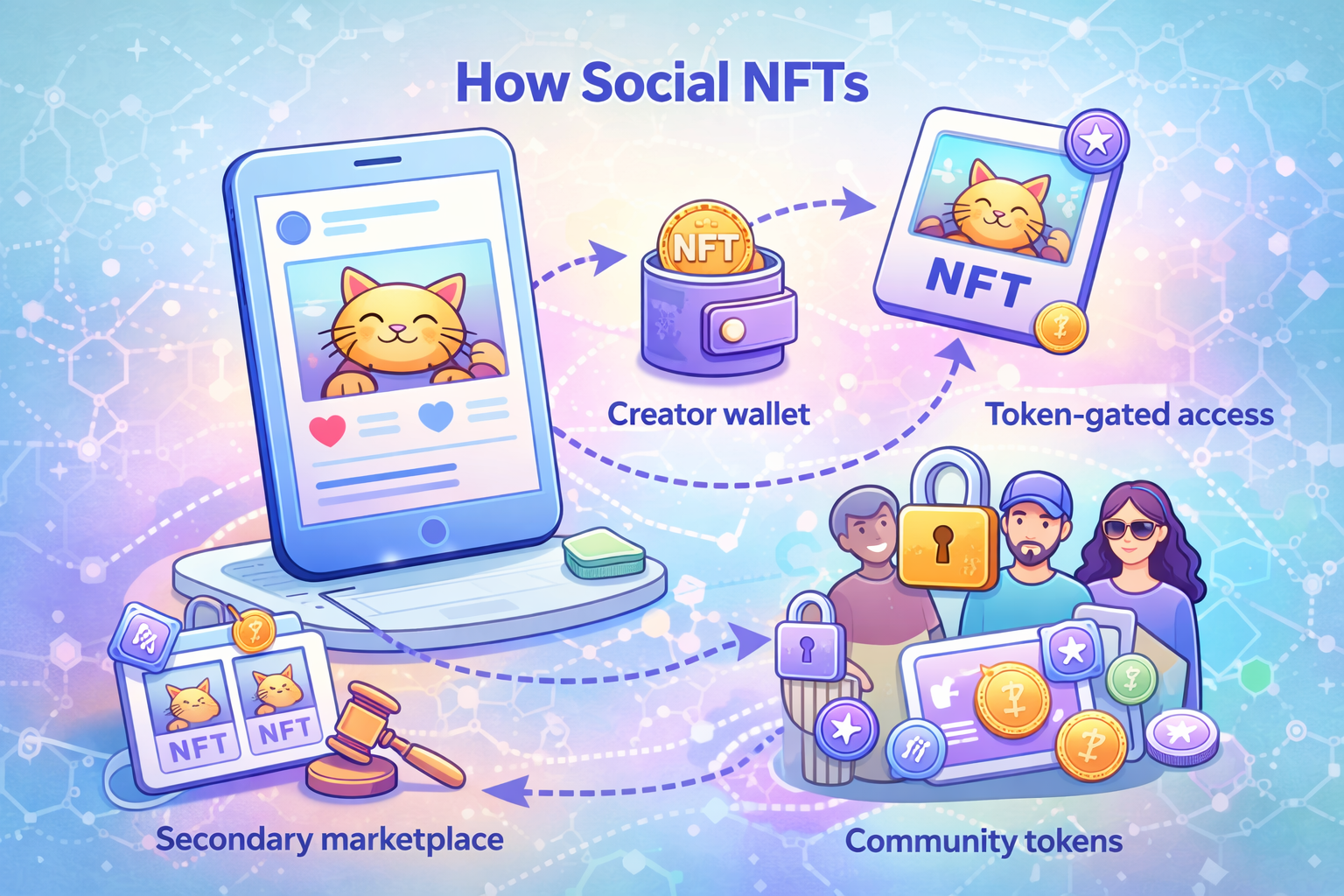
Web3 social networks open up new monetization tools for independent creators (influencers, artists, meme-makers, writers, etc.). Instead of relying solely on ads or brand deals, creators can earn directly from their audience via tokens and NFTs. Common strategies include:
Minting Content as NFTs: Creators turn unique content into collectibles. For example, an influencer might mint a viral TikTok or a meme as an NFT to sell. These NFTs can be sold at auction or set with creator royalties. Even chat clips and personal moments become digital collectibles.
NFT-Gated Access & Memberships: NFTs act as membership passes. For instance, a limited NFT series could grant holders entry to a private Discord, Telegram group or live event. Each NFT holder becomes part of an exclusive community. Creators often reward token holders with backstage content or direct input (e.g. voting on future projects). Artist RAC’s token ($RAC) is distributed to fans giving them access to private chats and exclusive drops.
Personal Social Tokens: Some creators issue their own fungible tokens. Fans buy these to support the creator and receive perks. For example, musician RAC launched $RAC (which is earned by Patreon support) so fans earn the token and get private Discord access. Soccer star Keisuke Honda created KSK Honda Coin, granting token holders exclusive video updates and private conversations with him. Similarly, esports team Gen.G’s Strike Coin lets holders join private chats with players and vote on team decisions. These tokens turn fans into investors who share in the creator’s growth.
On-Chain Tipping & Payments: Web3 platforms have built-in tip features. For instance, Farcaster allows direct crypto tips ($DEGEN) on posts. Creators can also link payment addresses for donations or subscriptions. Unlike traditional Patreon, tips are transparent and can happen within the feed.
NFT Royalties: NFTs have programmable royalty splits. This means if a creator sells an NFT of their content, they can earn a percentage of every future resale on the secondary market. For example, every time Gary Vaynerchuk’s VeeFriends NFT is resold, 10% automatically returns to him. This creates ongoing revenue from a one-time post or drop.
Brand Collaborations as NFTs: Creators use tokenized content in sponsorships. An influencer might “tokenize a sponsored post” as an NFT and give it exclusively to the brand. This turns each campaign into a limited digital collectible. Brands and creators have co-launched NFT drops as part of social campaigns, turning promotion into a shareable asset.
Brands and Campaigns Embracing Social NFTs
Not just individuals - brands are experimenting with tokenized social media for marketing and engagement. Some examples:
Starbucks Korea: Launched an eco-friendly campaign where customers earned “Eco Stamps” for using reusable cups, unlocking limited NFTs themed “My Own Cup”. Over 1,800 outlets took part. The NFTs served as digital rewards and social media shareables to promote sustainability.
Australian Open (Tennis): Created the AO Art Ball NFT collection – 6,776 generative art pieces linked to live match data. Each token corresponded to a segment of the tennis court, and holders received priority tickets and special rewards. The project tied real-time sports with NFTs, rewarding fans with unique collectibles and perks.
Japan Airlines (JAL): Partnered with ad agency Hakuhodo on “KOKYO NFT,” tokenizing unique experiences across six regions of Japan (like personal fireworks displays, rare sake tastings). They released dynamic origami-themed NFTs via social campaigns. The campaign aimed to strengthen tourism by turning local culture into shareable digital assets.
Celebrity Tokens: Athletes and celebrities issue social tokens. Soccer legend Keisuke Honda’s KSK Honda Coin grants fans private chats and exclusive updates. Esports giant Gen.G’s Strike Coin lets fans vote on jersey designs and access team Discords. These brand tokens engage communities by giving holders a stake in decisions and insider access.
These cases show diverse uses: coffee brands, sports events, airlines and entertainers are all leveraging NFTs and tokens in social marketing. They convert campaigns into ongoing communities with tradable digital badges.
Challenges: Spam, Identity & Moderation
Despite the promise, Web3 social faces growing pains. Open, permissionless networks can attract spam, bots and abuse if left unchecked. For example, Lens Protocol already hosts over 65,000 profiles and 300,000 posts. The Lens team warns that “uncontrolled spam and bots” could “blemish user experiences, erode trust, and compromise safety”. To address this, they helped launch CultivatorDAO – the first decentralized moderation DAO for social media. CultivatorDAO maintains community-driven “spam” and “verified” lists: users and developers can opt into its filters to hide low-quality content. This illustrates one approach: community curation and on-chain voting to moderate content without a central authority.
Identity is another thorny issue. Most Web3 profiles are just wallet addresses or pseudonyms. While this preserves privacy, it means users aren’t easily verified. In theory, every on-chain identity carries a public transaction history, so misbehavior could leave a “negative reputation” trail. But wallets alone can’t prove real-world identity, so trust must come from cryptographic proofs or optional verification. Some projects are exploring zero-knowledge methods or decentralized ID standards to link real people to chains without sacrificing privacy. For now, Web3 social often relies on community trust and wallet reputation systems.
Content moderation remains a key concern. Unlike centralized platforms (which impose community guidelines), decentralized networks can’t unilaterally censor. This allows free expression but raises risk of hateful content, scams or misinformation. Innovations are emerging to tackle this: for instance, Farcaster hackathon teams have built AI-driven tools to detect spam. The “Farcaster Content Cop” project uses on-chain AI to analyze posts for spam or unethical content, demonstrating how decentralized AI could help automate moderation while keeping it transparent. Ultimately, many agree that Web3 social will need a mix of on-chain governance (DAOs), community curation (like CultivatorDAO), and possibly AI/heuristic tools to keep platforms healthy and safe.
The Future of Tokenized Social Media
Social NFTs and tokenized content are still in early stages, but they point toward a new social media paradigm. Independent creators now have powerful tools to reclaim ownership and revenue – they can mint posts as NFTs, sell access via tokens, or earn royalties on reshares. At the same time, brands and networks are learning to integrate blockchain into campaigns in creative ways. Popular Web3 social projects (Lens, Farcaster, friend.tech, etc.) are attracting real users and developers who build on their open protocols.
Challenges like spam, identity and moderation will require innovative solutions (as outlined above), but the community is actively addressing them. If these platforms mature, we may see a shift where social media emphasizes ownership, transparency and creator incentives. In summary, the rise of Social NFTs represents an experiment in blending social networking with blockchain finance — a creator-centric wave that could reshape how we share and consume content online
NFT Birdies

NFT Birdies
17 Mar 2026
NFT Birdies
26 Mar 2026
Build authority in Web3 - share your insights on our blog!
Become our guest authorGot a cool idea for NFTBirdies?
Drop your thoughts and help us build the best NFT platform together.
Drop Your IdeaRecent comments

Share your review
Article: Social NFTs: The Rise of Tokenized Social Media Content