
NFT Birdies
11 Mar 2026
No-Code vs. Pro-Code in Web3: How Non-Developers Are Shipping Real Products
For the better part of a decade, building on Web3 meant one thing: you wrote Solidity, or you went home. The barrier to entry was not merely high; it was, for the vast majority of people, insurmountable. Launching a decentralized application required assembling a team of blockchain engineers commandering six-figure salaries, navigating the labyrinthine complexities of smart contract audits, and spending months wrestling with toolchains that seemed designed to repel all but the most determined specialists. The ethos of Web3 promised permissionless innovation, yet the reality was that the means of production remained firmly in the hands of a technical priesthood. If you could not code, you could not create.
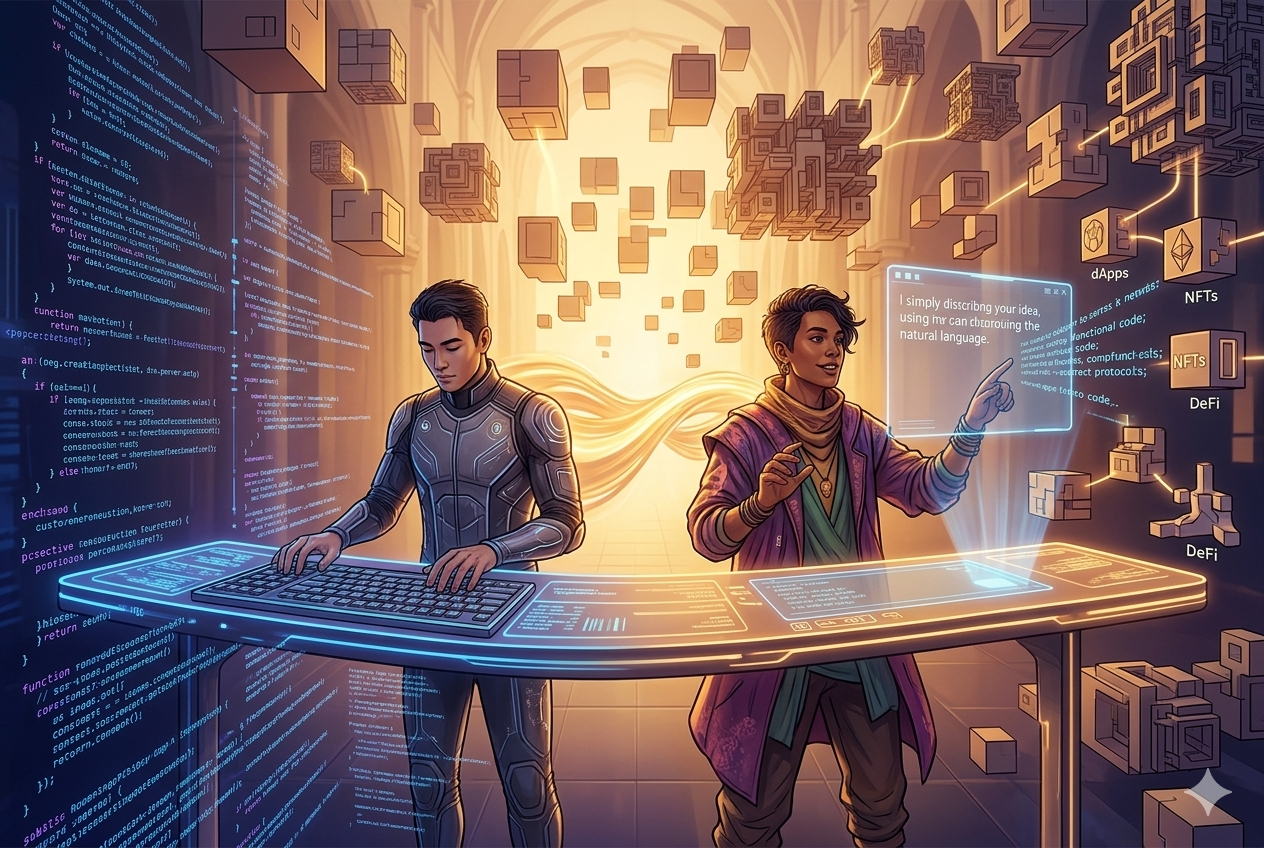
That era is ending. The year 2026 marks a profound inflection point in who gets to build on decentralized networks. A new generation of tools—spanning AI-native development platforms, visual no-code builders, and sophisticated marketplaces for production-ready code—is systematically dismantling the barriers that have long excluded non-developers from meaningful participation. The result is a Cambrian explosion of creativity, as founders, artists, and entrepreneurs who could never before touch a smart contract are now shipping real products that hold real value. This is not about replacing professional developers; it is about expanding the definition of who can be a builder, and in doing so, fundamentally reshaping the Web3 landscape.
The Historical Divide: Why Building Meant Coding
To understand the magnitude of what is happening, we must first appreciate the constraints that defined Web3 development for so long. At the heart of every decentralized application lies the smart contract—a piece of code that, once deployed, cannot be altered, and that often controls significant financial value. This immutability and this value created a culture of extreme caution and extreme expertise. Writing a correct smart contract meant understanding not just the syntax of Solidity or Rust, but the deep idiosyncrasies of the Ethereum Virtual Machine, the attack vectors catalogued in the Smart Contract Weakness Classification registry, and the gas optimization techniques that could mean the difference between a usable application and one that costs users a fortune.
The financial numbers underscored the exclusivity. Experienced Solidity developers commanded hourly rates between $150 and $300. A production-ready DeFi application could easily cost between $100,000 and $300,000 to develop, with audits alone adding anywhere from $10,000 for simple contracts to over $100,000 for complex protocols . These figures assumed a smooth process; one mistake, one overlooked vulnerability, and the costs multiplied alongside the risk of catastrophic loss. For the vast majority of people with good ideas but without technical backgrounds, the economics simply did not work.
This created a landscape where innovation was bottlenecked by developer supply. The same patterns—token launches, staking mechanisms, NFT mints—were reimplemented countless times, each iteration consuming engineering resources that could have been directed toward novel experimentation. The industry spoke of composability, but in practice, most teams were rebuilding the same lego bricks from scratch.
The Vibe Coding Revolution Comes to Web3
The breakthrough began on the traditional web development side, with what some have termed the "vibecoding" movement—the ability to generate fully functional applications from natural language prompts using AI. Platforms like those described in the CoinGecko ecosystem demonstrated that one could build a Solana token discovery application simply by describing what one wanted in plain English: "Build a Solana token discovery web app... with filters for low market cap, high volume, and trending tokens" . The AI handled the API integrations, the frontend rendering, and the deployment, compressing weeks of work into minutes.
Yet for a long time, this revolution bypassed Web3. The complexity of smart contracts, of wallet integrations, of on-chain state management, remained beyond the reach of these tools. That gap has now been closed. The launch of platforms like Sonic Labs' Spawn represents the arrival of true Web3-native AI development. Spawn is an end-to-end AI-powered builder that takes natural language descriptions and generates complete decentralized applications: smart contracts, compilation, deployment to testnet, and a fully functional frontend with wallet integration baked in . Describe a "coin flip game where players wager S tokens" or "an NFT collection with a public mint," and minutes later, you have a live application.
What makes Spawn significant is not merely the code generation, but the conversational interface through Spawny, an integrated AI agent that allows users to iterate on their applications through natural language chat. Refine the user interface, adjust the game logic, add new features—all without ever touching a line of code . The platform deploys to Sonic, an EVM-compatible Layer 1 blockchain capable of up to 400,000 transactions per second with sub-second finality, ensuring that the applications generated are not just prototypes but scalable, production-ready experiences . The demonstration at ETHDenver 2026—a fully playable Snake game with an on-chain leaderboard generated from a single prompt—was not a parlor trick. It was a proof point that the abstraction layer has finally arrived.
This pattern is being replicated across the ecosystem. Platforms like Noah AI enable similar natural-language development for Solana, Celo, and other chains, integrating seamlessly with data sources like the CoinGecko API to create rich, data-driven applications without manual coding . CodeXero, built by Cluster Protocol, positions itself as a "Liberation Engine for Decentralized Wall Street," allowing users to describe ideas and receive deployed dApps on the Sei Network, with the added twist that applications can "self-evolve" and become smarter with each new prompt . These are not isolated experiments; they are the leading edge of a structural shift.
The Market Alternative: Buying Production-Ready Code
Alongside the AI-native builders, a parallel ecosystem has emerged around the commercialization of existing code. The insight here is simple yet powerful: for the vast majority of applications that implement proven patterns—token launches, staking platforms, DEX deployments, NFT marketplaces—custom development represents capital and time misallocated. Why rebuild what has already been built securely and tested in production?
Platforms like Web3.Market have emerged to address this need, offering curated marketplaces where developers and founders can purchase production-ready smart contract and dApp templates . Unlike the fragmented and variable-quality code found on open repositories like GitHub, these commercial listings come with documentation, deployment instructions, clear licensing terms, and often, a history of prior audits. The difference between code that compiles and code that is ready for mainnet deployment is vast. Production-ready code includes reentrancy protection, access control patterns, emergency pause functionality, gas optimization, upgrade paths, and integration points for wallets and oracles . Acquiring such code off-the-shelf can reduce development costs by ninety percent or more, compressing timelines from months to days.
The build-versus-buy decision, long familiar in traditional software development, has now entered Web3 with full force. Smart teams are treating it as a portfolio allocation: commodity functionality is purchased, while true differentiation—the novel economic mechanism, the unique user experience—is built in-house. A staking contract that follows established patterns can be acquired for a few hundred dollars, freeing up tens of thousands in development budget to be directed toward the features that actually set a project apart . This is not laziness; it is capital efficiency. It is the recognition that in a competitive landscape, speed to market and focused resource allocation often matter more than NIH syndrome.
The Infrastructure Layer: What Makes It Possible
Underpinning both the AI-native builders and the code marketplaces is a mature infrastructure stack that has standardized much of what was previously bespoke and brittle. Node infrastructure providers like Alchemy and QuickNode have abstracted away the complexities of RPC management. Development frameworks have consolidated around industry standards: Hardhat for the JavaScript ecosystem, Foundry for those prioritizing speed and native fuzzing in Rust . Security analysis tools like Slither and Mythril can be run automatically against any code, catching common vulnerabilities before they ever reach an auditor.
Perhaps most importantly, the emergence of platforms like WalletKit, born from the team that built Robinhood Wallet, is addressing the user experience gap that has long plagued Web3 adoption. WalletKit provides simple HTTP APIs that abstract away the entire complexity of wallets, tokens, and NFTs . A developer building a rewards program no longer needs to worry about which chain to pick, how users will manage private keys, or the intricacies of gas management. They simply call an API, and WalletKit handles the rest, complete with a dashboard for managing all app-related digital assets. This is infrastructure designed for the mass adoption era, where the goal is to make decentralized features indistinguishable from any other web service.
The Security Imperative: No Free Lunches
It would be irresponsible to suggest that these new tools eliminate the need for security diligence. If anything, they shift the burden. AI-generated smart contracts can contain subtle logic errors, unsafe upgrade paths, or permissioning oversights that are not obvious to the non-technical user who prompted them into existence . Production-ready code purchased from a marketplace may have been audited, but the integration of that code into a larger system introduces new attack surfaces. The most dangerous code is often not the code that is obviously malicious, but the code that no one has examined carefully.
The industry response has been a layered approach to security that accommodates these new creation methods. Automated scanning tools can now analyze contracts for over a hundred vulnerability patterns in minutes . These are followed by human audits that examine economic logic and incentive structures. For projects built from templates or AI generation, the audit scope can be narrowed to the modifications and integration points, reducing both cost and timeline. Continuous monitoring and bug bounty programs through platforms like Immunefi provide ongoing coverage after deployment . The message is clear: these tools lower the barrier to creation, but they do not lower the standard for safety. Anyone shipping value must still verify, test, and protect.
The Cultural Shift: Non-Technical Professionals Enter Web3
The democratization of building is occurring alongside a parallel democratization of Web3 careers more broadly. The industry has matured to the point where technical skills, while still valuable, are no longer the sole gateway to participation. Marketing, business development, legal and compliance, community management—these functions are now recognized as critical to success, and the professionals filling them increasingly come from traditional backgrounds rather than crypto-native origins .
As Fernando Lillo Aranda, Chief Marketing Officer at Zoomex, observes: "The Web3 industry has become significantly more mature, and that is a very good sign. This technical revolution no longer relies solely on developers. It needs many non-technical professionals to expand its visibility, usage, and reach" . The complexity of the technology is increasingly abstracted away by the very tools we have been discussing, allowing these professionals to focus on what they do best: building brands, forming partnerships, and creating user experiences that resonate with mainstream audiences.
The transparency inherent in blockchain also creates new forms of professional reputation. On-chain activity—contributions to protocols, governance participation, NFT ownership—serves as a verifiable record of expertise that complements or even supersedes the traditional resume . In a industry built on the principle of "don't trust, verify," the ability to examine a person's on-chain footprint provides a form of due diligence that no PDF resume can match. The ideal candidate in 2026 is a hybrid: the discipline and structure of a Web2 professional combined with the practical, on-chain experience of a crypto native.
The Practical Middle Ground
For all the excitement around no-code and AI-powered development, the most successful organizations are not abandoning professional engineering. They are adopting what Dorian Vincileoni, Head of Regional Growth at Kraken, describes as a "practical middle ground" . The extreme vision of fully decentralized, code-only organizations has given way to a more balanced approach that combines the flexibility and incentive alignment of Web3 with the accountability and structure necessary to operate at scale.
This means that professional developers remain essential. They are the ones building the novel primitives, the ones auditing the AI-generated code, the ones architecting systems that can handle millions of users. But they are no longer the only ones in the room. The non-technical founder who could once only dream of launching a token can now do so. The artist who wants to create a dynamic NFT collection without learning Solidity can now realize that vision. The community builder who understands what their members need can now deploy the tools to serve them.
Looking Forward: The Unbundling of Development

What we are witnessing is the unbundling of the development process. The monolithic role of "the blockchain developer" is fragmenting into specialized functions, many of which can now be performed by non-coders or by AI assistants. The ideation phase, the prototyping, the assembly of standard components, the testing, the deployment—each of these can now be handled by different tools and different people.
The implications for innovation are profound. When the cost of experimentation falls to near zero, the volume of experiments increases exponentially. Most will fail, as most experiments always do. But the ones that succeed will come from a much wider pool of creativity than when development was the bottleneck. They will come from founders who understand user needs but never wrote a line of code. They will come from artists who understand aesthetics and community but never deployed a contract. They will come from the billions of people who have been excluded from the means of production in the digital economy, finally able to participate in building the next internet.
The tools have arrived. The question now is what we will build with them.
NFT Birdies
NFT Birdies
31 Mar 2026
NFT Birdies
30 Mar 2026
NFT Birdies
26 Mar 2026
Build authority in Web3 - share your insights on our blog!
Become our guest authorGot a cool idea for NFTBirdies?
Drop your thoughts and help us build the best NFT platform together.
Drop Your IdeaRecent comments

Share your review
Article: No-Code vs. Pro-Code in Web3: How Non-Developers Are Shipping Real Products