

NFT Birdies
20 Nov 2025
🚀 NFT Airdrop Strategies 2025: The Ultimate Guide to Building Unstoppable Hype Before Your Drop
Let's be real: the days of slapping together a mediocre NFT collection and watching it sell out in minutes are long gone. The market in 2025 is smarter, more competitive, and utterly saturated. So, how do you cut through the noise and make sure your project doesn't become just another line on a failed projects list?
The answer lies in one of the most powerful, yet most misunderstood, tools in a creator's arsenal: The Strategic Airdrop.

An airdrop isn't just a "free giveaway." In the hands of a savvy creator, it's a precision instrument for community building, hype generation, and long-term loyalty. It's the difference between launching to crickets and launching to a roaring crowd of dedicated fans. Let's break down how to master the art of the airdrop in 2025.
💡 The Modern Airdrop Playbook: Moving Beyond "Free Stuff"
Forget the 2021 model of airdropping tokens to random wallets. That attracted mercenary capital and ghost communities. The 2025 airdrop is about rewarding genuine contribution and building a narrative.
Here are the most effective models that are working right now:
1. The "Proof-of-Community" Airdrop (The Gold Standard)
This isn't about who has the most wallets; it's about who adds the most value.
How it works: You airdrop NFTs or tokens to users who complete specific, meaningful tasks.
Example Tasks:
Creating and sharing high-quality memes about your project
Writing a genuine blog post or thread about your project's lore
Consistently providing help and answers in your Discord server
Creating fan art or music inspired by your collection
Why it works: It directly incentivizes the kind of behavior that builds a strong, organic community. You're not just rewarding activity; you're rewarding value creation.
2. The "Loyalty Layer" Airdrop (For Existing Communities)
This is perfect if you already have a collection and are building a sequel or a new ecosystem.
How it works: You airdrop the new asset to proven holders of your original collection. The snapshot is based on how long they've held the asset or how many of your assets they possess.
Why it works: It rewards your most loyal supporters, the "day ones," and makes them feel valued. This dramatically increases the chance they'll support your new venture. It turns customers into evangelists.
3. The "Collaborative Cross-Pollination" Airdrop
This is a masterstroke for tapping into a new, relevant audience.
How it works: You partner with another, non-competing NFT project. You airdrop a special role or a unique asset to their holders, and they do the same for yours.
Example: A PFP project partners with a DeFi protocol. The PFP project airdrops a "DeFi Enthusiast" role to the protocol's users, and the protocol airdrops a small reward to the PFP holders.
Why it works: It’s a win-win. You get exposure to a pre-vetted, Web3-native audience that you know has a high propensity to collect, all while adding immediate utility to your own collection.
4. The "Quest-Driven" Airdrop (The Web3 On-Ramp)
This uses platforms like Galxe, Layer3, or Guild to create a structured onboarding journey.
How it works: Users complete a series of tasks (e.g., "Follow us on Twitter," "Join our Discord," "Mint a testnet NFT") to earn points or an "OAT" (On-Chain Achievement Token). The top performers or all completers receive the airdrop.
Why it works: It gamifies the onboarding process, filters for users willing to put in effort, and provides a clear, verifiable path to earning a reward.
🛡️ Fort Knox Your Airdrop: How to Avoid Sybil Attacks and Attract Real Humans
This is the biggest challenge. How do you reward real people and not bots? Here is your 2025 defense toolkit.
The Verification Stack:
Sybil-Resistant Quest Design: Instead of "Join Discord," make the task "Introduce yourself in the #general channel and reply to two other people." Bots can join, but they can't hold conversations.
Token-Gating & Holder Snapshots: Use tools like Collab.Land or Guild to verify that a user holds a specific asset before they can even see the airdrop tasks. This immediately raises the barrier to entry.
Behavioral Analysis: Look for on-chain signals of a real user, not a farmer.
Wallet Age: Is the wallet more than 30 days old?
Diverse Activity: Has the wallet interacted with more than just airdrop contracts? Have they bought NFTs, used DeFi, or sent funds to friends?
POAP & OAT History: Does the user have a history of participating in other community events? This is a strong positive signal.
The "Humanity" Check: Emerging solutions like Worldcoin or BrightID offer proof-of-personhood verification. While not yet mainstream, they represent the future of sybil-resistant distribution.
Manual Review & KYC (For High-Value Drops): For a massive, life-changing airdrop, some projects are now implementing KYC (Know Your Customer) to ensure one person, one wallet. It's controversial but effective.
The Golden Rule: Make it more expensive for a bot farm to cheat than the potential reward is worth. By layering these strategies, you create a system that is simply not cost-effective to game at scale.
🏆 Hall of Fame: Case Studies of Airdrop Mastery
Let's look at projects that absolutely nailed it and what we can learn from them.
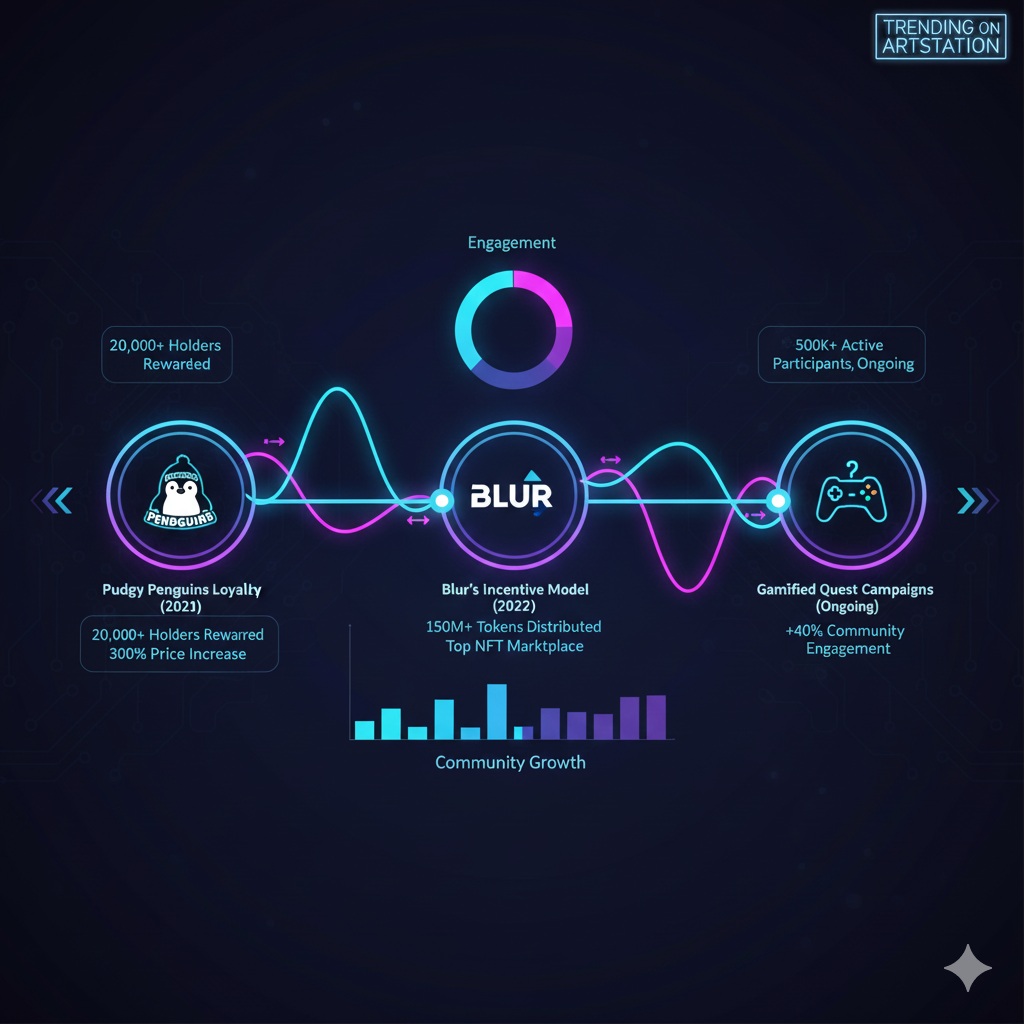
Case Study 1: Pudgy Penguins & Penguin Pass
The Strategy: Loyalty Layer + Proof-of-Community
Pudgy Penguins, after its revival, airdropped "Penguin Pass" NFTs to its holders. This pass granted access to IRL events, exclusive drops, and the broader "Pudgy Media" ecosystem.
The Result: It supercharged holder loyalty, creating a powerful feedback loop. Holding a Penguin wasn't just about the PFP; it was an access key to a growing world, making holders less likely to sell and more likely to promote.
Case Study 2: Blur's Incentivized Airdrop
The Strategy: A multi-season, behavior-based airdrop.
Blur didn't just airdrop once. They announced a multi-season points system where users earned points for listing, bidding, and loyalty. This wasn't a secret; it was a transparent game.
The Result: It completely disrupted the NFT marketplace landscape by strategically incentivizing the exact behavior that would build its liquidity (bidding and listing). It attracted real, active users, not passive farmers.
Case Study 3: A New Project's Quest-Based Launch
The Strategy: Quest-Driven Airdrop on Galxe.
A hypothetical new "CyberSamurai" project creates a Galxe campaign with tasks: follow on Twitter, join Discord, create a tweet with a specific hashtag, and mint a free testnet "training sword" NFT.
The Result: They onboard 5,000 users who have all actively engaged with the brand. They have a Discord full of people who have already done something for the project, creating a foundation of engaged, rather than passive, members.
🎯 Your Pre-Drop Airdrop Checklist: A 10-Point Plan
Ready to launch your own? Run through this list first:
Define Your Goal: Is it community size? Liquidity? Loyalty? Every decision flows from this.
Choose Your Model: Proof-of-Community? Loyalty Layer? Pick the one that aligns with your goal.
Design Sybil-Resistant Tasks: Make them require genuine human effort and creativity.
Set Clear, Transparent Rules: How many people will win? What are the exact tasks? Announce this publicly.
Choose Your Tech Stack: Will you use Guild for roles, Galxe for quests, a custom snapshot tool?
Create the Narrative: Frame the airdrop not as a "giveaway" but as an "earned reward" for early believers.
Promote the Mechanism, Not Just the Prize: Talk about the journey of becoming a part of your community.
Plan for Post-Airdrop Engagement: What happens after they get the NFT? How do you keep them engaged?
Be Prepared for Support: Have a FAQ ready and mods in Discord to handle questions.
Say Thank You: Genuine gratitude goes a long way in Web3.
The Bottom Line: Airdrops are About Building, Not Buying
In 2025, a successful airdrop isn't a marketing cost; it's an investment in your project's most valuable asset: its community. It's the process of finding your "true fans"—the people who will champion your art, defend your project in bear markets, and form the bedrock of your digital nation.
Stop thinking about airdrops as a way to bribe users into temporary attention. Start using them as a tool to recruit and reward the founding citizens of your world.
What's the most creative airdrop you've ever seen or been a part of? Share your story in the comments below—let's learn from each other's experiences!
👉 For more deep dives on community building, smart contract development, and Web3 marketing, make sure to bookmark our blog and follow us on X.
NFT Birdies
NFT Birdies
30 Mar 2026

NFT Birdies
17 Mar 2026
NFT Birdies
31 Mar 2026
NFT Birdies
26 Mar 2026
Build authority in Web3 - share your insights on our blog!
Become our guest authorGot a cool idea for NFTBirdies?
Drop your thoughts and help us build the best NFT platform together.
Drop Your IdeaTopics
Recent comments

Share your review
Article: 🚀 NFT Airdrop Strategies 2025: The Ultimate Guide to Building Unstoppable Hype Before Your Drop