

NFT Birdies
25 Dec 2025
How to Build White-Label NFT Marketplaces for Brands
An expert yet accessible guide for creators, builders, and Web3 teams

Non-fungible tokens (NFTs) have matured far beyond apes and pixel art. Today, brands of all kinds - from fashion houses and sports franchises to luxury goods and entertainment companies - want their own white-label NFT marketplaces where they can mint, sell, and manage branded digital assets without relying on public platforms like OpenSea or Blur. These custom marketplaces enable brands to control user experience, enforce royalties, design unique drops, and integrate loyalty programs, all while retaining a distinct aesthetic and brand identity.
But building a white-label NFT marketplace is not trivial. It involves architectural decisions, blockchain selection, smart contract logic, UI/UX design, backend infrastructure, treasury and payments, compliance rules, and community engagement. Unlike standard Web2 marketplaces where the platform owns the infrastructure, white-label solutions give brands the power to own their entire NFT ecosystem.
In this detailed guide, we’ll explore the strategic motivations behind white-label NFT marketplaces, walk through the core architectural components, discuss practical implementation steps, compare popular tech stacks, address legal and compliance considerations, and outline best practices for launch and growth. Our goal is to equip creators, brands, and Web3 builders with a clear roadmap from concept to deployment.
1. Why Brands Want White-Label NFT Marketplaces
In the early NFT era, brands dipped their toes in consumer NFT platforms with limited control. Over time, several limitations became obvious:
Shared User Experience: Generic interfaces dilute brand identity and limit storytelling.
Limited Governance: On marketplaces like OpenSea or Rarible, brands don’t control listing dynamics or monetization logic.
Inconsistent Monetization: Fee structures and royalties depend on marketplace policies.
Data Silos: Brands get limited access to user data and analytics.
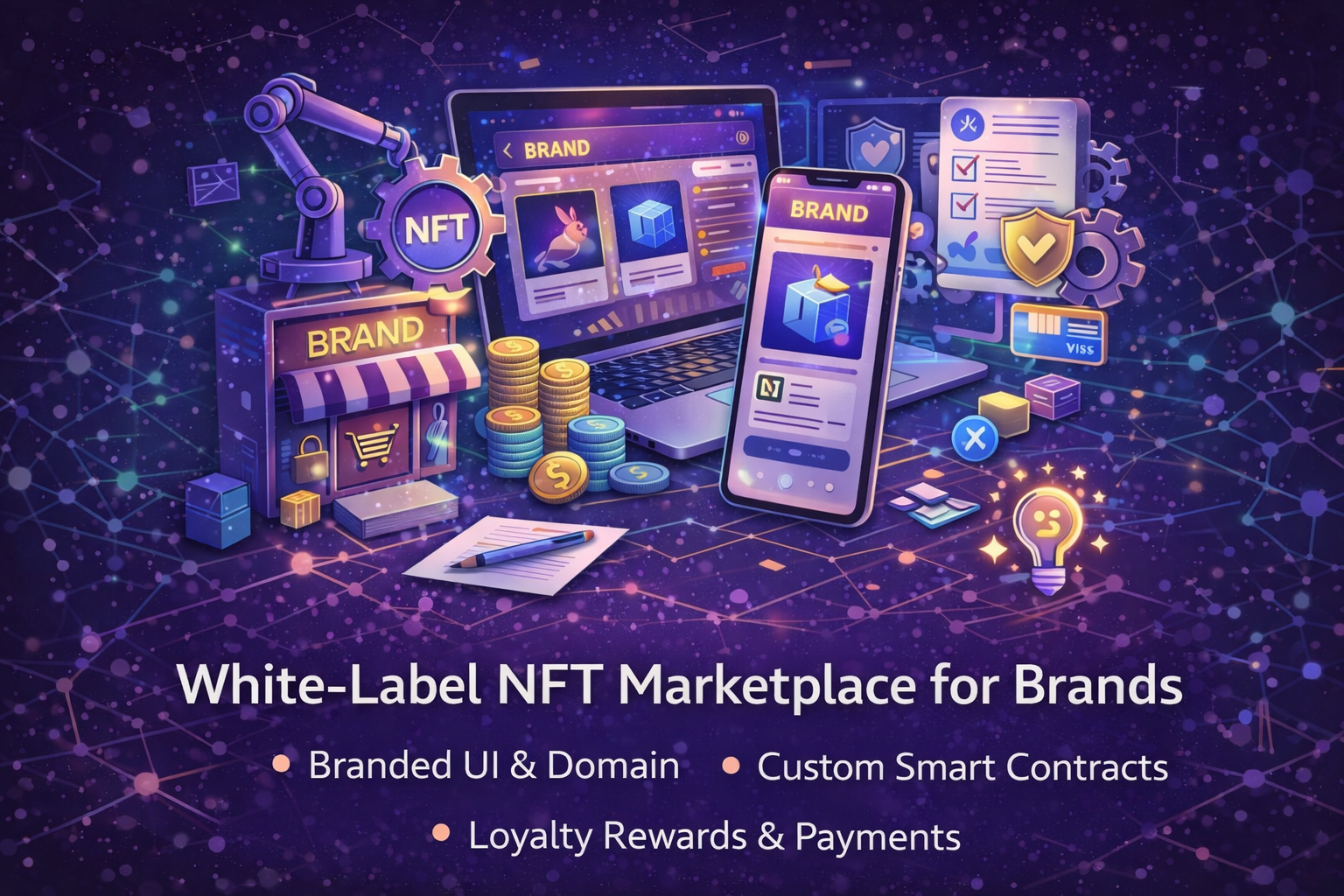
White-label NFT marketplaces solve these challenges by giving brands full control over their NFT ecosystem. They allow companies to build a branded storefront that integrates seamlessly with their broader digital presence (website, app, loyalty program, events, etc.). A well-built white-label marketplace can also serve as a hub for community engagement, exclusive drops, fan rewards, and loyalty tokens.
2. What Makes an NFT Marketplace “White-Label”?
At its core, a white-label NFT marketplace is a customizable, brand-specific version of a marketplace that uses configurable backend logic and modular front-ends. Instead of using a shared platform where multiple creators list items under a generic UI, a white-label marketplace:
Uses the brand’s identity and domain
Implements smart contracts under the brand’s governance
Enables branded drop mechanics
Supports custom fees, royalties, and reward logic
Offers integration with existing brand systems (CRM, loyalty programs, payment gateways)
Unlike marketplaces built on someone else’s user base, white-label solutions give brands control over every part of the user journey.
3. Key Architectural Components of a White-Label NFT Marketplace
While implementations vary, most white-label NFT marketplaces share the following components:
1) Blockchain Layer
This is the layer where NFT smart contracts are deployed. Choices here determine cost, speed, and user onboarding friction.
Ethereum Mainnet: The most secure and trusted, but expensive gas fees.
Layer 2s (Polygon, Arbitrum, Optimism, Base): Lower fees and high throughput, ideal for consumer-facing drops.
Other Chains (Solana, Avalanche): Lower fees and unique ecosystem features.
Private or Consortium Chains: For enterprise use cases with controlled access.
Your choice affects cost economics, collector experience, and marketplace integrations.
2) Smart Contracts
Smart contract design typically includes:
NFT minting contracts: Define how NFTs are created.
Marketplace logic: Handles listing, bidding, swapping, and settlement.
Royalty logic: Ensures brand or creator gets revenue on secondary sales.
Custom mechanics: Vesting, unlockable content, token staking, etc.
Smart contracts can either be standalone or extendable via well-known standards like ERC-721, ERC-1155, and EIP-2981 (royalty standard), depending on needs.
3) Backend Infrastructure
This is the server layer that:
Communicates with the blockchain via RPC providers (Alchemy, Infura, QuickNode)
Stores off-chain metadata (via IPFS/Arweave or centralized DB)
Handles indexing and search
Runs business logic (user profiles, notifications, analytics)
Many brands choose to combine decentralized metadata storage (e.g., IPFS + Filecoin for durability) with a backend that caches and serves faster responses.
4) Front-End Experience
The front-end is what collectors see. A white-label marketplace typically offers:
Branded UI design
Multi-wallet support (MetaMask, WalletConnect, Coinbase Wallet, etc.)
Search and discovery
Filters and collections
User dashboards
AR / 3D viewers (for rich media assets)
A good UX is crucial for adoption, especially for users unfamiliar with Web3.
5) Payments & Fiat On-Ramp
Even if the core runs on tokens:
You may need fiat on-ramps for mainstream users.
Payment processors like MoonPay, Transak, Ramp can be integrated.
Some marketplaces support credit/debit card purchases paired with wallet creation.
This reduces friction for non-crypto audiences.
6) Analytics & Data Layer
Brands want to know:
Who buys what
Floor price trends
Engagement metrics
Secondary sale performance
Integrations with analytics platforms like Dune, Nansen, and custom dashboards help derive insights.
7) Moderation, Compliance, and Legal Layer
Especially for enterprise brands:
Anti-money-laundering (AML)
Know-your-customer (KYC)
Geographic restrictions
Tax compliance
These can be embedded at the backend or enforced via third-party services.
4. Implementation Roadmap — From Concept to Launch
Building a white-label NFT marketplace is like launching any other digital product — but with a few blockchain-specific steps.
Step 1: Define Requirements & Business Logic
Before any code:
Decide minting model (public, allowlist, Dutch auction, gated)
Secondary royalty % and enforcement
Collector rewards (points, loyalty NFTs, token access)
Integration with brand systems
This shapes the contract logic and backend architecture.
Step 2: Choose Your Tech Stack
Common stacks include:
Contracts: Solidity (Ethereum/L2), Rust (Solana)
Frontend: React, Next.js, Web3 libraries (Ethers.js / Web3.js)
Backend: Node.js/Express, Python/Django
IPFS/Arweave: For decentralized storage
Third-party indexing (like The Graph) and push notifications (Push Protocol) are often added.
Step 3: Smart Contract Development
Develop, test, and audit:
Minting contracts
Marketplace contracts
Royalty enforcement
Custom token mechanics
Security is paramount — consider audits from firms like OpenZeppelin or ConsenSys.
Step 4: Backend & APIs
The backend will index blockchain events, manage JWT tokens, handle user sessions, and serve metadata for front-end queries.
Caching layers (e.g., Redis) help serve metadata quickly.
Step 5: Front-End and UX
Design for your audience. Brands often need:
Onboarding flows that explain wallets
Social logins with wallet creation
Clear signposts for minting/purchasing
Usability makes or breaks adoption.
Step 6: Integrations
Include:
Wallet connectors
Payment gateways (fiat <> crypto)
Analytics dashboards
Email & push notifications
Step 7: Testing, Audits, and Security
Thorough QA:
Smart contract tests
Penetration testing
Load testing
UX testing with real users
Security audits are essential before public launch.
Step 8: Launch & Growth
After launch:
Marketing campaigns
Collector programs
Early adopter perks
Airdrop or quests
Post-launch support is as important as development.
5. Popular Tech Stacks & Tools for White-Label Marketplaces
Here are some common building blocks:
Blockchain Layers
Ethereum: Highest trust
Polygon / zkSync / Base / Arbitrum: Low gas costs
Solana: Fast & cheap, different ecosystem
Smart Contract Tools
OpenZeppelin Contracts: Secure, reusable patterns
Hardhat/Foundry: Development & testing
EIP-2981: Royalty standard
Storage Solutions
IPFS + Pinning services
Arweave for permanence
Filecoin or decentralized ledger systems
APIs & Indexing
The Graph Protocol
Covalent
QuickNode / Infura / Alchemy
Frontend Libraries
React / Next.js / Web3Modal
RainbowKit / Wagmi / Ethers.js
Analytics & Insights
Dune Analytics
Nansen
Custom dashboards
6. Legal, Compliance, and Risk Considerations
Brands need to think about the regulatory landscape.
KYC / AML:
Depending on jurisdiction, you may need to verify users. This is especially true if your marketplace integrates fiat or revenue sharing.
Securities Regulations:
If NFTs represent rights to revenue, tokens may be considered securities. Consult legal counsel before launch.
Consumer Protection:
Clear terms, refund policies, and dispute procedures help mitigate risk.
Intellectual Property:
Smart contracts should reference licensed media. Distribution of copyrighted works without rights is illegal even on decentralized rails.
7. Monetization Strategies for Brands
A white-label NFT marketplace opens new business models:
Primary sales revenue
Secondary royalties
Membership and subscription NFTs
Token-gated experiences
Loyalty NFTs with perks
Collaborative drops with partners
Brand tokens and rewards
Monetization should be built into the marketplace from day one.
8. Best Practices for UX and Adoption
Web3 comes with friction; good UX minimizes it.
Wallet abstraction: Let users start with email or social login that creates a wallet behind the scenes
Clear pricing: Show gas or fee estimates in fiat
On-ramp integration: Use tools like Transak, MoonPay, or Ramp
Collector education: Web3 newbies need guides and prompts
Gamification: Early adopter perks, badges, and quests increase retention
9. Case Studies — Brands That Did It Right
1. Adidas Into the Metaverse
Adidas launched its own branded drops with curated utility and community engagement — tying primary sales to invite-only events. Though hosted on public marketplaces, the integration pointed toward bespoke marketplace strategies that future releases could build on.
2. Tiffany & Co. NFTiff
Tiffany’s took a luxury approach, embedding tokenized art with brand exclusivity. White-label marketplaces with configurable UI would allow brands like this to polish experience further.
3. NBA Top Shot & Bored Ape Yacht Club
While not pure white-label in the generic sense, these examples show how brand identity plus token mechanics can generate collectible economies — a valuable model for branded marketplaces.
10. The Future of White-Label NFT Marketplaces
White-label marketplaces are likely to evolve features beyond simple trading:
AI-powered recommendations
Social graph integration
On-chain reputation systems
Composable communities
Fractional ownership models
As infrastructure matures, white-label marketplaces will become normative for brands that want true ownership of their digital audience and assets.
Conclusion: Own Your NFT Narrative
White-label NFT marketplaces are not just a technical implementation — they are a strategic investment in brand control, ownership economics, and direct community engagement.
Deploying one means:
Owning your content and drop mechanics
Designing tailored monetization
Keeping analytical insights in house
Building stronger brand loyalty
For builders, creators, and brands in Web3, the ability to launch a custom marketplace is not just a technical differentiator — it’s a competitive advantage in a world where control over experience is king.
NFT Birdies


NFT Birdies
17 Mar 2026
Julie Guay
16 Mar 2026

NFT Birdies
26 Mar 2026

Build authority in Web3 - share your insights on our blog!
Become our guest authorGot a cool idea for NFTBirdies?
Drop your thoughts and help us build the best NFT platform together.
Drop Your IdeaTopics
Recent comments

Share your review
Article: How to Build White-Label NFT Marketplaces for Brands