

NFT Birdies
8 Dec 2025
Gaming NFTs 2025: Crafting the Digital Assets That Power the Next Generation of Play-to-Earn Economies
From Pixels to Property: The New Rules of the Game

Remember when finding a legendary sword in a game meant it was forever trapped in that save file? When your hard-earned character skin vanished if the servers went offline? That reality is crumbling. We are entering an era where the digital assets you earn, buy, and master in a game are no longer just bits of code controlled by a single company—they are verifiable, ownable, and tradable pieces of a larger economy.
Welcome to the frontier of Gaming NFTs in 2025. This isn't just about slapping a blockchain badge on a sword. It's a fundamental re-architecture of value, ownership, and incentive structures within interactive entertainment. We're moving beyond the first wave of speculative "play-to-earn" into a mature landscape of sophisticated "Play-and-Own" economies, where NFTs are the essential building blocks for interoperable identities, provable achievements, and truly player-driven markets.
For creators, developers, and players, understanding this shift isn't optional; it's the key to participating in the next decade of gaming. This guide will deconstruct the unique DNA of gaming NFTs, explore how they integrate into the engines that build our worlds, and map the defining trends shaping 2025 and beyond.
What Makes a Gaming NFT Different? It's All About Utility and Interoperability
At its core, a gaming NFT is a non-fungible token that represents an in-game asset. But to call it just a "digital item" misses the revolution. Unlike a static profile picture (PFP) NFT, a gaming NFT is dynamic, functional, and context-rich. Its value is derived not solely from rarity or art, but from its utility within a rules-based ecosystem and its potential across ecosystems.
Let's break down its defining characteristics:
The Dynamic Nature: More Than a JPEG
Metadata is Everything: A gaming NFT's metadata—the information stored on-chain—is complex. It doesn't just describe looks; it defines function.
Stats: Attack power, durability, speed modifiers.
State: Current level, enhancement status, cooldown timers.
History: Provenance of past owners, tournament wins, PvE kills.
Evolvable and Upgradeable: NFTs can be designed to change. A weapon can be "forged" (a transaction that mints a new, upgraded NFT). A character can "level up" (metadata updated via an oracle or game client signature). This creates a living history and deepens player investment.
Composable: Think of them as digital LEGO. An NFT "Core" could be a basic character, to which you attach NFT "Skill Gems," NFT "Armor Sets," and an NFT "Pet." This composability allows for near-infinite customization and player expression.
The Dual-Layer Value Proposition
A gaming NFT's value comes from two interconnected layers:
Intrinsic Utility Value: Its functional worth within its native game. How powerful is it? How rare is its ability? Does it grant access to exclusive content? This is governed by game design.
Extrinsic Market Value: Its worth on the open market. This is influenced by rarity, lore, aesthetics, community prestige, and speculative demand. This is governed by market dynamics.
The most successful gaming NFTs sit at the sweet spot where powerful utility meets cultural desirability.
Key Categories of Gaming NFTs in 2025:
Avatars & Identity: Your cross-game, cross-metaverse digital identity. More than a skin; it's your portable reputation and achievement hub.
Equipment & Items: Weapons, armor, tools. The backbone of in-game progression and combat.
Consumables & Crafting Materials: Potions, resources, blueprints. These fuel the in-game economy and crafting professions.
Land & Virtual Real Estate: Ownable parcels within game worlds for building, hosting, resource generation, or socializing.
Access Passes & Tickets: NFTs that grant entry to seasons, tournaments, exclusive zones, or beta tests.
Achievement Badges & Titles: Verifiable proof of skill, completion, or community contribution (e.g., "Season 1 Grand Champion").
Building the Bridge: How NFTs Integrate with Modern Game Engines
The magic doesn't happen by wishing for it. For NFTs to be seamless, functional parts of a game, they must be deeply integrated into the development pipeline. In 2025, this is no longer a niche hack but a streamlined process supported by major tools.
The Technical Handshake: API-First Architecture
Modern game studios don't build monolithic code. They use a services-oriented architecture. The game client (Unreal, Unity) talks to a "Game Server," which in turn talks to a "Blockchain Gateway Service." This service handles all the complex blockchain calls—verifying ownership, updating metadata, initiating minting—and presents simple results to the game server.
A Simplified Flow: Looting an NFT Sword
Player defeats a boss in the Unity-based game client.
Game Server logic determines the loot drop includes "Frostmourne's Edge."
Game Server calls the Blockchain Service: "Mint NFT Frostmourne_#1234 to wallet 0xPlayer...."
Blockchain Service creates the transaction on the chosen L2 (e.g., Immutable X, Polygon).
Once confirmed, it tells the Game Server: "Done. NFT ID is XYZ."
Game Server grants the item in the player's in-game inventory, now linked to NFT XYZ.
The player truly owns it and can see it in their connected wallet.
Engine-Specific Toolkits & Plugins (2025 Landscape)
Unity: Dominant in mobile and indie/web3 gaming. Plugins like ChainSafe Gaming SDK, Immutable Passport, and Moralis provide Unity developers with ready-made systems for wallet connection, NFT queries, and transaction building.
Unreal Engine 5: The powerhouse for AAA graphics. Integration is often more custom, using Epic's Online Services as a backbone, with C++ libraries from chains like Forta or Solana for high-performance needs. Expect more native-like support by 2025.
Godot & Other Engines: Open-source and niche engines are seeing growth via community-built plugins, making NFT integration accessible to smaller, innovative teams.
The Critical Role of Layer 2 & App-Specific Chains
Ethereum mainnet is too slow and expensive for gaming. The industry has standardized on:
Immutable X: The undisputed leader for gas-free, high-throughput NFT minting and trading, purpose-built for games.
Polygon Supernet & Avalanche Subnets: Offering "app-specific" blockchains where a game can have its own dedicated, customizable chain for maximal performance and control over gas fees.
Solana & Sui: Competing with extremely high transaction speeds and low costs, attracting fast-paced, transaction-heavy game economies.
The choice of chain is a foundational decision that affects everything from user experience to economic model.
2025 Trends: The Gaming Industry's Web3 Playbook
The trends for 2025 reflect a move from experimentation to sustainable, player-centric models.
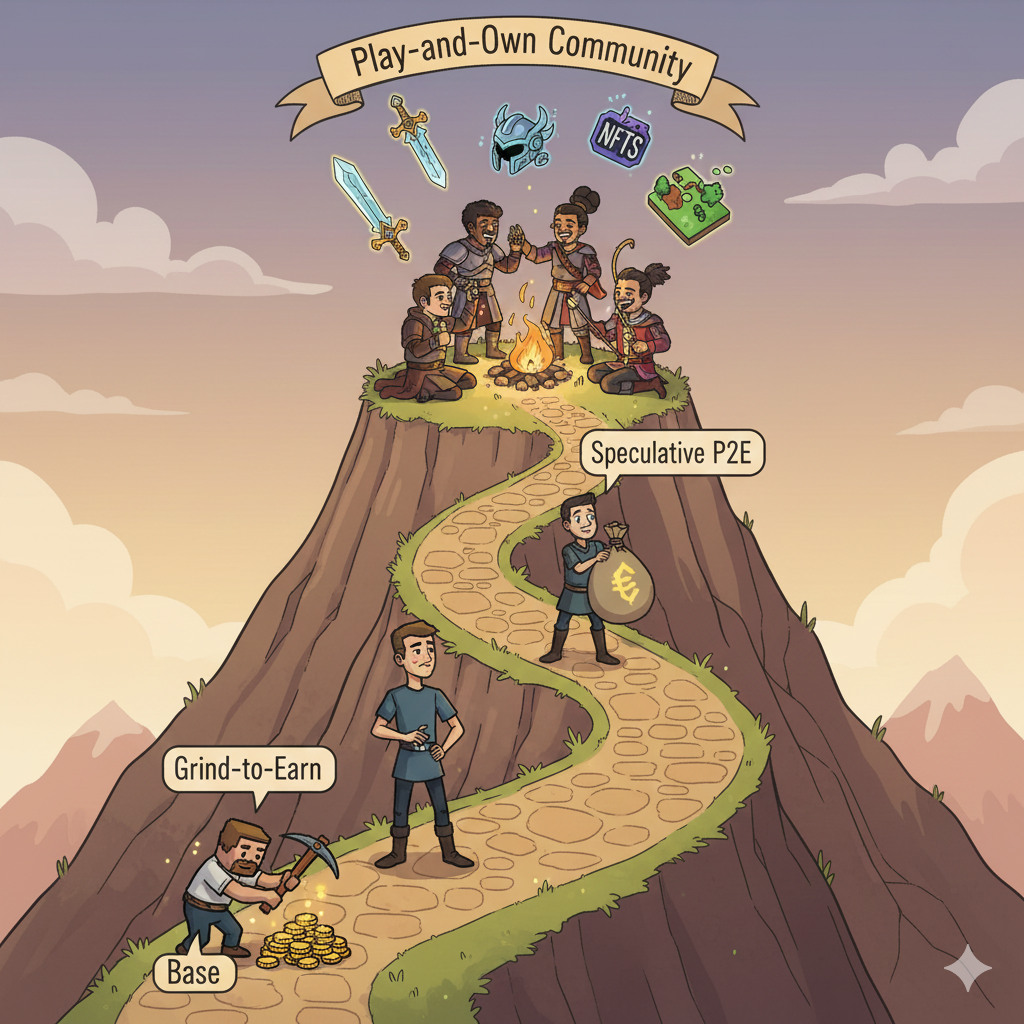
1. The Rise of "Play-and-Own" (The Evolution Beyond "Play-to-Earn")
The toxic grind of early "P2E" is giving way to "Play-and-Own". The focus shifts:
From: Earning tokens as a primary goal (a job).
To: Owning cool, functional assets as a result of having fun (a hobby).
The economy is driven by desire for assets, not the mere conversion of time into sellable currency. Games will hide sophisticated economies behind compelling gameplay loops.
2. Interoperability & The "Metaverse Light"
True full-interoperability (using one game's sword in another) remains a design nightmare. 2025's pragmatic trend is "Metaverse Light" or "Cosmetic/Identity Interop".
Your NFT avatar from Game A can appear as a cosmetic skin in Game B.
Your achievement badges are displayed in a universal "credential" layer across partnered games.
Governance tokens from one game's DAO might grant early access to another. It’s about shared social layers and status, not broken game balance.
3. AI-Generated, Player-Owned Content
AI tools (procedural generation, stable diffusion) allow players to co-create.
Minting unique, AI-generated "Loot" items based on a seed phrase.
Designing custom armor textures that are minted as NFTs and usable in-game.
This turns players into creators and curators, deepening ecosystem value.
4. Dynamic NFTs Powered by Oracles
NFTs will become living records. Chainlink Oracles or similar services will feed off-chain data onto the NFT.
A racing car NFT that updates its "Race Wins" metadata after each tournament.
A "Weather-Stone" NFT whose visual effects change based on real-world weather data.
This creates a powerful new class of reactive, ever-changing digital items.
5. Mainstream Studio Adoption: The "Stealth Web3" Model
Major AAA publishers won't scream "NFTs!" They'll quietly integrate ownership.
Think "Digital Deluxe Edition" that is actually a bundle of NFTs (skin, weapon, season pass).
"Collector's Edition" that includes a physical statue and a corresponding NFT companion.
The focus will be on player benefit—true ownership of purchased DLC, the ability to resell unwanted cosmetic items—without forcing a crypto-wallet tutorial on every player.
6. Sustainable Economic Design & DAO Governance
Lessons have been learned from inflationary tokenomics. New games feature:
Dual-Token Models: A stable "in-game currency" (for purchases) and a volatile "governance token" (for ecosystem ownership).
Sinks & Faucets: Careful balancing of resource generation (faucets) and resource consumption (sinks like upgrades, repairs, crafting) to maintain asset value.
DAO Treasuries: Communities governing a portion of marketplace fees or resource pools to fund esports prizes, community events, or new development.
A Creator's Blueprint: Designing a Gaming NFT Project in 2025
For a developer or creator entering this space, here is a strategic framework:
Phase 1: Foundation & Design
Concept: Is it an item, a character, land, or an access pass?
Utility Design: What does it do in the experience? Define its stats, rules, and evolution path.
Economic Design: How is it earned, crafted, or found? How does it interact with the game's economy?
Chain Selection: Choose based on speed, cost, and developer tooling (e.g., Immutable for pure gaming, Polygon for broad reach).
Phase 2: Technical Integration
Smart Contract Development: Code the logic for minting, upgrading, and transferring. Use audited, standard templates (ERC-1155 is king for gaming).
Engine Integration: Implement the chosen SDK/plugin into Unity/Unreal. Build the "loot drop" and "inventory sync" logic.
Backend Services: Set up the robust Blockchain Gateway Service to handle transactions reliably.
Phase 3: Launch & Community
Pre-Launch: Distribute "Founder" NFTs or access passes to build a core community. Share lore and utility previews.
Launch: Integrate the NFT minting seamlessly into a compelling game launch or seasonal event. The acquisition should feel like a natural part of play.
Post-Launch: Support the secondary market. Foster community by highlighting cool player stories involving the NFTs. Be prepared to balance the game based on real-world use.
The Future Is a Game: Final Thoughts
Gaming NFTs in 2025 represent the maturation of a powerful idea: that player investment—both time and passion—can be captured as tangible, ownable value. This is building a future where games are not just played but lived in, where economies are not just simulated but real, and where communities have a true stake in the worlds they love.
The technology is ready. The engines are compatible. The trends are clear. The question is no longer "if" but "how." Whether you're a developer, an artist, or a player, the next level awaits—and this time, you get to keep the loot.
NFT Birdies
NFT Birdies
30 Mar 2026

NFT Birdies
17 Mar 2026
Build authority in Web3 - share your insights on our blog!
Become our guest authorGot a cool idea for NFTBirdies?
Drop your thoughts and help us build the best NFT platform together.
Drop Your IdeaTopics
Recent comments

Share your review
Article: Gaming NFTs 2025: Crafting the Digital Assets That Power the Next Generation of Play-to-Earn Economies