

NFT Birdies
2 Apr 2026
Esoteric Ebb Review: The Closest Successor to Disco Elysium Yet
Introduction
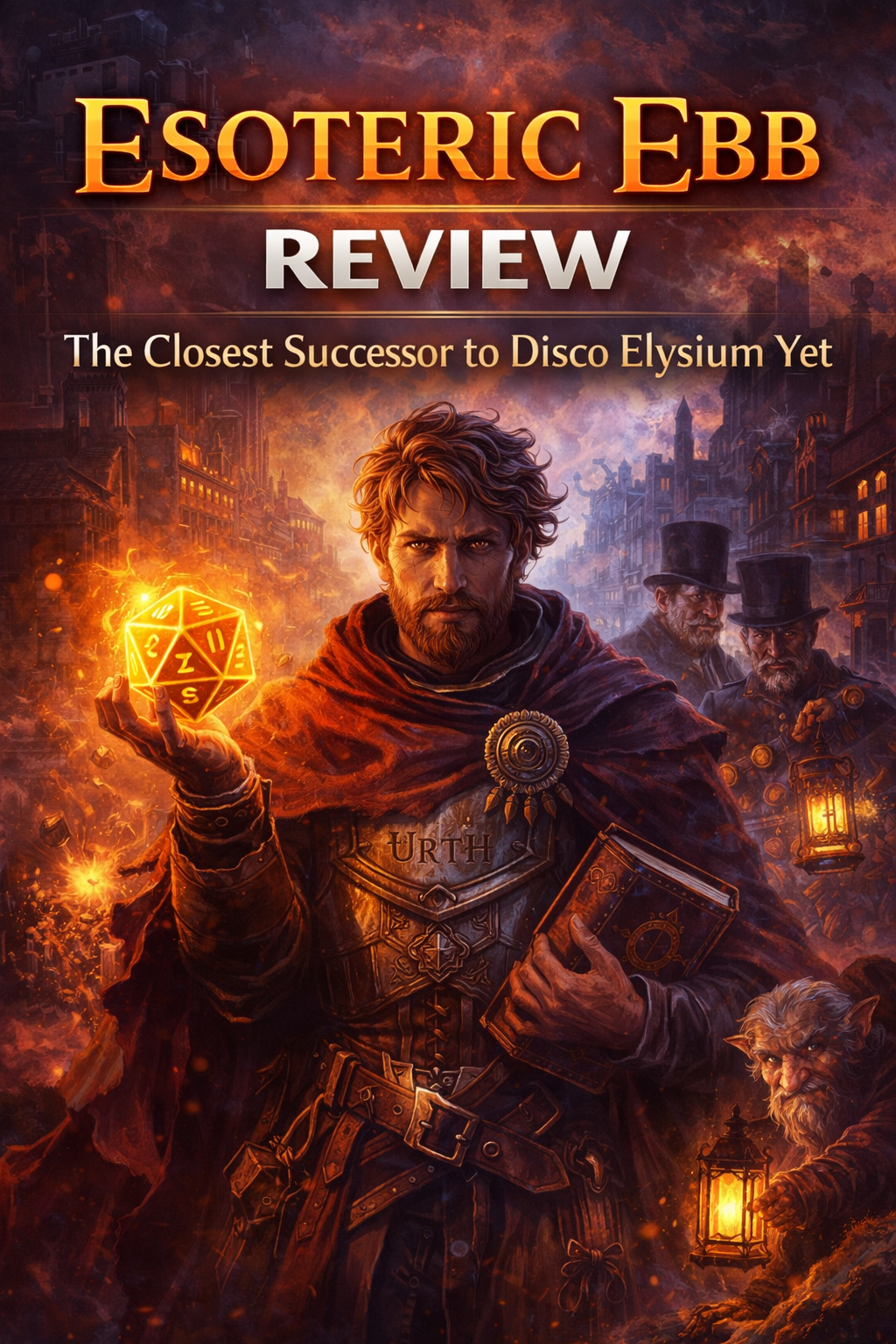
For a long time, players asking “I just finished Disco Elysium - what now?” were met with silence. ZA/UM’s uniquely cerebral mix of philosophy, fractured detective storytelling, and skill-driven roleplay felt impossible to follow. Esoteric Ebb, created by Christoffer Bodegård and published by Raw Fury, finally offers a compelling response to that lingering question.
Taking place in the strange, post-arcanepunk city of Norvik - where late medieval fantasy collides with modern political systems—the game casts you as a Cleric, an agent of the god Urth. Your mission: investigate a suspicious explosion in a tea shop just five days before the city’s first election. Naturally, nearly every faction in Norvik would prefer you didn’t uncover the truth.
The premise is knowingly playful, almost self-aware. And that tone carries through much of the experience.
Gameplay
Rather than simply imitating Disco Elysium, Esoteric Ebb actively deconstructs its ideas - experimenting with them, expanding them, and occasionally subverting them altogether.
At its foundation lies a dialogue-focused RPG built around D20-based skill checks. Your Cleric’s attributes - Strength, Dexterity, Charisma, Intelligence - shape far more than combat. Even mundane actions, like climbing a ladder, can become moments of potential failure (and embarrassment). Build a character focused on intellect and charm, and you might become eloquent yet physically inept. The game doesn’t punish this—it celebrates it.
Tip: Don’t ignore Dexterity. Early exploration often depends on physical checks, and repeated failures can cut off meaningful discoveries.
Unlike percentage-based systems, the D20 mechanic feels distinctly rooted in tabletop traditions, closer in spirit to Dungeons & Dragons. Each roll carries weight. Decisions matter. Preparation is rewarded, but failure is rarely frustrating - instead, it opens new paths.
Exploration follows a similarly open philosophy. Norvik is divided into districts dense with secrets, side stories, and environmental detail. Players are encouraged to wander, experiment, and occasionally make questionable decisions - like diving into a sewer with a goblin companion and dealing with the consequences afterward. The game thrives on these unscripted moments.
Skill Checks and Consequences
What truly elevates Esoteric Ebb is its understanding that failure is not a dead end - it’s narrative momentum. Missing a roll doesn’t halt progress; it reshapes it. NPCs respond differently to incompetence than to success, often leading to more memorable interactions.
This design makes character builds feel essential. Stats aren’t cosmetic - they define your experience. Where other RPGs treat them as flexible suggestions, here they act as structural pillars.
Graphics & Audio
Visually, the game prioritizes style over technical spectacle. Its painterly aesthetic complements Norvik’s eccentric tone: cobblestone alleys, warm candlelit interiors, and subtle hints of something darker beneath the surface.
The soundtrack has been widely praised for its tonal versatility, effortlessly shifting between absurd humor and quiet tension. Sound design adds texture to the world, becoming especially noticeable in moments of silence, where the absence of audio feels deliberate and unsettling.
Note: The game is largely the work of a single developer, Christoffer Bodegård, making its artistic cohesion even more impressive.
Story & Narrative
Narratively, Esoteric Ebb stands out as its own creation.
What begins as a simple investigation - who bombed a tea shop, and why - gradually expands into a layered political narrative. Norvik’s first election becomes a focal point for competing forces: religious authorities, criminal networks, reformists, and ancient entities lurking beneath the city’s surface.
The writing consistently rewards curiosity. Conversations with seemingly minor characters often reveal surprising depth. Comparisons to Terry Pratchett are well-earned - the game blends absurd humor with sharp social commentary, much like the Discworld novels.
Tonally, it differs from Disco Elysium. Where that game leans into existential despair, Esoteric Ebb approaches similar themes with irony and wit. For some, this lighter touch may feel less impactful; for others, it’s a welcome shift.
Verdict
Esoteric Ebb is not without flaws. Its inspirations are unmistakable, and at times it feels more like homage than evolution. Players expecting the bleak intensity of Disco Elysium might find its tone comparatively restrained.
Yet these shortcomings don’t overshadow its achievements. Christoffer Bodegård isn’t trying to replace Disco Elysium - he’s extending its ideas into new territory. And for the most part, he succeeds. The writing is sharp, the world is rich with possibility, and the D20 system gives every decision tangible weight.
For fans of Planescape: Torment, Disco Elysium, or anyone drawn to narrative-driven RPGs with a strong authorial voice, Esoteric Ebb is essential.
The long-standing question finally has an answer.
Esoteric Ebb Review
Esoteric Ebb is the closest thing yet to a true successor to Disco Elysium - and it earns that comparison. Drawing inspiration from Planescape: Torment and Terry Pratchett’s Discworld, it manages to feel both familiar and fresh. Norvik is alive with personality, humor, and hidden depth. The writing rarely misses, the mechanics demand attention, and the characters linger in your mind long after you’ve finished playing.
Yes, it leans heavily on established formulas - but it does so with enough confidence and craftsmanship that it rarely feels derivative. If you’re looking for a CRPG that embraces failure, rewards exploration, and trusts the player to shape their own journey, this is it.
Don’t overlook it.
Pros
Clever, multi-layered writing with humor and political nuance
A dense, memorable setting full of discovery
Meaningful roleplay shaped by the D20 system
Unique tonal balance between satire and seriousness
Strong reception from both critics and players
Cons
Clear structural similarities to Disco Elysium
Lighter tone may not satisfy those seeking darker narratives
Frequent skill checks require careful planning
Minimal guidance can make progression feel unclear
NFT Birdies

NFT Birdies
26 Mar 2026

NFT Birdies
20 Mar 2026

NFT Birdies
31 Mar 2026

NFT Birdies
30 Mar 2026

Build authority in Web3 - share your insights on our blog!
Become our guest authorGot a cool idea for NFTBirdies?
Drop your thoughts and help us build the best NFT platform together.
Drop Your IdeaTopics
Recent comments

Share your review
Article: Esoteric Ebb Review: The Closest Successor to Disco Elysium Yet