

NFT Birdies
15 Jan 2026
Decentralized AI Marketplaces: The Next Web3 Economy
When AI Meets Web3: The Birth of a New Economic Paradigm
Let's start with a hard truth: the artificial intelligence revolution is currently being built on centralized infrastructure. A handful of tech giants control the compute power, data, and models that are shaping our collective future. They decide who gets access, at what price, and under what terms. But what if there was another way? What if instead of AI being controlled by corporate gatekeepers, it could flourish in an open marketplace where anyone can contribute, access, and benefit?
Welcome to the dawn of decentralized AI marketplaces - the most exciting convergence of Web3 and artificial intelligence since NFTs met digital art. This isn't just about putting AI models on blockchain (though that's part of it). It's about creating entirely new economic systems where intelligence becomes a tradable commodity, computation becomes a liquid asset, and data sovereignty becomes a fundamental right.
In this new economy, developers in Nairobi can sell their specialized image recognition models to startups in Norway. Researchers can monetize their datasets without losing control. And anyone with a spare GPU can rent it out to train the next breakthrough model. We're moving from an AI oligopoly to an AI democracy—and the implications are staggering.
The Centralized AI Problem: Why We Need a Decentralized Alternative
Before we dive into solutions, let's understand the problem with today's AI landscape:
The Triple Gatekeeper Problem
Compute Concentration: 90% of AI training happens on infrastructure controlled by 3-4 cloud providers
Data Monopolization: The best training data is locked in corporate silos
Model Centralization: A handful of organizations control the most powerful models
The Economic Inefficiencies
Sky-High Costs: Training large models can cost millions, pricing out everyone but well-funded corporations
Underutilized Resources: Millions of GPUs sit idle worldwide while AI compute remains scarce
Value Extraction: Data contributors and smaller model creators get minimal compensation
The Innovation Bottleneck
Permissioned Innovation: You need approval from platform owners to build certain applications
Single Points of Failure: Entire AI ecosystems depend on centralized infrastructure
Lack of Transparency: "Black box" models with unclear training data and biases
This centralized model isn't just inefficient—it's dangerous for the long-term development of beneficial AI. Decentralized marketplaces offer a fundamentally different approach.
How Decentralized AI Marketplaces Actually Work
At their core, these platforms create peer-to-peer networks for trading AI resources. Think of them as the "Airbnb for AI" or the "DeFi for artificial intelligence." Here's what makes them tick:
The Three-Layer Architecture
1. The Infrastructure Layer (The "Compute Marketplace")
Where GPU owners rent out their processing power
Uses token incentives to match supply and demand
Examples: Akash Network, Render Network, Gensyn
2. The Data & Model Layer (The "AI Asset Marketplace")
Where datasets and trained models are bought and sold
Implements privacy-preserving techniques like federated learning
Examples: Ocean Protocol, Bittensor, SingularityNET
3. The Governance & Incentive Layer (The "Coordination Engine")
Tokens that align network participants
Decentralized quality control mechanisms
Reputation systems for reliable providers
The Key Players in This New Economy
Compute Providers: Anyone with spare processing power (gamers, data centers, crypto miners)
Data Contributors: Individuals and organizations with valuable training data
Model Creators: Developers who build and fine-tune AI models
AI Consumers: Businesses and developers needing AI services
Validators & Curators: Those who ensure quality and prevent fraud
The Token Mechanics: More Than Just Payment
Tokens in these ecosystems serve multiple purposes:
Medium of Exchange: Paying for compute, data, or models
Incentive Alignment: Rewarding quality contributions and good behavior
Governance Rights: Deciding platform upgrades and parameters
Staking Mechanisms: Ensuring service reliability and commitment
The Trailblazers: Platforms Building the Future Today
Bittensor: The "Internet of AI"
Bittensor is creating a decentralized network where machine intelligence is produced and consumed as a commodity. Imagine a global brain where:
Different "subnets" specialize in different tasks (text, image, audio)
Models compete based on performance, not marketing budget
The network continuously improves through collective intelligence
Their TAO token rewards models that provide useful predictions, creating a self-improving ecosystem where the best AI rises to the top organically.
Ocean Protocol: Turning Data into Liquid Assets
Ocean solves one of AI's biggest challenges: accessing quality data while preserving privacy and ownership. Their approach:
Data NFTs: Represent ownership of datasets
Compute-to-Data: Algorithms visit the data (not vice versa), protecting privacy
Data Tokens: Liquid representations of data access rights
This means hospitals can monetize medical data without ever exposing patient records, or researchers can access rare datasets they could never afford centrally.
Akash Network: The Decentralized Cloud
Dubbed the "Airbnb for server space," Akash creates a competitive marketplace for cloud compute:
90% cheaper than traditional cloud providers
Uses underutilized capacity from data centers worldwide
Perfect for AI training and inference workloads
Their secret? A reverse auction model where providers bid to fulfill compute requests, driving prices down through competition.
Render Network: From Graphics to AI
Originally for 3D rendering, Render has pivoted beautifully to AI compute:
500,000+ GPUs in their network (and growing)
Seamless integration with popular AI frameworks
Proof-of-Render work verification system
Artists who bought RNDR tokens for rendering can now earn from AI training—a perfect example of Web3 resource repurposing.
Gensyn: The Machine Learning Supercomputer
Gensyn takes a different approach: creating a globally distributed supercomputer specifically for AI:
Verifiable computation using cryptographic proofs
Automatic task partitioning across thousands of devices
Fault-tolerant design that handles dropouts gracefully
Their system can handle training runs that would normally require expensive, specialized hardware.
Real-World Use Cases: More Than Just Hype
Healthcare: Collaborative Research Without Compromising Privacy
Imagine a global Alzheimer's research project where:
100 hospitals contribute patient data (encrypted and anonymized)
Researchers worldwide train models using Ocean's compute-to-data
New diagnostic tools emerge without any hospital losing data control
Contributors earn tokens when their data leads to breakthroughs
This isn't theoretical—early pilots are already happening.
Climate Science: Democratizing Environmental AI
Climate modeling requires massive compute resources typically available only to governments and large institutions. Decentralized marketplaces change this:
University researchers can access 10,000 GPUs for atmospheric modeling
Satellite data becomes accessible through token-gated marketplaces
Citizen scientists can contribute local environmental data and get paid
The resulting models are open and verifiable, not locked in corporate servers
Creative Industries: The Next Generation of AI-Assisted Art
Beyond text-to-image generators, decentralized AI enables:
Style Transfer as a Service: Rent a model trained on Van Gogh's entire corpus
Personalized Music Generation: Commission a model trained on your favorite era
Collaborative Film Making: Multiple AI specialists contribute to different aspects
Royalty Tracking: Smart contracts automatically split earnings among contributors
The key difference from centralized platforms? Artists control their style models and get compensated when others use them.
Small Business Empowerment: Enterprise AI for Everyone
Today, sophisticated AI is prohibitively expensive for most businesses. Decentralized marketplaces democratize access:
A bakery can rent a model optimized for inventory prediction
A local newspaper can access summarization tools for regional news
Manufacturers can implement quality control vision systems affordably
All without expensive enterprise contracts or vendor lock-in
The Challenges: What Stands Between Us and This Future
Technical Hurdles
Latency Issues: Distributed systems can be slower than centralized ones
Quality Control: Ensuring consistent service quality across diverse providers
Security Concerns: Protecting against malicious models or data manipulation
Interoperability: Making different AI marketplaces work together seamlessly
Economic Design Challenges
Tokenomics That Actually Work: Avoiding the pitfalls of previous DeFi projects
Preventing Collusion: Ensuring providers don't game the system
Sustainable Incentives: Balancing short-term rewards with long-term network health
Price Stability: Making AI services predictably affordable
Adoption Barriers
User Experience: The current state is still too technical for mainstream users
Regulatory Uncertainty: How do securities laws apply to AI tokens?
Enterprise Hesitation: Large companies are wary of unproven infrastructure
Mindset Shift: Moving from "buying AI services" to "participating in AI networks"
Ethical Considerations
Bias Amplification: Decentralized doesn't automatically mean unbiased
Accountability: Who's responsible when a decentralized AI makes a harmful decision?
Transparency vs. IP Protection: Balancing open development with creator rights
Distributed Responsibility: The "tragedy of the commons" problem for AI safety
The Roadmap: Where This Is All Heading
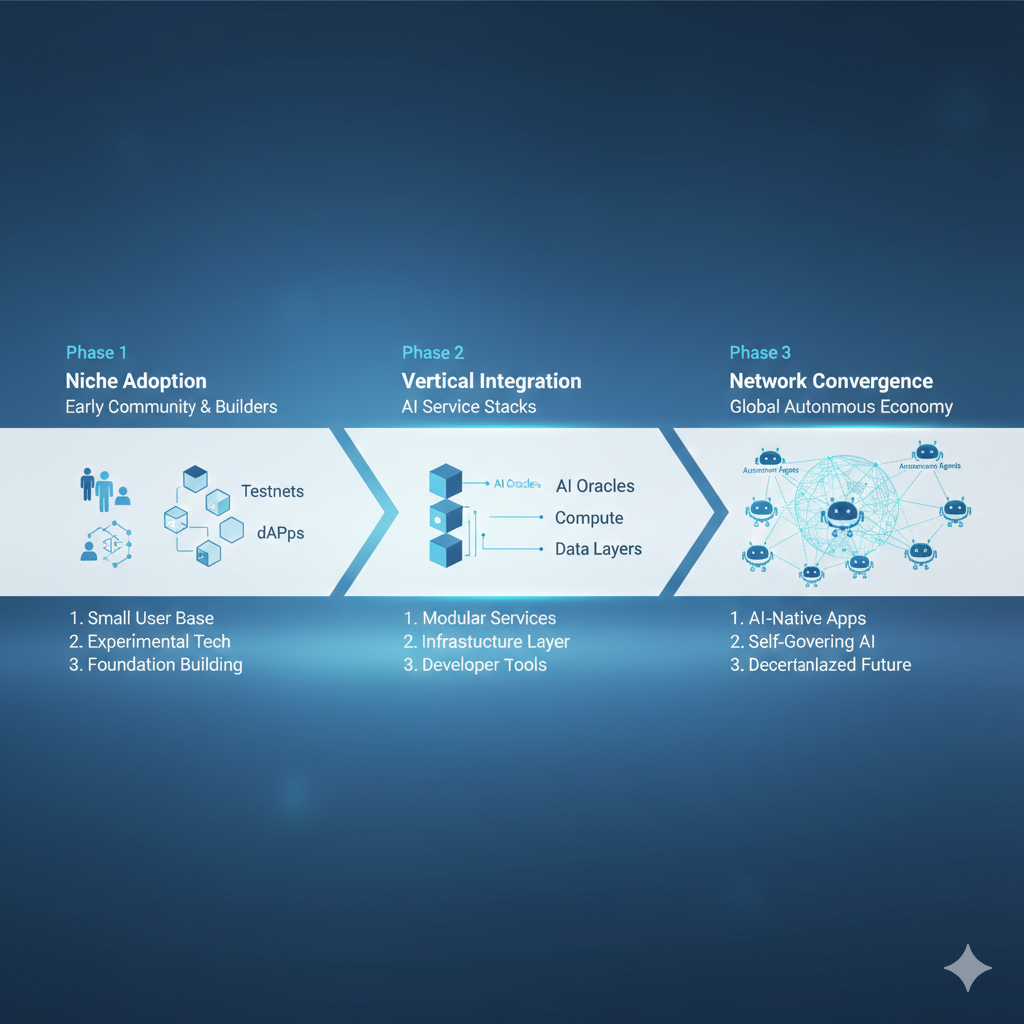
Phase 1: Niche Adoption (2024-2025)
Specialized AI services on decentralized platforms
Early adopters in research and crypto-native projects
Basic interoperability between major platforms
Regulatory frameworks beginning to take shape
Phase 2: Vertical Integration (2026-2027)
Complete AI stacks on decentralized infrastructure
Mainstream developer adoption through better tooling
Enterprise pilots showing cost and efficiency advantages
Emergence of "killer apps" that demonstrate clear superiority
Phase 3: Network Convergence (2028-2030)
Seamless AI resource movement between platforms
AI agents that autonomously navigate between marketplaces
Most new AI development happening in decentralized environments
Centralized AI becoming the exception, not the norm
The Endgame: Autonomous AI Economies
Imagine a future where:
AI models earn their own income and pay for their own compute
Models collaborate and compete in decentralized marketplaces
Human oversight focuses on high-level direction, not implementation
The line between AI service and AI agent becomes increasingly blurry
This is where Web3's vision of decentralized autonomous organizations (DAOs) meets AI's potential for autonomous action.
How to Get Involved (Yes, You!)
For Developers
Start experimenting with platform SDKs (most have generous testnet incentives)
Consider specializing in "AI middleware" - tools that bridge traditional and decentralized AI
Contribute to open-source model development with clear attribution and reward mechanisms
Build applications that demonstrate clear advantages over centralized alternatives
For Researchers and Data Owners
Explore monetizing your datasets through Ocean Protocol or similar platforms
Consider federated learning approaches for collaborative research
Publish models with clear licensing and compensation structures
Participate in governance of platforms you use regularly
For Compute Providers
Monetize idle GPUs through Akash or Render
Consider specializing in certain types of AI workloads
Participate in staking and governance to secure networks
Diversify across multiple platforms to mitigate risk
For Investors and Token Holders
Look beyond hype to actual usage metrics
Consider the tokenomics carefully - are incentives truly aligned?
Diversify across the stack (compute, data, models, infrastructure)
Participate in governance - these networks need active, informed stakeholders
For End Users and Businesses
Start with non-critical workloads to test reliability
Compare costs carefully - decentralized isn't always cheaper (yet)
Consider the strategic advantage of vendor independence
Provide feedback to platforms - they're evolving rapidly based on user needs
The Big Picture: Why This Matters Beyond Crypto
Decentralized AI marketplaces represent more than just another Web3 use case. They offer:
A Solution to AI Concentration
By distributing control, we reduce single points of failure and points of control. This makes AI development more resilient and less subject to corporate or governmental capture.
A New Economic Model for Intelligence
Intelligence—whether human or artificial—becomes something that can be contributed, combined, and compensated in granular ways. This could eventually extend to human expertise as well.
Alignment Through Architecture
Rather than hoping centralized AI developers will act ethically, decentralized systems bake alignment into their architecture through transparent incentives and distributed oversight.
Acceleration Through Competition
When AI models compete openly on performance rather than marketing budgets, improvement accelerates dramatically. The best ideas win, regardless of their origin.
The Final Word: We're Building the Nervous System of the Future Internet
The convergence of AI and Web3 isn't just inevitable - it's already happening. The question isn't whether decentralized AI marketplaces will exist, but what role you'll play in their development.
Will you be a passive observer watching from the sidelines? A cautious adopter waiting for others to prove the concept? Or an active participant helping shape one of the most important technological developments of our time?
The platforms are live. The tools are maturing. The early adopters are already seeing benefits. What's stopping you from exploring what decentralized AI can do for your projects, your research, or your business?
Remember: the centralized AI giants aren't waiting. They're consolidating power and building moats. The time to explore alternatives is now - before the current paradigm becomes permanently entrenched.
The next Web3 economy won't be built on speculation or memes. It will be built on something far more valuable: intelligence, openly traded and collectively owned. And that's an economy worth building.
NFT Birdies


NFT Birdies
17 Mar 2026
Julie Guay
16 Mar 2026

NFT Birdies
26 Mar 2026

Build authority in Web3 - share your insights on our blog!
Become our guest authorGot a cool idea for NFTBirdies?
Drop your thoughts and help us build the best NFT platform together.
Drop Your IdeaTopics
Recent comments

Share your review
Article: Decentralized AI Marketplaces: The Next Web3 Economy