
NFT Birdies
8 Apr 2026
Cross-Chain Messaging Explained: LayerZero, Wormhole, CCIP and the Future of Web3 UX
For much of blockchain’s history, the experience of moving between networks has felt like navigating a fractured archipelago without a map. A user holding value on Ethereum cannot simply use it on Solana; an application built on Arbitrum does not automatically understand state on Optimism. The dominant solution - bridges that lock tokens on one chain and mint representations on another - has proven both operationally clumsy and, in too many cases, catastrophically insecure. Between 2021 and 2023, cross-chain bridges were exploited for billions of dollars, accounting for the majority of all crypto theft in those years. The industry learned a painful lesson: moving value between blockchains is not a problem that can be solved by escrow accounts and hope.
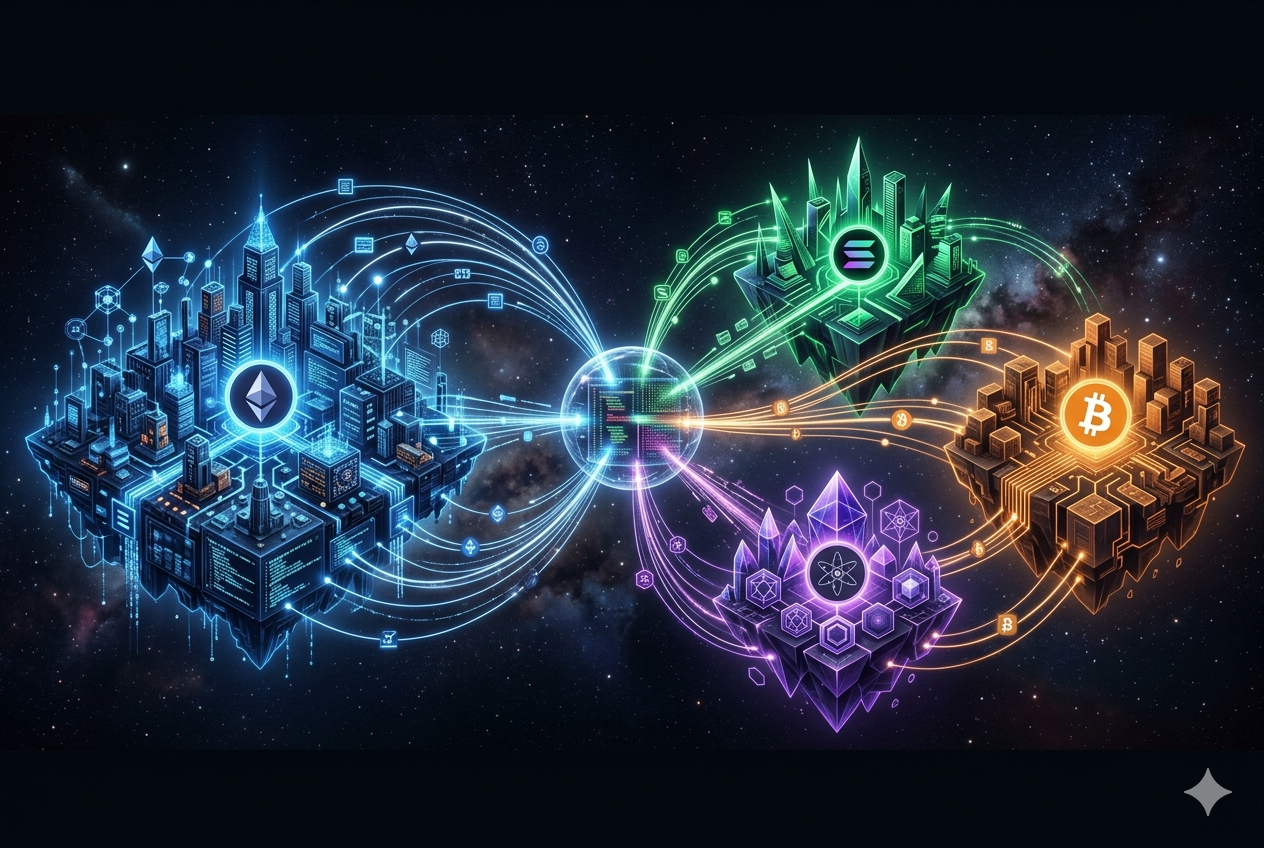
The answer, increasingly clear, is not better bridges but a more fundamental layer of infrastructure: cross-chain messaging protocols. These systems do not simply shuttle tokens; they transmit arbitrary data, state, and instructions between blockchains in a verifiable, trust-minimized manner. They are the plumbing that will allow Web3 to function as a unified ecosystem rather than a collection of isolated islands. And after years of development, experimentation, and hard-won security lessons, they are finally mature enough to deliver on that promise.
Why Cross-Chain Messaging Matters More Than Ever
The fragmentation of Web3 is not a temporary condition; it is a structural reality of how blockchains are designed. Different networks optimize for different trade-offs - Ethereum for security and decentralization, Solana for speed and throughput, Cosmos for sovereignty and interoperability, and a growing array of layer‑2 rollups for scalability. A world with one chain would be simpler, but it would also be less innovative and less capable. The challenge, then, is not to eliminate diversity but to enable communication across it.
Cross-chain messaging protocols provide this capability by allowing smart contracts on one blockchain to trigger actions on another. An application on Ethereum can query the state of a liquidity pool on Solana. A governance vote on Arbitrum can execute a treasury transfer on Optimism. A user holding collateral on Base can borrow funds on Polygon without ever manually bridging. These are not future fantasies; they are live use cases today, powered by a new generation of interoperability infrastructure.
The distinction between cross-chain messaging and traditional bridging is crucial. A bridge typically moves tokens by locking them in a vault on the source chain and minting a derivative on the destination chain. This approach works but introduces significant risk: the security of the derivative token depends entirely on the security of the bridge. If the bridge is compromised, the derivative becomes worthless, and users lose their locked funds. Cross-chain messaging takes a different approach. Instead of moving assets, it moves messages - verified proofs that something has happened on one chain, which can then trigger actions on another. When combined with standards for native asset transfers - such as burning tokens on the source chain and minting them on the destination - messaging protocols enable secure, non-custodial interoperability without the vulnerabilities of traditional bridges.
LayerZero: The Omnichain Abstraction Layer
LayerZero has emerged as one of the most widely adopted cross-chain messaging protocols, supporting over 50 blockchains and facilitating billions in cross-chain volume. Its architecture is built around a simple but powerful insight: secure cross-chain messaging does not require a new blockchain or a trusted federation. It requires a lightweight communication layer that leverages the security properties of the chains themselves.
The core of LayerZero is the Ultra Light Node (ULN). Unlike traditional light nodes, which rely on block headers, the ULN uses a combination of oracles and relayers to verify cross-chain messages. An oracle - such as Chainlink - reports the block headers of the source chain to the destination chain. A relayer independently reports the transaction proofs. The destination chain's smart contract compares the two sources; if they match, the message is accepted. This two-step verification ensures that neither the oracle nor the relayer can unilaterally forge a message.
n early 2026, LayerZero took a significant step forward with the announcement of Zero, a new high-performance layer‑1 blockchain designed to serve as a settlement and coordination layer for the broader LayerZero ecosystem. Zero uses zero-knowledge proofs to decouple execution from verification, replacing the redundant replication of traditional blockchain architectures with a more efficient heterogeneous model. The move positions LayerZero not merely as a messaging protocol but as a foundational piece of cross-chain infrastructure. As one analysis notes, LayerZero has evolved beyond its initial positioning as a bridge to become the "TCP/IP of blockchain"—a base protocol that allows heterogeneous networks to communicate in a unified language.
For developers, LayerZero's value proposition is straightforward: omnichain composability. An application written once can send messages to and receive messages from any supported chain without custom integration for each network. This has made LayerZero the go-to choice for projects like Stargate (a cross-chain DEX), Pudgy Penguins (which used LayerZero to bridge its NFTs from Ethereum to zkSync Era), and countless DeFi protocols seeking to expand across chains without fragmenting liquidity.
Wormhole: The Guardian Network
Wormhole takes a different architectural approach, one that prioritizes decentralization through a guardian network. The protocol is currently connected to over 40 blockchains, making it one of the most broadly integrated interoperability solutions in production.
At the heart of Wormhole is a set of Guardian nodes - currently 19, with plans to expand - that observe events on connected chains and sign attestations of their validity. Each Guardian runs a full node of every blockchain in the Wormhole network, ensuring that they have direct, trustless access to each chain's state rather than relying on light clients or third-party oracles. When a message is sent via Wormhole, the core contract on the source chain emits an event that Guardians observe. After a supermajority of Guardians (typically two‑thirds) have signed the same attestation, the message is packaged into a Verified Action Approval (VAA) and can be delivered to the destination chain via a relayer.
The Guardian Network's security model is distinct from LayerZero's oracle‑relayer architecture. Instead of relying on two independent off-chain actors, Wormhole places trust in a set of known validators who have economic incentives to behave honestly. The protocol's governance is managed by W token holders, who can vote on upgrades, fee structures, and the addition or removal of Guardians. This hybrid model - decentralized validation with token‑based governance - has proven effective, though it introduces a different trust assumption: users must trust that the Guardian Network will not be compromised.
Wormhole has become the interoperability backbone for several major ecosystems. Solana, in particular, relies heavily on Wormhole for cross-chain asset transfers and messaging. The protocol has also expanded beyond simple token bridging to support arbitrary data messaging, enabling complex cross-chain applications such as governance coordination, NFT bridging, and cross-chain lending.
Chainlink CCIP: The Institutional Standard
While LayerZero and Wormhole emerged from the crypto‑native world, Chainlink's Cross-Chain Interoperability Protocol (CCIP) was designed from the ground up with institutional requirements in mind. Chainlink's reputation as the premier oracle network—securing over $75 billion in DeFi value at its peak - has given CCIP a credibility advantage when dealing with traditional financial institutions and regulated entities.
CCIP's architecture leverages Chainlink's existing decentralized oracle network, known as the Decentralized Oracle Network (DON). Instead of introducing a new set of validators, CCIP uses the same infrastructure that has reliably delivered off-chain data to smart contracts for years. The protocol is blockchain‑agnostic, supporting interactions across over 60 mainnets including Ethereum, Polygon, Arbitrum, and Base, and facilitating cross-chain operations across 99 tokens.
A key differentiator for CCIP is its risk management layer. The protocol includes a dedicated Risk Management Network that monitors cross-chain activity for suspicious patterns - such as anomalous transfer volumes or attempts to exploit vulnerabilities. If the Risk Management Network detects a threat, it can pause the protocol, effectively creating a circuit breaker that protects users' funds. This feature has been particularly attractive to institutional users who require the same level of operational security they expect from traditional financial infrastructure.
The v1.5 upgrade, released in early 2025, significantly enhanced CCIP's capabilities with Fast Transfers for near‑instant cross-chain settlements and Hooks for post‑transfer automation. These features, combined with Chainlink's existing reputation, have positioned CCIP as the leading interoperability solution for tokenized real-world assets (RWAs) and institutional DeFi. Chainlink data standards have already been deployed on major institutional networks like Canton, with CCIP itself scheduled to launch there to support secure cross-chain transfers of tokenized assets.
Beyond the Big Three: The Expanding Interoperability Landscape
While LayerZero, Wormhole, and CCIP dominate the conversation, they are far from the only players in the cross-chain messaging space. A rich ecosystem of protocols has emerged, each with its own architectural philosophy and security model.
Axelar operates a decentralized proof-of-stake network of validators, similar to Wormhole's Guardian model but with a broader focus on programmability. The protocol has integrated with Stellar, Hedera, and other non-EVM chains, positioning itself as a neutral interoperability layer that can connect disparate ecosystems without favoring any single chain. Axelar's 2026 roadmap emphasizes institutional adoption, enhanced economic security, and privacy‑preserving compliance features—priorities that align with the growing interest in regulated, on‑chain finance. In a notable development, Circle signed an agreement in late 2025 to acquire key talent and intellectual property from Interop Labs, core contributors to Axelar, while the Axelar Network itself and its AXL token remain independent and community‑governed.
Hyperlane takes a different approach entirely: it is an open framework for cross-chain messaging that allows any developer to deploy their own validators and security model. Instead of relying on a single global set of validators, Hyperlane enables "sovereign interoperability" where each application can choose its own verification mechanism—whether that's a multisig of trusted parties, a proof-of-stake validator set, or even zero-knowledge proofs. This flexibility has made Hyperlane popular among developers building custom cross-chain applications, and the protocol now processes tens of thousands of messages monthly supporting billions in swap volume.
IBC (Inter-Blockchain Communication) remains the gold standard for interoperability within the Cosmos ecosystem. Originally designed for Cosmos SDK chains, IBC has expanded significantly. The March 2025 launch of IBC Eureka brought one‑click transfers for hundreds of billions in assets across Ethereum, Bitcoin, and Cosmos, marking the first time IBC connected to non‑Cosmos chains. The IBC v2 upgrade, released in early 2025, has reduced bridging costs by an estimated 40 percent while boosting throughput to 5,000 transactions per second. For users within the Cosmos ecosystem, IBC offers a level of native interoperability that other protocols struggle to match.
Circle's Cross-Chain Transfer Protocol (CCTP) deserves special mention, as it solves a specific but critical problem: native USDC transfers across chains. Unlike protocols that rely on wrapped representations, CCTP burns USDC on the source chain and mints native USDC on the destination chain, preserving the asset's fungibility and eliminating bridge risk for USDC transfers. The v2 upgrade, launched in March 2025, introduced Fast Transfers that settle in seconds and Hooks for post‑transfer automation, enabling developers to build sophisticated cross-chain applications on top of USDC transfers. CCTP now supports over 15 chains and is rapidly becoming the standard for cross-chain stablecoin movement.
The Security Landscape: Trust Models and Trade-Offs
Despite significant advancements, cross-chain messaging remains one of the most complex and risk‑prone areas in Web3. The fundamental challenge is inherent: how can one blockchain trust an assertion made by another? Every interoperability protocol answers this question differently, and each answer comes with trade-offs.
LayerZero's oracle‑relayer model offers flexibility and avoids a single trusted set of validators. However, it requires developers to configure their own oracle and relayer pairs, and the security of the system depends on the independence of these two actors. If an oracle and a relayer collude, they could potentially forge messages. LayerZero mitigates this by allowing developers to choose from multiple oracle and relayer providers, including decentralized networks like Chainlink and Pyth.
Wormhole's Guardian model consolidates validation into a known set of nodes. This simplifies the trust model—users need to trust that the Guardian Network is secure—but introduces a different form of centralization risk. A compromise of a supermajority of Guardians could lead to catastrophic losses. Wormhole addresses this through token‑based governance and economic incentives, but the risk cannot be eliminated entirely.
CCIP leverages Chainlink's existing DON infrastructure, which has been battle‑tested over years of oracle operations. The addition of the Risk Management Network provides an extra layer of protection, but it also introduces a central point of potential failure: the pause mechanism, if compromised or misused, could disrupt cross-chain activity.
Industry analysis in 2025 continues to highlight that bridges remain Web3's weakest link. Security is fragmented across competing models, and composability is limited by protocol mismatch and validator coordination. Even when a bridge itself is secure, protocols that integrate it inherit its security assumptions; the safety of a cross-chain asset is only as strong as the bridge that created it.
The next frontier in cross-chain security is zero-knowledge proofs. Protocols are increasingly exploring ZK‑based validation, where the source chain generates a succinct proof of a state transition that can be verified on the destination chain without trusting any intermediary. This approach, sometimes called "atomic interoperability," promises to eliminate bridge risk entirely. Early implementations are already emerging, but widespread adoption will require significant advances in proof generation efficiency and on-chain verification costs.
The User Experience Revolution
The ultimate goal of cross-chain messaging is not technical elegance but practical usability. For the average user, the ideal cross-chain experience is indistinguishable from a single-chain one: they should be able to perform actions across networks without manual bridging, gas token management, or even awareness of which chain they are using.
This vision is slowly becoming reality. Intent‑based architectures, where users express what they want to achieve and solvers compete to execute the necessary cross-chain steps, are gaining traction. The Reown State of Onchain UX Report highlights that seamless wallet experiences, frictionless cross‑chain interactions, and embedded compliance features are emerging as key themes for 2025 and beyond. Protocols like Avail's Nexus aim to act as a Web3 execution hub, handling cross-chain complexity behind the scenes so that users can simply interact.
Yet significant challenges remain. Users still struggle with onboarding, security concerns, and cost barriers that limit how much they engage on‑chain. Cross-chain transactions typically require holding gas tokens on multiple networks, navigating different wallet interfaces, and understanding the security properties of various bridges and messaging protocols. For mainstream adoption to occur, these complexities must be abstracted away entirely.
The Future: Standards, Regulation, and Mass Adoption
Looking ahead, several trends will shape the evolution of cross-chain messaging. The emergence of formal standards - such as the xERC20 standard (implementing ERC-7281) for cross-chain token transfers and the ISO/TS 23516 interoperability framework - will provide common ground for different protocols to interoperate. The ITU‑T X.1414 recommendation on cross-chain security requirements further indicates that international bodies are taking interoperability seriously.
Regulatory clarity will also play a role. As tokenized real-world assets and institutional DeFi grow, the demand for compliant cross-chain infrastructure will increase. CCIP's institutional focus and Axelar's emphasis on privacy‑preserving compliance features reflect this shift.
Most importantly, the user experience will continue to improve. Chainless applications - dApps that are aware of the user's context across multiple chains without forcing them to switch networks—are beginning to appear. As these become standard, the friction of cross-chain interaction will fade, and Web3 will finally deliver on its promise of a truly interconnected, permissionless financial system.
Conclusion
Cross-chain messaging protocols are the hidden infrastructure that will enable the next generation of Web3 applications. LayerZero, Wormhole, and Chainlink CCIP each offer different security models, trust assumptions, and developer experiences, but they share a common goal: to make blockchains communicate as seamlessly as the internet routes packets. The road has been long and littered with exploits, but the technology has matured. For developers, the tools are now available to build truly omnichain applications. For users, the experience is finally becoming usable. And for the industry as a whole, the fragmented archipelago of blockchains is slowly, but inexorably, becoming a unified continent.
NFT Birdies
NFT Birdies
30 Mar 2026

NFT Birdies
17 Mar 2026
Build authority in Web3 - share your insights on our blog!
Become our guest authorGot a cool idea for NFTBirdies?
Drop your thoughts and help us build the best NFT platform together.
Drop Your IdeaTopics
Recent comments

Share your review
Article: Cross-Chain Messaging Explained: LayerZero, Wormhole, CCIP and the Future of Web3 UX