

NFT Birdies
23 Dec 2025
Arweave, Filecoin, and Sia — Where to Store NFT Metadata and Files in Web3

When we discuss the burgeoning landscape of non-fungible tokens, conversations often gravitate toward market dynamics, artistic merit, or speculative potential. Yet, beneath these surface-level discussions lies a foundational technical reality that fundamentally dictates an NFT's longevity and authenticity: where the asset's core content actually resides. The vibrant image, the evocative audio, the intricate 3D model—these are not the token itself. The on-chain contract is merely a unique, unforgeable deed pointing to a location. That location, its architecture, and its economic model determine whether an NFT is a durable piece of digital culture or a fragile link waiting to break. As the ecosystem matures beyond speculative collectibles into domains demanding unwavering reliability—such as enterprise record-keeping, persistent gaming assets, and verifiable legal documents—the choice of decentralized storage infrastructure transitions from an afterthought to a critical pillar of project credibility and collector trust. Today, three distinct protocols dominate this essential conversation: Arweave, Filecoin, and Sia. Each embodies a different philosophical and economic approach to solving the problem of data permanence and accessibility in a trustless environment. This exploration will dissect their operational mechanics, illuminate their core trade-offs, and provide a strategic framework for creators, collectors, and projects navigating the vital decision of where to anchor their digital assets for the long term.
The significance of NFT storage extends far beyond a technical checkbox; it is the bedrock of the value proposition itself. Technically, the majority of NFTs function as smart contracts containing a token ID, ownership information, and a pointer—typically a URI—to a metadata file. This metadata file, often in JSON format, contains the crucial descriptive attributes and, most importantly, another link to the actual media asset (the JPEG, MP4, GLB, etc.). This chain of references creates a critical vulnerability: if any link in this sequence fails—if a centralized server hosting the image goes offline, if a cloud storage account lapses, or if a company ceases operations—the NFT effectively becomes a hollow shell. Its on-chain provenance remains intact, proving ownership of a token that points to nothing, a modern-day digital ghost asset. This reality has birthed the term "rug pull" in a new, non-financial context, where projects vanish, taking their hosted art with them and leaving collectors with worthless metadata pointers. Beyond outright disappearance, centralized storage introduces risks of silent mutation, where a file could be altered or censored post-mint, betraying the expectation of immutability that collectors rightfully assume. For NFTs evolving into vessels for identity, membership, and legal attestation, these are not edge cases but existential threats. Consequently, decentralized storage is not a peripheral feature for avant-garde projects; it is rapidly becoming the non-negotiable infrastructure for any serious endeavor aiming to create lasting value in Web3.
Arweave: The Digital Marble of Permanent Storage
Arweave distinguishes itself with a bold and singular value proposition: one-time payment for permanent storage. This model positions it not as a rental space for data but as a mechanism for etching information into a persistent, global ledger. Its architecture is built around a novel consensus mechanism called Proof of Access, which requires miners to prove they are storing not only the most recent block but also a randomly recalled previous block. This elegantly ties network security directly to the act of data retention, incentivizing miners to store the entire chain's history—the "blockweave"—in perpetuity. The one-time fee paid by a user is placed into an endowment; the returns from this endowment are designed to fund the miner rewards for storing that data far into the future, theoretically ensuring its availability for at least 200 years. Once data is committed to Arweave, it is immutable, cannot be deleted, and is accessible via its content address as long as the network persists.
This paradigm of permanent immutability resonates profoundly with the core ethos of many NFT projects. For digital artists, it ensures their work cannot be tampered with or lost due to third-party service failure. For cultural archives and historical collections minted as NFTs, it provides the durability akin to a museum's permanent collection. For DAOs and protocol governance, it creates an unalterable record of proposals and decisions. The practical result is that a vast number of prominent NFT marketplaces, minting platforms, and tooling suites now default to or heavily recommend Arweave for metadata storage. It has become the de facto standard for securing the foundational layer of an NFT's identity. However, this permanence comes with inherent trade-offs. The upfront cost, while a one-time expense, is typically higher than the initial deposit for a time-limited contract on other networks, which can be a consideration for projects storing vast amounts of high-resolution media. Furthermore, the model is intentionally inflexible—it is designed for data that should never change. While protocols like Bundlr Network have built layers on top to handle massive data uploads and abstract away crypto complexities, Arweave is fundamentally architected as digital marble, ideal for the final, canonical version of an asset meant to endure unchanged.
Filecoin: The Scalable Marketplace for Dynamic Persistence
In contrast to Arweave's focus on permanence, Filecoin operates as a decentralized, verifiable marketplace for storage. Its philosophy is one of efficiency and scalability, creating a competitive environment where storage providers (miners) offer their disk space to clients. Clients pay to store their data for a specified period through storage deals, which are cryptographically enforced agreements. Miners are required to consistently prove they are storing the client's data correctly via a sophisticated Proof of Replication and Proof of Spacetime mechanism, earning rewards for reliable service and facing slashing penalties for failures. This model closely mirrors conventional cloud storage economics—paying for duration and amount—but with the critical distinctions of decentralization, cryptographic verification, and open-market pricing. Filecoin's ecosystem is deeply symbiotic with the InterPlanetary File System (IPFS), which provides the content-addressing layer; Filecoin adds the persistent, incentivized storage layer on top.
This architecture makes Filecoin exceptionally powerful for NFT use cases that prioritize scale, flexibility, and cost-efficiency for large datasets. It is the infrastructure of choice for NFT gaming studios and metaverse platforms that must manage petabytes of constantly evolving in-game assets, textures, and models that may not require literal "forever" storage but do demand high availability and redundancy. The ability to set storage durations and renew deals provides operational flexibility that permanent storage lacks. However, this flexibility introduces a different set of responsibilities. Persistence on Filecoin is not automatic; it requires the client or a service provider to actively maintain and renew storage deals. Without this active management, data can lapse and become unavailable when deals expire. This "responsibility to renew" model means that while Filecoin provides powerful tools for decentralized persistence, it does not offer the "set-and-forget" guarantee of Arweave. It is best conceptualized as highly resilient, verifiable cloud storage, offering a compelling balance between decentralization, cost, and control for dynamic, large-scale Web3 applications.
Sia: The Engine of Private, Efficient, and Programmable Storage
Sia, while receiving less mainstream NFT spotlight than Arweave or Filecoin, represents a third crucial pillar in the decentralized storage landscape: privacy, cost-optimization, and developer sovereignty. At its core, Sia is a protocol that enables the formation of smart contracts between "renters" (users) and "hosts" (storage providers). Before uploading, a renter's files are encrypted and split into thirty segments using Reed-Solomon erasure coding, which are then distributed across a global network of hosts. No single host holds a complete file, ensuring both privacy and robust redundancy—even if a significant number of hosts fail, the original file can be fully reconstructed. Payments are held in escrow within the smart contract and are periodically released to hosts as they provide continuous proof of storage. This creates a highly competitive, open market that often results in storage costs dramatically lower than traditional centralized providers.
For the NFT ecosystem, Sia's value proposition is highly targeted. It is an ideal solution for privacy-sensitive or enterprise-grade NFT applications. Consider a project involving medical research data, confidential legal documents, or proprietary design files minted as NFTs for verification and access control; Sia's default client-side encryption and sharded architecture provide a security model that other protocols do not natively emphasize. Furthermore, its API-driven, programmable nature makes it a powerful choice for development teams that wish to build custom storage logic directly into their applications, such as complex redundancy schemes or bespoke access workflows. The trade-off for this power and privacy is a currently smaller ecosystem of native, out-of-the-box integrations with popular NFT minting platforms and marketplaces. It often requires more technical configuration and a proactive approach to infrastructure. Sia is, therefore, the specialist's tool—less about cultural permanence or internet-scale markets, and more about achieving specific goals of cost control, data security, and architectural flexibility.
Strategic Synthesis: Choosing and Combining Storage Protocols
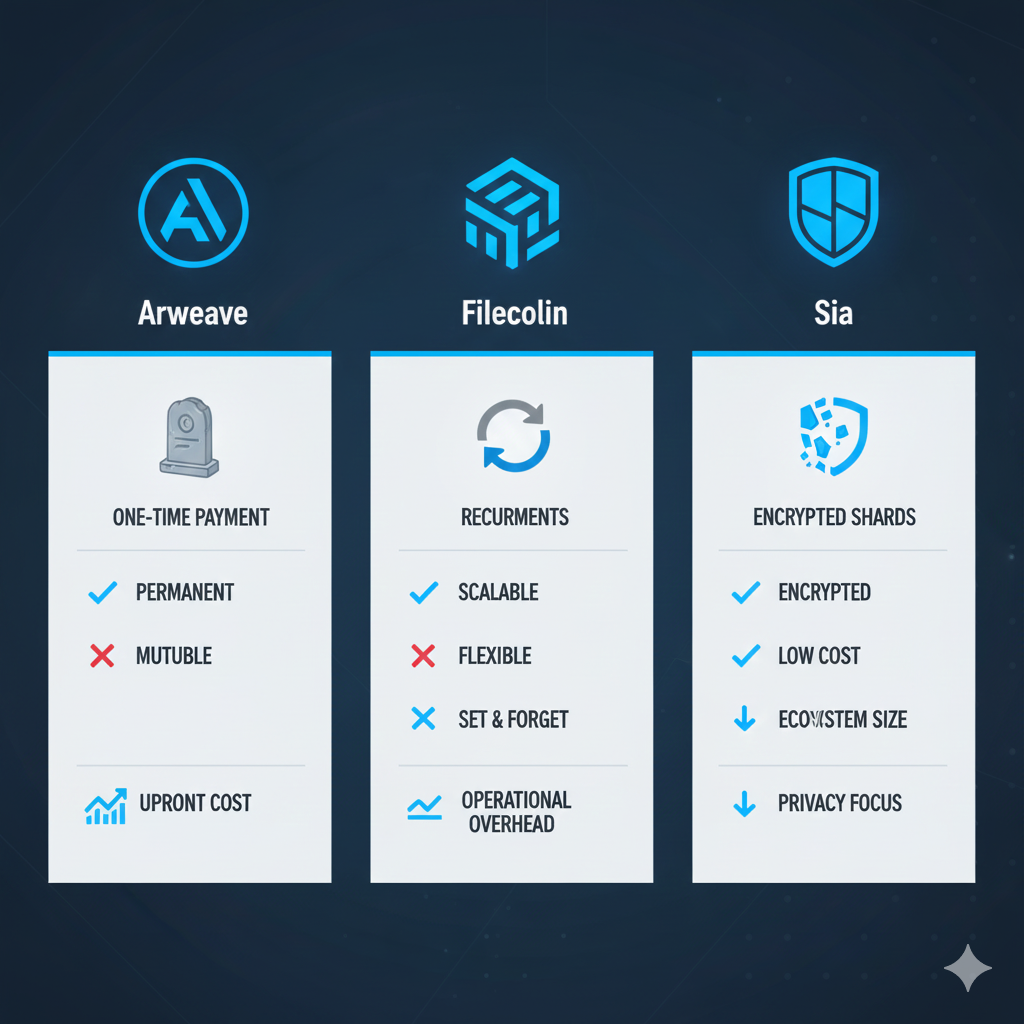
The question for creators and projects is not necessarily "which one is best?" but "which one is right for this specific asset and its intended lifecycle?" A sophisticated, modern NFT project will often employ a hybrid, multi-layered storage strategy that leverages the strengths of each protocol. A common and robust pattern involves storing the critical, immutable metadata JSON file on Arweave, ensuring the NFT's core identity and attributes are permanently anchored. The larger associated media files (high-resolution images, videos, 3D models) might then be stored on Filecoin for cost-effective, scalable persistence, or on Sia if privacy is a paramount concern. The content identifiers (CIDs) from IPFS or Arweave transactions are then embedded within the metadata and, critically, can be further anchored or timestamped on a base-layer blockchain like Ethereum through mechanisms like hash anchoring. This creates a verifiable chain of custody from the immutable blockchain, through the permanent metadata, to the persisted content.
For creators, the imperative is to ask probing questions during the technical design phase: What is the failure model if our project's frontend disappears? Can a collector independently verify the integrity of the asset without relying on our servers? Will this digital asset be functional and accessible in a decade? The answers to these questions are increasingly shaped by storage choices. For collectors and investors, evaluating a project's storage strategy has become a key component of due diligence; a project cutting corners with centralized storage is often a red flag signaling a lack of commitment to long-term value. As we look toward a future where NFTs underpin gaming universes, AI training data rights, and decentralized social graphs, storage will further specialize. We will see permanent cultural ledgers (Arweave's domain), dynamic asset pools for virtual worlds (Filecoin's strength), and confidential data vaults for enterprise and identity (Sia's niche) evolve in parallel. Arweave, Filecoin, and Sia are not simply competitors vying for the same niche; they are complementary architectural primitives in the growing toolkit for building a durable, user-sovereign digital future. Understanding their nuances is, therefore, more than technical acumen - it is a fundamental literacy for anyone serious about constructing or collecting assets meant to endure the relentless passage of digital time.
NFT Birdies
NFT Birdies
31 Mar 2026
NFT Birdies
30 Mar 2026
NFT Birdies
26 Mar 2026
Build authority in Web3 - share your insights on our blog!
Become our guest authorGot a cool idea for NFTBirdies?
Drop your thoughts and help us build the best NFT platform together.
Drop Your IdeaRecent comments

Share your review
Article: Arweave, Filecoin, and Sia — Where to Store NFT Metadata and Files in Web3