

NFT Birdies
5 Feb 2026
AI-Powered NFT Generators: Creating Collections with Artificial Intelligence in 2026

Over the last decade, the intersection of technology and creativity has accelerated at an unprecedented pace. Once a niche curiosity relegated to research labs and experimental art communities, artificial intelligence has now become a central force in cultural production — from music and prose to visual arts and design. In parallel, NFTs emerged as a disruptive paradigm for digital ownership, enabling artists and collectors to ascribe scarcity and provenance to digital artifacts in ways that were previously impossible. As we enter 2026, the convergence of AI and NFT creation tools is not merely a passing trend or speculative gimmick; it represents a fundamental shift in how digital culture is produced, curated, and commercialized. What was once the domain of technically adept artists has become an accessible ecosystem where creativity, computation, and community intersect to generate art that is not just novel, but meaningfully expressive.
AI-powered NFT generators in 2026 are far more than random image-spitting algorithms; they are sophisticated, context-aware systems trained on diverse datasets, capable of producing artwork that responds to cultural signals, stylistic cues, and even market demand. This evolution has transformed the landscape of digital art: where once the artistic process was solitary and human-centered, it now often incorporates collaborative workflows between humans and models. Artists use AI not as a crutch, but as a partner — iterating, steering, refining, and co-creating. The creative dialogue between human intention and machine intelligence has opened up new aesthetic territories, enabling collections that are uniquely generative, deeply layered, and commercially viable within NFT marketplaces.
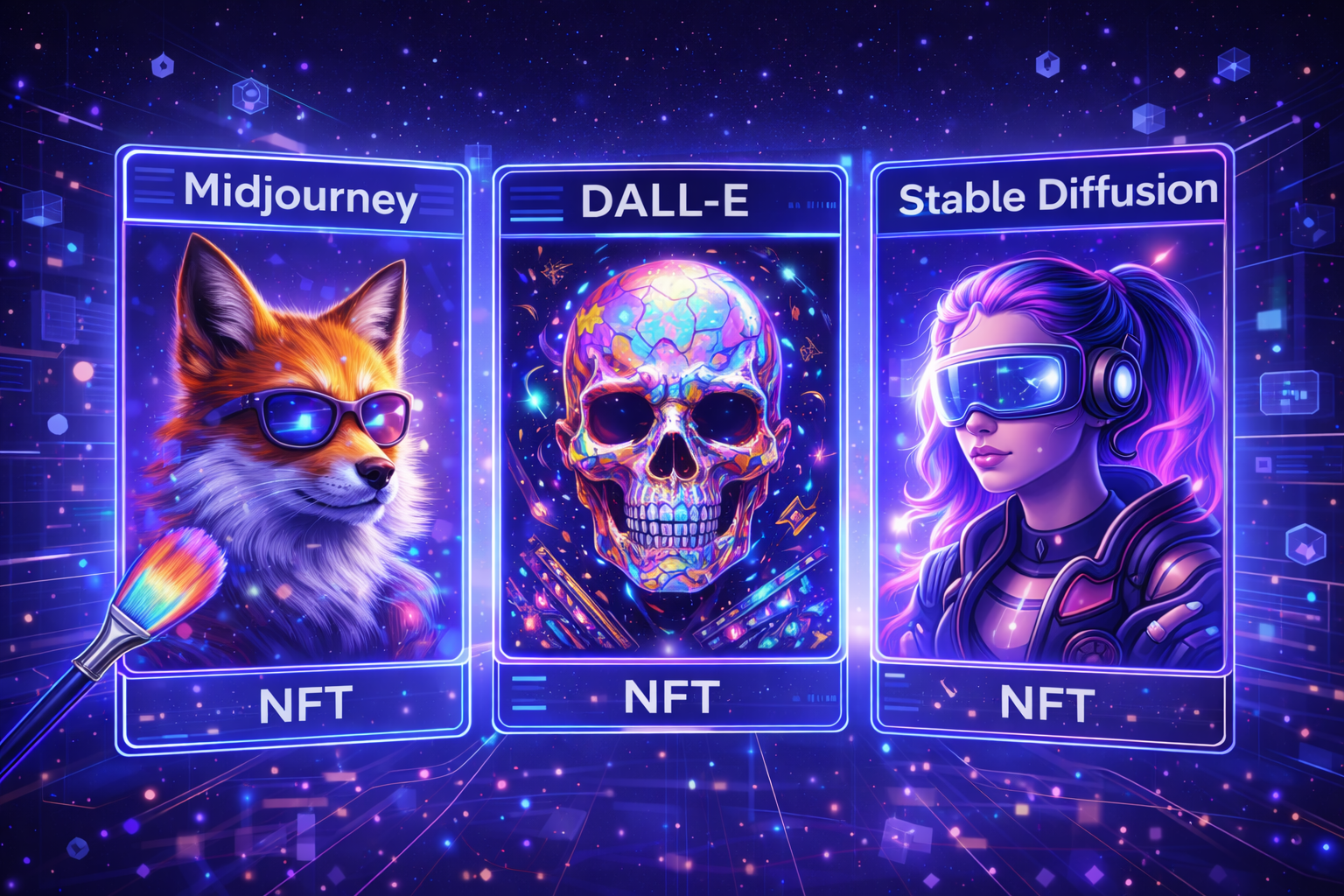
To understand the current state of AI-powered NFT generation, we must first examine the tools and platforms that dominate this space in 2026. Three names stand out not just because of their technological capability, but because of how they have been adopted by creators across communities: Midjourney, DALL-E, and Stable Diffusion. Each platform embodies a different philosophical approach to generative art, and each has cultivated distinct ecosystems and creative cultures around it. Understanding these differences illuminates not only how collections are made, but how AI itself is shaping the very language of visual expression within Web3.
Midjourney began as an experimental, research-oriented platform that emphasized artistic abstraction and stylistic exploration. Its models were trained to interpret textual prompts in ways that often produce dreamlike, painterly results — images that seem less like neutral reproductions of text and more like aesthetic interpretations. Midjourney’s community-driven development model allowed artists to share prompts, refine style variations, and collaborate in ways that led to emergent visual cultures long before many mainstream observers realized the potential of generative models. In 2026, Midjourney remains a favorite among creators who prioritize artistic ambiguity and aesthetic nuance, particularly within projects that aim to push the boundaries of visual art rather than simply produce recognizable assets.
In contrast, DALL-E, developed by OpenAI, tends toward clarity and conceptual fidelity. Where Midjourney often prefers abstract texture and evocative composition, DALL-E seeks to render detailed, semantically aligned visuals based on textual description. For creators who need precise control over specific themes, characters, or visual elements — for example, when designing branded NFT collections or narrative-driven art series — this level of determinism is invaluable. DALL-E’s iterative refinement between versions has also introduced greater support for compositional editing, allowing creators to adjust elements post-generation without losing coherence or introducing artifacts. This makes it particularly powerful for projects that bridge storytelling and visual identity.
Stable Diffusion occupies a somewhat different niche. As an open-source model with extensive customizability, its influence in the NFT space is broad not just technologically, but culturally. Because its weights and pipelines are publicly accessible, artists, developers, and researchers have built entire toolchains, plugins, and specialized interfaces around it. Creative studios use Stable Diffusion as a backend engine that can be fine-tuned with proprietary datasets, integrated into automated pipelines, and embedded in applications where bespoke generative behavior is required. The result is a fertile ecosystem of derivative creativity: not just standalone pieces, but procedural generators, rule-based stylers, and interactive creative frameworks that empower artists to encode narrative, rule sets, and even community-driven parameters into generative collections.
Comparing these platforms reveals not just technical differences but cultural orientations. Midjourney’s aesthetic sensibility fosters art that feels expressive, evocative, and stylistically unified. DALL-E emphasizes conceptual precision and compositional control. Stable Diffusion prioritizes extensibility and customizability, enabling a decentralized ecosystem of tools rather than a monolithic creative engine. Within the NFT landscape of 2026, creators choose their generative tools not only on output quality but on how those tools integrate with their artistic process, community engagement strategy, and market positioning.
Creating a unique NFT collection with AI in 2026 typically begins with ideation and narrative design. Successful collections are not random assortments of images; they are visual ecosystems where theme, variation, rarity, and cultural significance intertwine. The generative process starts with concept development — defining a story, motif, or set of visual rules that will give the collection coherence. This conceptual layer often draws from cultural history, personal narrative, or speculative worlds that engage collectors on emotional and symbolic levels. Once the conceptual framework is established, prompts are engineered — carefully crafted combinations of textual descriptors, stylistic references, and compositional rules — which serve as the input to generative models.
Prompt engineering has evolved into a discipline of its own. Initially, prompts were simple phrases that loosely described desired outcomes. Today, they are structured, layered specifications that incorporate stylistic constraints, thematic annotations, and even meta-instructions that guide models toward desired creative directions. Prompt engineers often collaborate with artists and data scientists, iterating through thousands of variations to refine visual output. In many high-profile collections, prompts are versioned, annotated, and archived as part of the creative provenance — a novel form of creative metadata that documents the machine-aided evolution of art.
Once a satisfactory generative pipeline is established, creators often engage in curation and selection — a stage that remains deeply human. Even the most advanced models produce artifacts that require human judgment: images that are technically interesting but misaligned with narrative goals, or pieces that evoke unintended interpretations. Curation involves not just selecting the best outputs but organizing them into a coherent collection architecture with rarity tiers, thematic groupings, and visual continuity. Many projects use statistical distribution techniques to ensure that rarer stylistic variations are identified algorithmically but validated by human curators to maintain artistic integrity.
The final stage of collection publication leverages emerging NFT minting platforms that integrate generative logic directly into the tokenization process. These platforms allow creators to embed generative scripts or latent vector seeds into smart contracts, enabling on-chain generative minting where each token’s final appearance is resolved at the moment of sale. This approach deepens the connection between cryptographic provenance and creative process, as each NFT’s metadata captures the generative lineage from prompt to output. Collectors increasingly value this transparency, as it situates each piece within a documented creative trajectory rather than making it a static post-hoc artifact.
Beyond tools and techniques, AI-powered generation has generated robust debate regarding authorship, originality, and ethics. Critics have raised concerns about training data provenance, model biases, and the potential homogenization of visual culture. The open-source nature of models like Stable Diffusion complicates these debates: while open access democratizes creative tooling, it also raises questions about dataset curation, attribution, and the unintentional reproduction of copyrighted material. Platforms and communities are responding with emerging standards for dataset documentation, ethical use policies, and creative commons licensing structures that aim to reconcile generative freedom with accountability.
Moreover, the relationship between AI-generated art and market value continues to evolve. Early critics assumed that machine-assisted art would dilute scarcity and undermine collector interest. What has emerged instead is a new economy of scarcity where scarcity is not only a function of token count but of creative process transparency, model configuration, and narrative intentionality. Collections that articulate their generative methodology, document prompt evolution, and engage community participation typically achieve higher cultural and financial resonance within NFT marketplaces. Collectors increasingly seek not just visuals but the story behind the generation — the creative dialogue between human and machine that birthed the work.
As we look ahead beyond 2026, the frontier of AI-powered NFT generation will likely push further into interactive and adaptive art. Rather than static images generated once and minted forever, future collections may evolve over time, respond to external data feeds, or incorporate user interaction as part of their generative logic. Imagine NFT avatars that subtly shift with market sentiment or landscapes that morph based on ecological data — art that is alive not in metaphor but in algorithmic behavior. These developments will coordinate computational creativity with real-world signals, yielding dynamic collections that defy the boundaries of static aesthetic forms.
In conclusion, AI-powered NFT generators in 2026 signify a profound transformation in how digital culture is created, experienced, and valued. The tools that artists use — whether Midjourney’s evocative stylistic engine, DALL-E’s precise conceptual rendering, or Stable Diffusion’s extensible ecosystem — shape not only the aesthetic qualities of collections but the cultural logics that define them. Creating unique AI-generated collections requires not only technical fluency but conceptual rigor, narrative design, and community engagement. As these practices mature, the space between human creativity and computational generation continues to blur, yielding art that is at once personal, collective, and algorithmically rich. The future of NFT art is not simply generative; it is dialogic, adaptive, and deeply intertwined with the tools and communities that cultivate it.
NFT Birdies
NFT Birdies
31 Mar 2026
NFT Birdies
17 Mar 2026
Build authority in Web3 - share your insights on our blog!
Become our guest authorGot a cool idea for NFTBirdies?
Drop your thoughts and help us build the best NFT platform together.
Drop Your IdeaTopics
Recent comments

Share your review
Article: AI-Powered NFT Generators: Creating Collections with Artificial Intelligence in 2026