

NFT Birdies
18 Nov 2025
🤖 AI-Powered NFT Generators: Creating 10,000 Item Collections with Artificial Intelligence in 2025

Remember the early days of NFTs? Creating a 10,000-piece PFP (Profile Picture) collection meant hiring a team of artists, spending months on design, and draining your budget before you even minted a single token. Fast forward to 2025, and the game has completely changed. Artificial Intelligence hasn't just entered the chat; it's taken over the entire studio.
Welcome to the era of AI-powered NFT generation, where the only limit is your imagination (and your prompt engineering skills). This isn't about replacing artists; it's about empowering creators, builders, and visionaries to bring their wildest concepts to life at a scale and speed that was previously unimaginable.
Let's dive into the best tools, the smartest strategies, and the future of AI in the NFT space.
🛠️ The 2025 AI Art Arsenal: A Guide to the Top Tools
The market is flooded with AI image generators, but for serious NFT creation, a few platforms have risen to the top. Each has its own strengths, quirks, and ideal use cases.
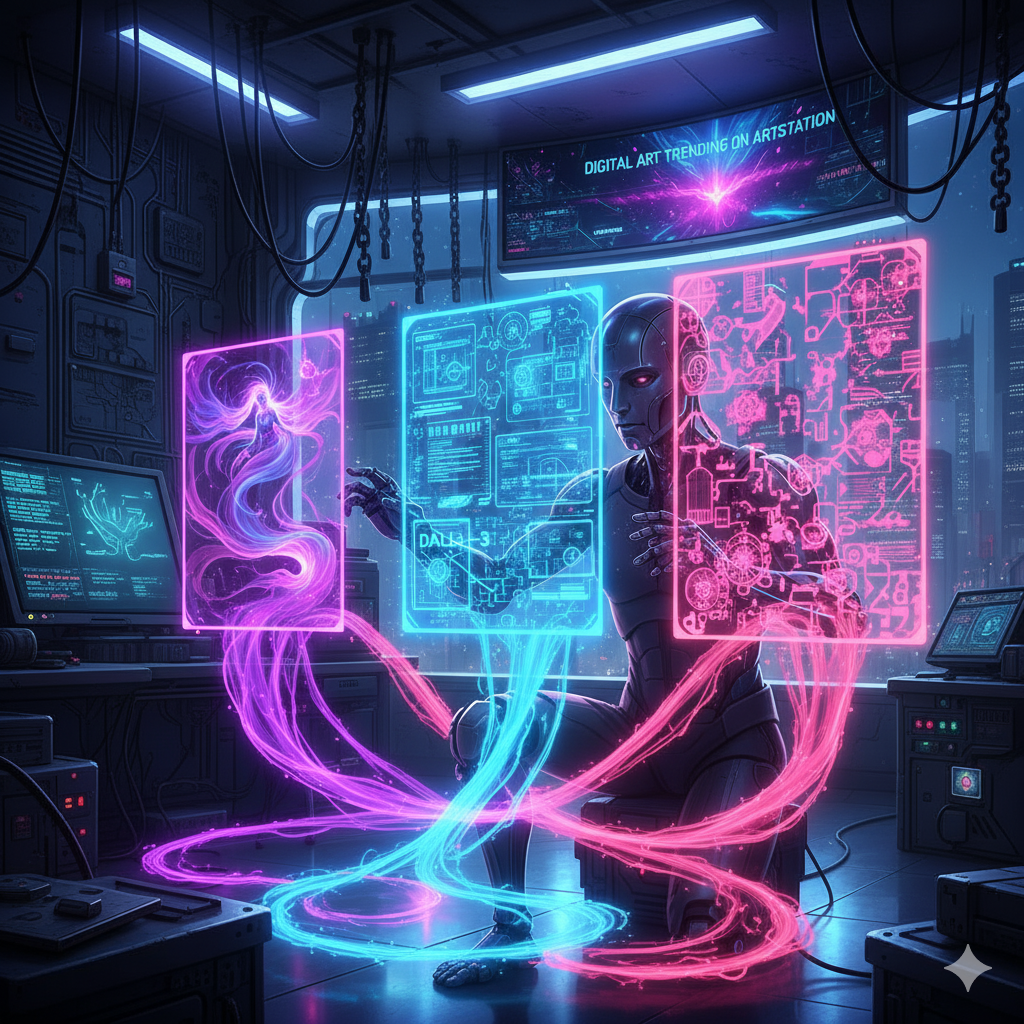
1. Midjourney: The King of Aesthetic & Style
If you're looking for that "wow" factor—stunning visuals, cohesive style, and artistic flair—Midjourney is often the go-to choice.
The Vibe: Dreamlike, hyper-artistic, and incredibly consistent. It excels at creating beautiful, stylized images that feel like they belong in a gallery.
Best For: High-end art collections, PFPs with a unified aesthetic, and projects where visual appeal is the top priority.
The Workflow: Operates through Discord, which can be a bit clunky but fosters a strong community for inspiration.
NFT-Specific Power: Its --seed command is a game-changer. By using the same seed number across different prompts, you can generate thousands of variations while maintaining a core, consistent style—perfect for establishing a collection's DNA.
2. DALL-E 3 (via ChatGPT): The Master of Prompt Understanding
OpenAI's DALL-E 3 is less of a "diva artist" and more of a precise, literal-minded assistant. Its integration with ChatGPT makes it incredibly powerful for complex and specific concepts.
The Vibe: Clean, literal, and highly detailed. It's exceptionally good at understanding nuanced language and rendering exactly what you ask for.
Best For: Collections with complex lore, specific character traits, and world-building. If your NFT has a detailed backstory, DALL-E 3 can bring it to life.
The Workflow: The ChatGPT interface allows for conversational refinement. You can ask it to "make the helmet more futuristic" or "change the background to a cyberpunk city," and it understands context brilliantly.
NFT-Specific Power: Its ability to handle complex scenes and multiple subjects in one image makes it ideal for generating unique, scene-based NFTs beyond simple PFPs.
3. Stable Diffusion (with Custom Models): The Developer's Playground
Stable Diffusion is the open-source powerhouse. It's less of a single product and more of a foundational technology that you can customize, control, and fine-tune to your heart's content.
The Vibe: Raw, powerful, and infinitely customizable. The base model can be unpredictable, but its potential is unlimited with the right add-ons.
Best For: Technical creators, developers, and those who want total control. It's the engine behind many specialized NFT generator SaaS platforms.
The Workflow: Run it locally on your own GPU (for maximum power and privacy) or use web-based interfaces like Leonardo.ai or Mage.space. You use tools like Automatic1111 or ComfyUI for granular control.
NFT-Specific Power: This is where the real magic happens for large collections.
LoRAs (Low-Rank Adaptations): You can train a small, efficient model on a specific character or style (e.g., on your own hand-drawn sketches) and then apply it to generate infinite variations.
ControlNet: This is the holy grail for consistency. You can input a pose sketch or a depth map and have the AI generate new characters in that exact same pose and composition, ensuring your entire collection has a unified structure while varying the details like clothing, colors, and accessories.
⚙️ Building Your AI NFT Collection: A Step-by-Step Blueprint
Generating one cool image is easy. Building a coherent, desirable 10k collection is a process. Here’s how the pros are doing it in 2025.
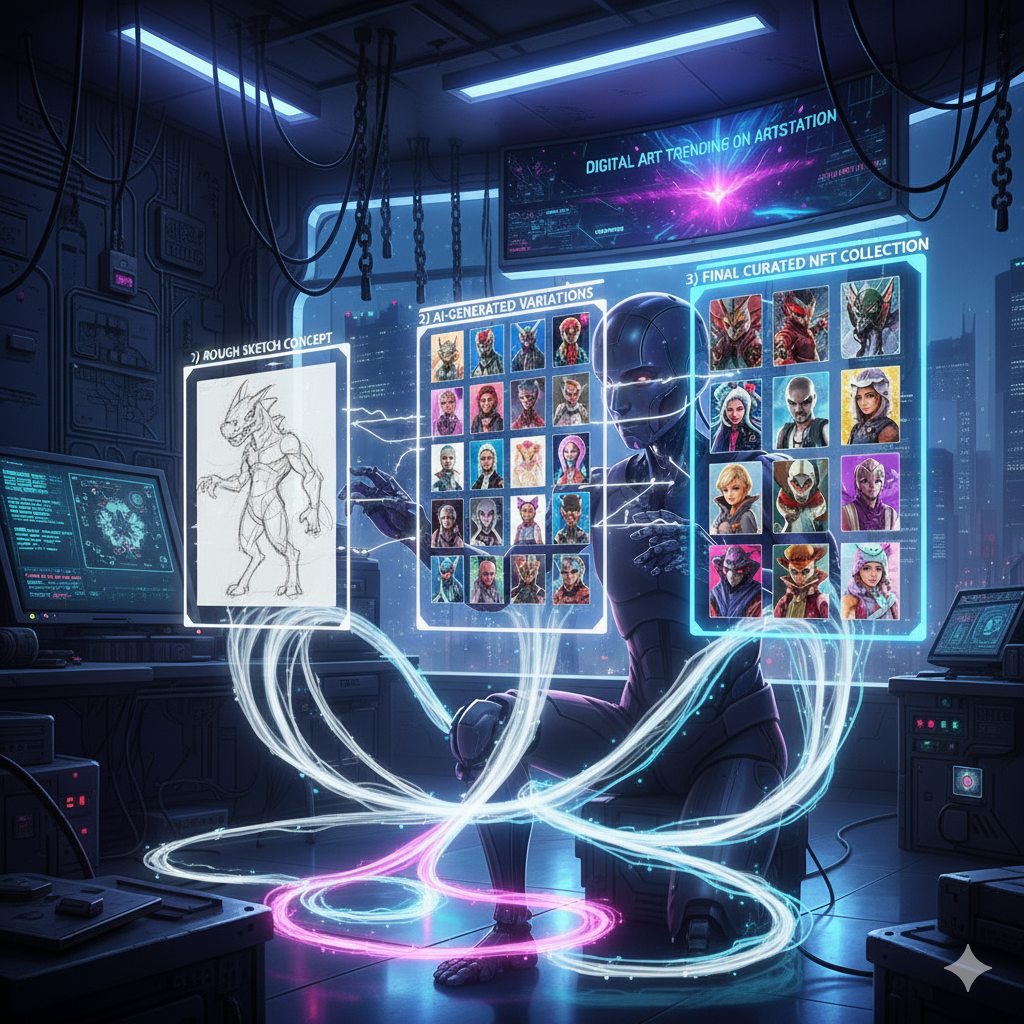
Step 1: The Foundation - Concept and "DNA" Creation
Before you type a single prompt, you need a rock-solid concept. Who are your characters? What is their world? What makes them unique?
Action: Create a "DNA Document." Define your core character, their key features (e.g., "cyberpunk elf," "golden glowing eyes," "neon tribal tattoos"), and a list of variable traits (e.g., 50 hairstyles, 30 backgrounds, 25 weapon types).
Pro Tip: Use DALL-E 3 or Midjourney to brainstorm and visualize your core character. Generate 50-100 concepts to hone in on the perfect look before scaling.
Step 2: The Engine Room - Prompt Engineering for Scalability
Your base prompt is the recipe for your entire collection. It needs to be robust and structured.
Bad Prompt: "a cool robot"
Good Prompt: "portrait of a [ROBOT_TYPE] android, with [EYE_COLOR] glowing eyes and [ARMOR_MATERIAL] armor, standing in a [BACKGROUND_SCENE], intricate details, cyberpunk style, cinematic lighting --seed 42 --style raw"
See the placeholders [LIKE_THIS]? This structured approach allows you to programmatically swap out traits using scripts or AI image generator APIs.
Step 3: The Assembly Line - Automation and Trait Layering
This is where you choose your weapon. For massive collections, Stable Diffusion is often the winner.
Method A: The All-in-One Generator. Use a platform like Leonardo.ai that has built-in "AI Canvas" features and model training. You can train a model on your concept art and then use it to generate thousands of images, using its interface to manage traits.
Method B: The Pro Code Approach. Run Stable Diffusion locally and use a Python script to cycle through a CSV file of your traits, generating images automatically. This gives you absolute control and is how the most successful generative projects are built.
Step 4: The Final Touch - Quality Control and Curation
AI is not perfect. You will get mutated hands, weird artifacts, and failed generations.
Action: Plan to generate 20-30% more images than you need. Use a dedicated week for manual review. Tools like Bulk Image Downloader and simple gallery software can help you sort through thousands of images quickly to weed out the duds.
📊 The Ultimate Showdown: Midjourney vs. DALL-E 3 vs. Stable Diffusion
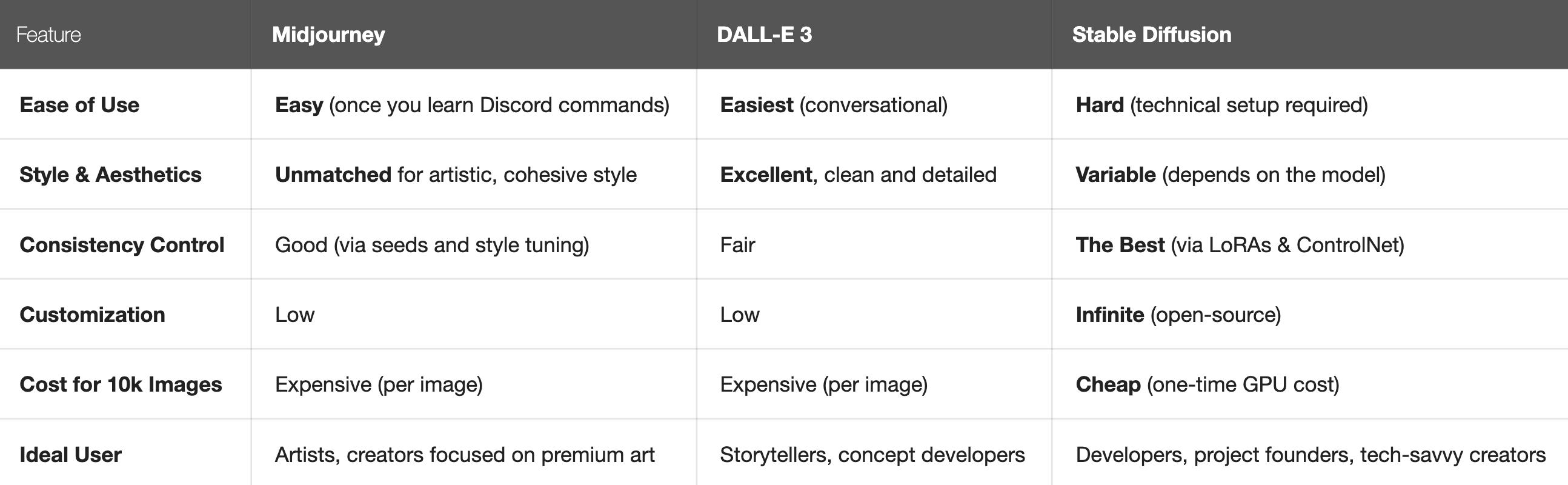
The Verdict: There's no single "best" tool.
Choose Midjourney for breathtaking art with minimal technical fuss.
Choose DALL-E 3 for nailing a complex concept with precise language.
Choose Stable Diffusion for building a massive, trait-based collection with total control.
🚀 Beyond the Image: The Future of AI in NFTs
AI's role in NFTs is evolving beyond just image generation.
Generative Music & Audio: Tools like Suno.ai and Audialab are allowing creators to generate unique soundtracks and audio properties for their NFTs, creating multi-sensory experiences.
Dynamic Metadata: Imagine an NFT whose appearance changes based on real-world data, powered by AI and oracles. An "AI Weather Spirit" that changes with the climate, or a "Trading Card" that evolves based on its owner's portfolio performance.
Provenance & Authenticity: AI models are being used to detect copycats and verify the originality of generative art collections, adding a layer of trust and security to the ecosystem.
🎯 The Bottom Line for Creators
We are in the golden age of digital creation. AI has democratized the ability to build vast, imaginative worlds and populate them with unique assets. The role of the creator is shifting from a pure executor to a visionary director—the one who crafts the prompt, curates the output, and builds the community and story around the art.
The tools are here, they are powerful, and they are more accessible than ever. The question is no longer "Can I create an NFT collection?" but "What incredible world will I build next?"
What's your favorite AI tool for creating NFTs? Have you tried generating a collection with any of these platforms? Share your experiences and tips in the comments below!
👉 For more deep dives into the tools and trends shaping the future of Web3, make sure to bookmark our blog and follow us on X!
NFT Birdies
NFT Birdies
17 Mar 2026
NFT Birdies
11 Mar 2026
NFT Birdies
26 Mar 2026
Build authority in Web3 - share your insights on our blog!
Become our guest authorGot a cool idea for NFTBirdies?
Drop your thoughts and help us build the best NFT platform together.
Drop Your IdeaTopics
Recent comments

Share your review
Article: 🤖 AI-Powered NFT Generators: Creating 10,000 Item Collections with Artificial Intelligence in 2025